
Prison State vs. Freedom, Third Country Placement vs. Macedonian Life
By Jason Straziuso
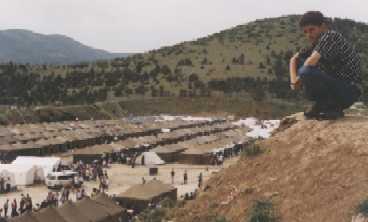
Stankovac I is a cramped camp - tents cover almost every square foot, leaving precious little space for recreation. However, Stankovac I, also called Brazda, is the place to be if you want to leave the country.
Two weeks ago (May 7), close to 30,000 refugees lived here. Less than 11,000 remain (as of May 23, 1999). Located six miles from the capital of Skopje, transportation to the airport is easy. Repatriation of these refugees also might be in preparation to close down the camp before winter, officials say.
"I don't think it's possible to keep this camp through the winter," said Bernd Schell of the German Red Cross.
The refugee relocation program is having an unforeseen side effect; Refugees staying with host families are coming to Stankovac I and registering, gambling their more comfortable home-stay for tent life -- all for the chance to go to a third country.
This concerns Catholic Relief Services and UNHCR officials, according to a press release. They say it contributes to the perception that the camps are unequal. But the camps are unequal ijn almost every way.
For instance, down the road three miles from Stankovac I is Stankovac II. This French-run camp was built among small hills which serve as natural windbreakers.
Here there is plenty of room. A soccer field, with goals of wood and metal fencing, and a small playground have been built. Unlike at Stankovac I, privacy is not hard to find with several hills to wander -- all within the fenced-in area.
Both Stankovac camps, located in ethnic-Macedonian areas, are heavily guarded, with Macedonian police stationed around the perimeters.
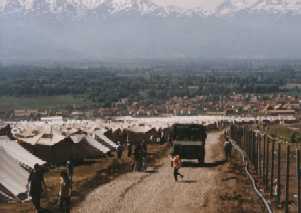
With that freedom of movement comes a higher morale, according to Jennifer Brill of the International Catholic Migration Commission, who spends time at both Cegrane and the Stankovac camps.
There are several thousand empty tents waiting for new arrivals, Brill said.
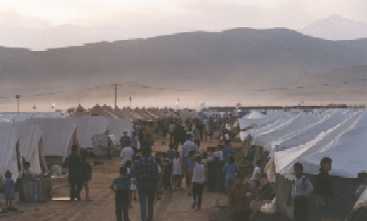
There is an uncanny carnival atmosphere at Cegrane quite opposite from the prison-like Stankovac camps. Outside the main gate there is a hamburger stand and a bumper car ride, as if it were a county fair.
But Cegrane has its drawbacks. Located int he mountains, mid-day highs in the 80s give way to lows in the 30s -- a large swing in temperature for those living in tents.
WIth a rocky and slanted terrain, the tent rows are built on tiers, so you're usually walking up or down. The elderly have difficulty walking, Brill said, and sleeping on the stone-covered ground looks less comfortable than at the Stankovac camps.
Also, there are few third-country relocations taking place at this isolated camp.
The tent rows are more uniform here than the English-built Stankovac I or the French-built Stankovac II.
"I think that may be the influence of the German army," Brill said.
One thing equal to all the camps is the noise from above. All hours of the day the skies are filled with the din of military jets and transport helicopters. The other thing that all the camps share is the refugees' main desire: to return to a free Kosovo.
"This isn't living, it's surviving," said Ekrem Misimi, a refugee at Stankovac I. "The only thing on these people's minds is to somehow get back to where they were before."