| The ‘Rock’ was the prison of all prisons. Outlaws and badmen like Al Capone and ‘Machine Gun’ Kelly found it the end of the line. Over the years, the fog-enshrouded confines of Alcatraz confined the world’s most notorious criminals from the rest of the world. Since it was closed down in 1963, many believe that it now imprisons their ghosts! |
|
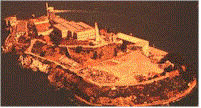
Want an inside look at the haunted walls of Alcatraz?
It is the one place from which there is no escape, even after death.
Welcome to Haunted Alcatraz … or ‘Hellcatraz’ as it was called by some inmates. The history does not begin or end with the use of Alcatraz as a prison and penitentiary, for it was known to Native Americans, and avoided as a place that contained evil spirits. The energy of those who came to the ‘Rock’ and never left, still remains for visitors from around the world to see, feel and even hear. Alcatraz is a portal to another dimension, where unexplainable events continue to occur.
Whoever, or whatever, lurks in the shadows can be heard, seen and felt. As parapsychologists suggest, where so much trauma and negative emotion have occurred, there is bound to be residual energy … and Alcatraz has the feel of an immense haunted house, complete with fog and restless spirits. Although the candle may have burned out for Alcatraz long ago, its legend never did.
Prior to its discovery by
the Europeans, Alcatraz was viewed as a barren, white rock - white because it
was covered with pelican droppings - thus receiving the name of La Isla de los
Alcatraces or ‘The Island of the Pelicans’, by the Spanish. However, it wasn’t
until the 1850’s that the importance of this tiny island as a defensive
position was realized. Finally, the military decided to build a fortress in
case an unfriendly ship might decide to enter the Golden Gate. The Army Corps
of Engineers began to build an impenetrable and imposing structure in 1854.
The original construction estimates of $300,000 did not take into account the
wind, rain, fog, strong ocean currents, lack of water, lack of vegetation and
the fact that there was only one possible place to land equipment and
supplies.
Construction began with the erection of a temporary wharf for supplies. This
was followed by wooden shops, storehouses, barracks and offices. Those who
couldn’t make it in the gold fields became reluctant laborers on Alcatraz. The
labor force carved out roadways and other features as the fortress slowly took
shape. It was only a matter of time before Alcatraz began taking human life.
During 1857, while a crew was excavating along the roadway between the wharf and the guardhouse, a 7000 cubic-yard rock landslide buried a team of laborers: Daniel Pewter, age 50, of Ireland and Jacob Unger, 25, of Germany, were the first known deaths on Alcatraz.
On a cold December day in
1859, the Third Artillery arrived on Alcatraz with a group of eleven anonymous
soldiers of Company H - the first prisoners to be incarcerated in the basement
cell room of the guardhouse for crimes not recorded in Army files. Alcatraz
was now a fully operational fortress and prison. By August 27, 1861, Alcatraz
was designated as the official military prison for the entire Department of
the Pacific. Living conditions were grim. Men slept side-by-side, head-to-toe,
lying on the stone floors. There was no running water or heat in the cells,
sanitary facilities were almost non-existent and disease was rampant.
After the Civil War, Confederate sympathizers caught celebrating the death of
President Lincoln were sent to Alcatraz. In 1868, the Army designated Alcatraz
as a prison for military convicts and malcontents of society. By the late
1800’s and early 1900’s, Indian chiefs and tribal leaders of Arizona and
Alaska were incarcerated along with some of the worst thieves, deserters,
rapists and repeated escapees from the Army. Alcatraz again became a
disciplinary barracks for U.S. Army military incorrigibles, as well as a
health resort when soldiers returning from the Spanish-American War
convalesced there.
On the morning of the 1906 San Francisco earthquake, Alcatraz shook, but sustained little damage. That same year, four prisoners tried to paddle to the mainland on a butter vat, only to have strong currents bring them back. Driftwood was used for escape attempts in 1912, 1916, 1927 and a ladder was used during an escape attempt in 1929. All of the men were captured or surrendered, victims of the cruel currents and cold water. In 1911, Alcatraz was officially named the United States Disciplinary Barracks - an official Army prison which included both U.S. Army prisoners as well as German seamen who became prisoners of war.
The social upheaval of the
1920’s and 1930’s, and rampant crime sweeping America, provided Alcatraz with
new life. Daring escapes, gang-related murders and mass rioting were a menace
to an orderly prison. Attorney General Homer Cummings supported J. Edgar
Hoover in creating a facility which would instill fear in would-be criminals
by creating a place where prisoners could be safely controlled and could not
escape. In 1933, the prison facility was formally turned over to the Federal
Bureau of Prisons. During 1934, Alcatraz became an escape-proof, maximum
security prison, where only the most hardened convicts were brought.
The first residents of the newly created Alcatraz received numbers 1-32, with
Frank Bolt having the distinction of being Federal Prisoner #1 while serving a
five-year sentence for Sodomy. He was followed by Charles Copp (Robbery and
attempted Assault); Leon Gregory (Robbery, Assault and AWOL); Joseph Harrison
(Sodomy); Forrest Henry (Robbery and Assault); Clyde Hicks (Sodomy); Ralph
Hills (Robbery and Assault); Albert Hoke (Robbery); Alan Hood (Sodomy); and
Frederick Holme (Sodomy and False Enlistment) to round out the first ten
inmates. Al Capone was the first celebrity on the first train to Alcatraz,
arriving in August 1934. He was given number 85.
Guards armed with machine guns, insured there were no escapes. Many convicts found Alcatraz the end of their career in crime, as well as the end of their lives. For 29 years, the fog-enshrouded island, with its damp, cold winds and isolation, made Alcatraz one of America's safest prisons. The shell of steel and reinforced concrete confined ruthless men to a life of deprivation, rules and routines that proved almost intolerable. When one adds the fact that the convicts could hear the party boats pass by, and see some of the San Francisco city lights, it is little wonder that some preferred death to this kind of isolation. Failure to acquiesce to prison rules resulted in confinement in ‘D’ block, the treatment unit. Here, men could leave their four-by-eight cells only once in seven days for a brief, ten-minute shower.
Life was hard on Alcatraz, just the way that Warden Johnson envisioned it. His motto was "Take each day of your sentence, one day at a time. Don’t think how far you have to go, but how far you’ve come." For many prisoners, Alcatraz became synonymous with hell.
There were a number of
escape attempts from Alcatraz, but the bloodiest occurred on May 2, 1946,
involving Bernard Coy, Joseph Cretzer, Sam Shockley, Clarence Carnes, Marvin
Hubbard and Miran Thompson. It cost the lives of three inmates and two guards,
with 17 guards and one prisoner wounded. The trial afterward, resulted in the
execution of two more convicts who took part in the aborted escape.
Attorney General Robert Kennedy officially closed the doors of Alcatraz on
March 21, 1963. From 1963 to 1969, the prison was unoccupied. Today, it is
maintained by the Golden Gate National Recreation Area where almost a million
visitors per year pay to see ‘the Rock’. To get there, take a seat aboard the
Red and White Fleet ferry service. Reservations can be obtained by contacting
(800) 229-2784.
The reputation of Alcatraz,
like the solid ground it was built on, represents a lasting reminder that no
man is above the law, and for some, it is an eternal payback for their crimes
against humanity -kind of a paranormal prison.
Here are some of the stories:
During a visit to Alcatraz
by the television show, Sightings, in 1992, several of the Park Service staff
confirmed the haunted history of the prison. Many rangers had experienced
unexplainable crashing sounds, cell doors mysteriously closing, unearthly
screams and intense feelings of being watched. Sightings called on psychic
investigator Peter James to walk through portions of the abandoned prison to
get his impressions. James began to pick up on the voices of the tortured
souls driven mad since its inception as a prison. He also sensed unusual
vibrations of abuse, mistreatment, fear and pain. His overall impression of
Alcatraz was that it had an energy like no other he had ever experienced … a
persistent and overwhelming intensity that engulfed the island.
Some of the more haunted locations on Alcatraz appear to be the Warden’s
house, the hospital, the laundry room and the cell block ‘C’ utility door
where convicts Coy, Cretzer and Hubbard died during their escape attempt in
1946.
The most haunted area of Alcatraz is the ‘D’ cell block, or solitary, as it
was often called. To most of those who go there, a feeling of sudden intensity
pervades the cells and corridor. Some rangers refuse to go there alone. It is
intensely cold in certain cells, far colder than normal -especially in cell
14-D. This cell is oftentimes so cold, that wearing a jacket barely helps
-even the surrounding area is twenty degrees warmer. It is no wonder the area
is called ‘the Hole’.
When authors Richard Winer and Nancy Osborn visited Alcatraz, they ventured down to solitary with a park ranger. As Osborn entered cell 14-D, she immediately felt strong vibrations coming from within. Winer and the ranger followed Osborn, and within seconds, each of them experienced an intense tingling sensation in their hands and arms -they were convinced that something or someone was in there with them. The far corner of the cell, where they were standing and feeling the intense energy, was the exact spot where the naked, shivering prisoners would huddle, night after night, in the unforgiving darkness. Osborn said that she had never felt so much energy in one spot.
Renowned ghost hunter
Richard Senate, and a psychic, spent the night on Alcatraz as a part of a KGO
radio promotion. They chose Al Capone’s cell as a place of temporary refuge.
According to Senate, emotions seemed to drip from every corner of Alcatraz as
the long night progressed. He and the psychic visited the spots where rangers
said they heard marching footsteps, and clanking metal; however, nothing
happened. Finally, Senate locked himself in cell 12-D, where an evil and
persistent ghost is rumored to dwell. As the thick, steel door was closed,
Senate immediately felt icy fingers on his neck and his hair stood on end. He
knew he was not alone. Additionally, the psychic picked up on the twisted and
dismembered bodies of uniformed men. Both left the island convinced that
Alcatraz had its own special energy.
According to Antoinette May, much of the paranormal activity on Alcatraz occurs around areas associated with the penitentiary’s worst tragedies. One of them is the block ‘C’ utility corridor, cell blocks ‘A’ and ‘B’, with the eeriest area centering around cell 14-D -where it is always cold. According to May, gifted psychic Sylvia Brown, accompanied by a CBS news team, investigated parts of Alcatraz. As Brown toured the prison hospital, she picked up cards and notes tacked up on a wall, and the letter ‘S’. A ranger confirmed that the ‘S’ probably stood for Robert Stroud who spent a ten-and-a-half years in the hospital, in the very room where they were standing. He also had hundreds of notes and cards tacked up all around him. Brown sensed strong energy in what used to be the therapy room, and the prison laundry room, where at least one prisoner was murdered.
Co-author, Michael Kouri, visited Alcatraz in July of 1984 with his uncle. After several preliminary psychic impressions, Kouri reached cell 14-D, and entered. He first felt a ‘tingling sensation’, which began at his fingertips; then, a very intense feeling of cold engulfed him. In a slight trance, he began to communicate with a man of small stature; who had his head shaved and was left in ‘the hole’. The spirit, in obvious pain, "told" of a horrifying tale of being beaten, his legs broken by guards, and left in solitary confinement -he had squealed on another inmate -the year was 1939. Kouri then tried to lead the poor soul to the light. (Note: Kouri’s other unique experience with a visitor, is truly remarkable, as well as an interview with the wife of an ex-warden -but you’ll have to wait until the book comes out for those.)
A former guard related his
stories about cell block ‘D’ (particularly cells 12 and 14), and the
frightening remnant energy lingering in the subterranean portion of the
prison. During his stint in the mid-1940’s, convicts were often confined in
one of the 14 cells in ‘D’ blocks. Cells 9-14 were called ‘the Hole’, because
they contained no windows, and only one light which could be turned off by the
guards. The darkness made it seem like a hole in the ground -hence the name.
On one occasion, an inmate was locked in ‘the Hole’. Within seconds, the
inmate began screaming that someone with glowing eyes was in there with him.
Tales of a ghostly presence wandering the darkened corridors in clothing from
the late 1800’s were a continual source of practical joking among the guards,
so the convict’s pleas of being ‘attacked’ were ignored.
The man’s screaming continued well into the night, until there was silence.
The following day, the guards inspected the cell -the convict was dead, a
horrible expression etched on his face and noticeable hand-marks around his
throat. The autopsy revealed that the strangulation was not self-inflicted.
Some say he was strangled by a guard who had enough of the man’s screaming,
although no guard ever admitted it, even to the other guards.
Others believed it was the restless, evil spirit of a former inmate who
exacted his vengeance on yet another helpless soul. To add to the mystery, the
day after the tragedy, several guards, performing a line-up of the convicts,
counted one too many people. At the end of the line, the guards saw an extra
body -that of the recently deceased convict. As everyone looked on in stunned
silence, the figure of the ghostly convict vanished into thin air.
A number of guards from 1946 through 1963, experienced something out of the ordinary at one time or another. From the outer rim on the grounds to the deepest caverns, there was constant talk of people sobbing and moaning, horrible smells, cold spots and seeing the ‘Thing’ with the glowing eyes. Even groups of phantom prisoners and soldiers have appeared in front of startled guards, guests and the families who lived on the island.
Sometimes the old lighthouse (long since demolished) appeared out of a dense fog, accompanied by a ghostly whistling sound, and a green flashing light which passed slowly around the island, just as if the lighthouse was still active. The spectacle would then vanish before the startled eyes of guards and visitors. Phantom cannon shots, gun shots and screams often sent seasoned guards falling flat on their stomachs thinking that prisoners had escaped and obtained weapons. Each time, there was no explanation. A deserted laundry room would sometimes emanate a strong scent of smoke, as if something was on fire. The sensation of the choking smoke would drive guards out of the room, only to return a few minutes later, the area now completely smoke free. The phantom smoke occurred many times over the years.
Even Warden Johnston, who
didn’t believe in ghosts, encountered the unmistakable sounds of a woman
sobbing, as if coming from inside the walls of the dungeon while he
accompanied a number of guests on a tour of the facility. As if that weren’t
enough, an icy, cold wind blew through the group, chilling them to the bone,
just as the sobbing stopped.
The now burned-out shell of the Warden’s house has also been a focal point for
sightings since the 1940’s. During a Christmas party, several guards witnessed
the chilling apparition of a man wearing a gray suit, brimmed cap, and
mutton-chop sideburns. When the men saw the apparition, the room turned
deathly cold, the fire in the Ben Franklin stove was extinguished and, after
less than a minute, the man vanished.
These are but a few of the ‘Haunted Alcatraz’ stories. When you visit and journey down the now deserted corridors of this world famous penitentiary, keep your wits about you, and all five of your senses in tune, and perhaps your sixth sense will help you to encounter some of the many spirits who inhabit Alcatraz.
Source:
Taylor, Troy - "Haunting of America" (2001)
