Prominent Worldwide Events
Throughout the years
(Year 1000AD-2000AD)
| 1000 | First millennium ends; Y1K problem overblown - widespread fear of the end of the world proved unfounded | ||
| 1000 | Vikings first settle Newfoundland | ||
| 1004 | Chinese unity crumbles with treaty between the Song and the Liao giving the Liao full autonomy; China will remain fractured until the Mongol invasion in the 13th century (see 1206) | ||
| 1025 | Navy of Cholas in Southern India crushes the empire of Srivijaya in modern Myanmar to protect their trade with China | ||
| 1054 | Italy and Egypt formalize commercial relations | ||
| 1066 | William the Conqueror is victorious over Harold II in the Battle of Hastings, establishing Norman rule in England and forever linking the country with the continent | ||
| 1081 | Venice and Byzantium conclude a commercial treaty (renewed in 1126) | ||
| 1095 | First of the crusades begins; Pope Urban II calls on Europe's noblemen to help the Byzantines repel the Turks; the crusaders' travel, stories, and goods acquired along the way help increase trade across Europe and with the Mediterranean and Asia | ||
| 1100 | Japan begins to isolate itself from the rest of the world, not really opening up again until the mid-19th century (see 1858) | ||
| 1100 | China invents the mariner's compass and becomes a force in trade; widespread use of paper money also helps increase trade and prosperity | ||
| 1100 | Inca Empire in the Andes begins to develop, eventually encompassing about 12 million people until its destruction by the Spanish in 1553; cities specialize in certain farming and trade with others for what they don't make | ||
| 1132 | Corporate towns in France granted charters by Henry I to protect commerce | ||
| 1189 | German merchants conclude treaty with Novgorod in Russia | ||
| 1200 | Islam is introduced to Southeast Asia by spice traders | ||
| 1200 | Over 60,000 Italian merchants work and live in Constantinople | ||
| 1206 | Genghis Khan becomes the Great Khan, controlling most of northern China; after his death in 1227, the Khan clan conquers much of Asia by mid-century and promotes trade by commerce, reviving the ancient Silk Road that linked Chinese and Western traders | ||
| 1215 | Magna Carta, a pact between the English king and his subjects, is signed by King John, who becomes subject to the rule of law | ||
| 1229 | German merchants sign trade treaty with the Prince of Smolensk in Russia | ||
| 1252 | First gold coins issued in the West since the fall of Rome, in Florence | ||
| 1269 | England institutes toll roads | ||
| 1270 | Venetian Marco Polo and his father travel through Asia and the Middle East, becoming the first European travelers to establish extensive links with the region | ||
| 1279 | Kublai Khan unites China and creates the Yuan (Origin) dynasty; by the time he dies in 1294, he has created a unified Mongol Empire extending from China to Eastern Europe | ||
| 1300 | The early stirrings of the Renaissance begin in Europe as people are exposed to other cultures, primarily through merchants and trade | ||
| 1300 | Trade fairs are held in numerous European cities | ||
| 1315 | A great famine hits Europe, lasting two years, more widespread and longer than any before | ||
| 1348 | The plague (the Black Death) kills one-fourth to one-third of the population in Europe (25 million people) in just three years, disrupting trade as cities try to prevent the spread of the disease by restricting visitors; it likely started in Asia in the 1320s; massive inflation took hold, since goods could only be obtained locally; serfs were in high demand and began moving to higher wage payers, forever altering Europe's labor landscape | ||
| 1358 | German Hanseatic league officially formed by the Hansa companies of merchants for trade and mutual protection, eventually encompassing more than 70 cities and lasting nearly 300 years | ||
| 1375 | Timur Lang the Turk conquers lands from Moscow to Delhi | ||
| 1381 | English rioters kill foreign Flemish traders as part of the 100,000-stron peasant rebellion against Richard II, which was led by Wat Tyler in a failed attempt to throw off the yoke of feudalism | ||
| 1392 | England prohibits foreigners from retailing goods in the country | ||
| 1400 | Koreans develop movable-type printing (see 1450) | ||
| 1404 | Chinese prohibit private trading in foreign countries, but foreign ships are allowed to trade in China with official permission | ||
| 1415 | China begins significant trading with Africa through government expeditions | ||
| 1425 | Hanseatic city of Brugge becomes the first Atlantic seaport to be a major trading center | ||
| 1427 | Aztec Empire is created by Itzcotl; it will encompass about 6 million people until its destruction in 1519 | ||
| 1430 | Portuguese Henry the Navigator explores west Africa coast to promote trade | ||
| 1441 | Mayan empire collapses as the city of Mayapan is destroyed in a revolt | ||
| 1450 | Renaissance takes hold in Florence, its traditional birthplace | ||
| 1450 | Gutenberg Bible if first book printed with movable type; the ability to mass-produce books creates an information revolution | ||
| 1453 | Byzantine Empire is destroyed as Muhammad II sacks Constantinople (renaming it Istanbul) | ||
| 1464 | French royal mail service established by Louis XI | ||
| 1470 | Early trademark piracy committed by Persians, who copy mass-produced Chinese porcelain to capitalize on its popularity in foreign countries | ||
| 1479 | Under the Treaty of Constantinople, in exchange for trading rights in the Black Sea, Venice agrees to pay tribute to the Ottoman Empire | ||
| 1482 | England organizes a postal system that features fresh relays of horses every 20 miles | ||
| 1488 | Bartolomue Diaz sails around the coast of Africa; this, along with the voyages of Christopher Columbus, ushers in the era of sea travel | ||
| 1492 | Christopher Columbus "discovers" the New World | ||
| 1494 | Portugal and Spain divide the unexplored world between them with the Treaty of Tordesillas | ||
| 1500 | Rise of mercantilism, the accumulation of wealth by the state to increase power, in Western Europe; states without gold or silver mines try to control trade to maintain a surplus and accumulate gold and silver; Englishman Thomas Mun was one of the great proponents in 1600, who realized that the overall balance of trade was the important factor, not whether each individual trade resulted in a surplus | ||
| 1500 | Slave trade becomes a major component of commerce | ||
| 1504 | Regular postal service established between Vienna, Brussels, and Madrid | ||
| 1520 | First chocolate brought from Mexico to Spain | ||
| 1521 | Mexico is conquered by Hernand Cortez after Aztec ruler Montezuma is accidentally killed | ||
| 1522 | Megellan's expedition completes its three-year sail around the world; it is the first successful circumnavigation | ||
| 1531 | Antwerp stock exchange is the first exchange to move into its own building, signifying its importance in financing commercial enterprises throughout Europe and the rising importance of private trade and commerce; Antwerp emerges as a trading capital | ||
| 1532 | Brazil is colonized by the Portuguese | ||
| 1534 | England breaks from the Catholic Church, ending its dominance of politics and trade throughout Europe, as Henry VIII creates the Church of England | ||
| 1553 | South American Incan Empire ends with conquest by Spanish; the Incas had created an extensive area of trade, complete with an infrastructure or roads and canals | ||
| 1555 | Tobacco trade begins after its introduction to Europe by Spanish and Portuguese traders | ||
| 1557 | Spanish crown suffers first of numerous bankruptcies, discouraging cross-border lending | ||
| 1561 | Tulips come to Europe from Near East for first time | ||
| 1564 | William Shakespeare is born ; many of his plays are stories of merchant traders | ||
| 1567 | Typhoid fever, imported from Europe, kills two million Indians in South America | ||
| 1588 | Spanish Armada defeated by Britain, heralding Britain's emergence as the world's greatest naval power; this power will enable Britain to colonize many regions of the globe and lead to its becoming the world's commercially dominant power for the next 300 years | ||
| 1596 | First flush toilet is developed for Britain's Queen Elizabeth I by Sir John Harington; Flush toilets are VERY important in the world's scheme of things - click here to learn more about this very important invention! | ||
| 1597 | Holy Roman Empire expels English merchants in retaliation for English treatment of Hanseatic league | ||
| 1600 | Potatoes are brought from South America to Europe, where they quickly spread to the rest of the world and become a staple of agricultural production | ||
| 1600 | Japan begins trading silver for foreign goods | ||
| 1600 | Britain's Queen Elizabeth I grants charter to the East India Company, which will dominate trade with the East until its demise in 1857 | ||
| 1601 | France make postal agreements with neighboring states | ||
| 1602 | Dutch charter their own East India Company, which will dominate the South Asian coffee and spice trade | ||
| 1607 | British colony of Jamestown built | ||
| 1609 | Dutch begin fur trade through Manhattan | ||
| 1611 | Japan gives Dutch limited permission to trade | ||
| 1612 | British East India Company builds its first factory in India | ||
| 1620 | Mayflower sails for the New World | ||
| 1620 | Father of the scientific revolution Francis Bacon publishes Novum Organum, promoting inductive reasoning through experimentation and observation | ||
| 1625 | Dutch jurist Hugo Grotius, sometimes called the father of international law, publishes On the Laws of War and Peace | ||
| 1636 | Harvard University founded | ||
| 1651 | English pass first of so-called Navigation Acts to restrict Dutch trade by forcing colonies to trade only with English ships | ||
| 1654 | Spain and Germany develop hereditary land rights, a concept that will help lead to the creation of great wealth in single families and thus to the development of private commercial empires | ||
| 1687 | Apple falling on Newton's head leads to his publication of the law of gravity | ||
| 1694 | The Bank of England is established; it offers loans to private individuals at 8 percent interest | ||
| 1698 | First steam engine is invented |
|
|
| 1719 | French consolidate their trade in Asia into one company, the French East India Company; rival British East India Company maintains its grip on the region's trade, however, and French revert to individual company trading 60 years later | ||
| 1725 | Rise of Physiocrats; followers of the economic philosopher Francois Quensay, who believed that production, not trade, created wealth and that natural law should rule, which meant producers should be able to exchange goods freely; movement influenced Adam Smith's ideas promoting free trade | ||
| 1740 | Maria Theresa becomes Empress of the Holy Roman Empire (until 1780); she ends serfdom and strengthens the power of the state | ||
| 1748 | First modern, scientifically drawn map, the Carte Geometrique de la France, comprising 182 sheets, was authorized and subsequently drawn by the French Academy; Louis XV proclaimed that the new map, with more accurate data, lost more territory than his wars of conquest had gained | ||
| 1750 | Benjamin Franklin shows that lightning is a form of electricity by conducting it through the wet string of a kite | ||
| 1750 | Industrial Revolution begins and takes off with the manufacture, in 1780, of the steam engine to drive machines; increased productivity and consumption follow (as do poor working conditions and increased hardship for workers) | ||
| 1760 | China begins strict regulation of foreign trade, to last nearly a century, when it permits Europeans to do business only in a small area outside Canton and only with appointed Chinese traders | ||
| 1764 | British victories in India begin Britain's dominance of India, Eastern trade, and trade routes | ||
| 1764 | British begin numbering houses, making mail delivery more efficient and providing the means for the development of direct mail merchants centuries later | ||
| 1773 | Boston Tea Party symbolizes start of American Revolution; impetus comes from American merchants trying to take control of distribution of goods that were being controlled exclusively by Britain | ||
| 1776 | American Declaration of Independence proclaims the colonies' rights to determine their own destiny, particularly their own economic destiny | ||
| 1776 | Theory of modern capitalism and free trade expressed by Adam Smith in The Wealth of Nations; he theorized that countries would only produce and export goods that they were able to produce more cheaply than could trading partners; he demonstrates that mercantilists were wrong; it is not gold or silver that will enhance the state, but the material that can be purchased with it | ||
| 1783 | Treaty of Paris officially ends the American Revolution following British surrender to American troops at Yorktown in 1781 | ||
| 1787 | U.S. constitution is approved; it becomes a model document for constitutions for at least the next two centuries; written constitutions will help to stabilize many countries and encourage foreign investment and trade with them | ||
| 1789 | French Revolution begins; it will alter the power structure in Europe and help lead to the introduction of laws protecting the individual and to limited democracy in the region | ||
| 1792 | Gas lighting introduced; within three decades most major European and U.S. cities will use gas lights | ||
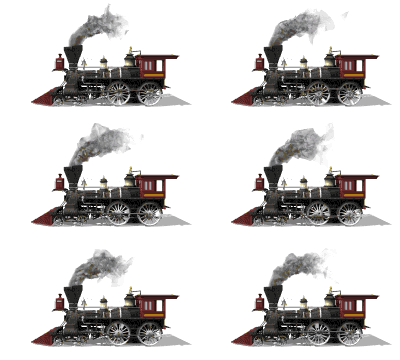
| 1804 | Steam locomotive introduced; it will become the dominant form of transport of goods and people until the mid-20th century when the airplane becomes commercially viable | ||
| 1804 | Napoleon crowns himself emperor, overthrowing the French revolutionary government, and tries to conquer Europe (after already occupying Egypt as a means of cutting off British trade with the East), the failure of which results in the redrawing of national boundaries in Europe and Latin America | ||
| 1807 | Robert Fulton's steamboat is the first to usher in a new age of transport when his Clermont sails from New York to Albany | ||
| 1807 | French Napoleonic code issued; it becomes a model of civil law adopted by many nations around the world | ||
| 1807 | U.S. President Thomas Jefferson bans trade with Europe in an effort to convince warring British and French ships to leave the neutral U.S. trading ships alone | ||
| 1810 | Frenchman Nicolas Appert successfully cans food and prevents spoilage | ||
| 1810 | Following Napoleon's invasion of Spain and Portugal, Simon Bolivar begins wars of independence for Spanish colonies in Latin America, leading to new governments in Bolivia, Colombia, Ecuador, Peru, and Venezuela | ||
| 1814 | First practical steam locomotive is built by George Stephenson in England, leading to the birth of railroad transportation in 1825, with the first train carrying 450 passengers at 15 miles per hour | ||
| 1815 | Napoleon defeated at Battle of Waterloo and gives up throne days later | ||
| 1815 | British build roads of crushed stone, greatly improving the quality and speed of road travel | ||
| 1817 | David Ricardo publishes Principles of Political Economy and Taxation, in which he proposes modern trade theory ; that comparative advantage drives trade, and that countries will produce and export goods for which they have a comparative advantage as opposed to Adam Smith's absolute advantage (see 1776) | ||
| 1821 | Britain is first to adopt gold standard to back value of its currency | ||
| 1823 | U.S. President James Monroe promulgates the doctrine bearing his name that declares the Americas closed to colonization in an attempt to assert U.S. influence over the region | ||
| 1837 | Reign of Britain's Queen Victoria begins; she oversees the growth of the British Empire and Britain's emergence as an industrial power (she dies in 1901) | ||
| 1837 | Electronic telegraph begins wide commercial use, transmitting information, including production orders, swiftly | ||
| 1839 | Process for recording negative images on paper is introduced in England, the precursor to modern film technology | ||
| 1841 | Briton David Livingstone begins 30 years of exploring Africa | ||
| 1842 | Hong Kong ceded to Britain with the treaty of Nanjing following the Opium War; the city will become a financial and trading center for Asia | ||
| 1844 | China opens five ports to U.S. ships | ||
| 1847 | First government-backed postage stamps issued by the United States leading to more certain and efficient communication by post | ||
| 1848 | John Stuart Mill publishes Principles of Political Economy, completing the modern theory of trade by stating that gains from trade are reflected in the strength of the reciprocal demand for imports and exports and that gains would come from better terms (see 1817) | ||
| 1848 | The Communist Manifesto, authored by Germans Karl Marx and Friedrich Engels, is issued; it will become the basis for the communist movements of the 20th century | ||
| 1851 | First international world's fair held in London, showcasing new technology | ||
| 1856 | Declaration of Paris recognizes the principle of free movement for trade, even in wartime - blockades could only extend along the enemy's coast; it also establishes the practice of allowing the accession to treaties of nations other than the originals signatories | ||
| 1857 | Russia and France sign trade treaty | ||
| 1858 | Ansei Commercial Treaties with Japan open the formerly closed country to trade with the West (treaties follow "opening" of Japan to the West by American Matthew Perry in 1854) | ||
| 1860 | The Cobden Treaty aims to create free trade by reducing or eliminating tariffs between Britain and France; also leads to most-favored-nation status in bilateral agreements and eventually to multilateral agreements | ||
| 1860 | Passports are introduced in the United States to regulate foreign travel | ||
| 1866 | The principle of the electric dynamo is found by German Werner Siemens, who will produce the first electric power transmission system | ||
| 1866 | The trans-Atlantic cable is completed, allowing nearly instant (telegraphic) communication between the United States and Europe | ||
| 1869 | Suez Canal completed after 11 years of construction; the canal significantly cuts the time for travel between Europe and Asia, shortening, for example, the trip between Britain and India by 4,000 miles. | ||
| 1869 | First U.S. transcontinental rail route is completed, heralding a boon for commerce; first commercially viable typewriter patented; the typewriter enables anyone to produce documents quickly and legibly | ||
| 1873 | United States adopts the gold standard to fix the international value of the dollar | ||
| 1875 | Universal Postal Union created in Switzerland to provide for an international mail service | ||
| 1876 | Alexander Graham Bell is granted a patent for the telephone, which will revolutionize communications | ||
| 1880 | Thomas Edison creates first electric power station, after inventing the electric light in 1878, which lights New York City and starts a revolution in culture and business - making a truly 24-hour day and paving the way for electronic machines | ||
| 1881 | Zoopraxiscope, which shows pictures in motion, is developed | ||
| 1884 | The basis for establishing standard time and measuring the longitude of any spot in the world is created with the designation of Greenwich, England, as the prime meridian (0° longitude) | ||
| 1886 | American Federation of Labor founded, becoming a model for workers around the world to unite against management and gain higher pay and better working conditions | ||
| 1901 | Italian Guglielmo Marconi sends the first radio message; the radio could be said to spark the start of globalization because of the speed with which information is able to be transmitted | ||
| 1903 | First successful flight of an airplane, piloted by Orville Wright, takes place at Kitty Hawk, North Carolina | ||
| 1904 | First vacuum tube is developed by John Fleming, allowing alternating current to become direct current and helping to create widespread use of the radio | ||
| 1913 | Assembly line introduced by Henry Ford; it will revolutionize manufacturing | ||
| 1914 | The first war to involve much of the world begins with the assassination of Archduke Francis Ferdinand and lasts four years; construction of Panama Canal completed, making trade faster and easier | ||
| 1917 | Lenin and Trotsky lead Russian revolution, creating a living economic model that will affect trade (adversely) for the rest of the century | ||
| 1919 | First nonstop trans-Atlantic flight completed, paving the way for cargo to be transported quickly around the globe | ||
| 1920 | League of Nations created, establishing a model for international cooperation (though it failed to keep the peace) | ||
| 1923 | Vladimir Zworykin creates first electronic television, which will eventually help integrate cultures and consumers across the world | ||
| 1929 | Great Depression starts with crash of U.S. stock market | ||
| 1935 | Radar developed in Britain; it will allow travel on ships and planes even when there is no visibility, enabling the goods to keep to a transport schedule (eventually allowing the development of just-in-time and other cost-saving processes) | ||
| 1938 | American Chester Carlson develops dry copying process for documents (xerography) (which, among other things, will enable governments to require that multiple forms be filled out to move goods) | ||
| 1939 | World War II begins with German invasion of Poland; over 50 million people will die | ||
| 1943 | The first programmable computer, Colossus I, is created in England at Bletchley Park; it helps to crack German codes | ||
| 1944 | Bretton Woods Conference creates basis for economic cooperation among 44 nations and the founding of the International Monetary Fund to help stabilize exchange rates | ||
| 1945 | Atomic weapons introduced; World War II ends; United Nations founded | ||
| 1947 | General Agreement on Tariffs and Trade (GATT) signed by 23 countries to try to reduce barriers to trade around the world | ||
| 1948 | Transistor is invented; it replaces the vacuum tube, starting a technology revolution | ||
| 1949 | People's Republic of China founded by Mao Zedong, which will restrict access to the largest single consumer market on the globe | ||
| 1957 | European Economic Community (EEC) established by Belgium, France, West Germany, Italy, Luxembourg, the Netherlands, the precursor to today's European Union | ||
| 1961 | Berlin Wall is erected, creating Easter and Western Europe by a physical and spiritual barrier | ||
| 1964 | Global satellite communications network established with INTELSAT (International Telecommunications Satellite Organization) | ||
| 1965 | Unsafe at Any Speed published by Ralph Nader, sparking a revolution in consumer information and rights | ||
| 1967 | European Community (EC) established by uniting the EEC, the European Coal and Steel Community, and the European Atomic Energy Community | ||
| 1971 | First microprocessor produced by Intel, which leads to the personal computer; Communist China joins the UN, making it a truly global representative body | ||
| 1971 | United States abandons gold standard, allowing the international monetary system to base exchange rates on perceived values instead of ones fixed in relation to gold | ||
| 1973 | Arab oil embargo jolts the industrial world into understanding the totally global nature of supply and demand | ||
| 1980 | CNN founded, providing instant and common information the world over, taking another significant step in the process of globalization started by the radio in 1901 | ||
| 1987 | ISO issues ISO 9000 to create a global quality standard | ||
| 1989 | Berlin Wall falls, symbolizing the opening of the East to the West for ideas and commerce | ||
| 1991 | Soviet Union formally abandons communism, as most formerly communist states move toward capitalism and the trade it fosters; Commonwealth of Independent States (CIS) established among Russia, Ukraine, and Belarus | ||
| 1993 | NAFTA ratified by U.S. Congress; European Union created from the European Community, along with a framework for joint security and foreign policy action, by the 1991 Maastricht Treaty on European Union; the EEC is renamed the EC | ||
| 1994 | The Chunnel (Channel Tunnel) is opened between France and Britain, providing a ground link for commerce between the Continent and Britain | ||
| 1995 | World Trade Organization (WTO) set up as successor to GATT; by 2000 over 130 members will account for over 90 percent of world trade | ||
| 1997 | Hong Kong, a world trading and financial capital and bastion of capitalism, is returned to communist Chinese control; Pathfinder lands on Mars, and rover goes for a drive but finds no one with whom to trade | ||
| 1999 | Euro introduced in 11 European Union nations, paving the way for the creation of a true trade union and trade bloc | ||
| 1999 | Seattle Round of WTO negotiations pits United States vs. European Union | ||
| 1999 | Control of the Panama Canal, a major trade lane, is returned to Panama | ||
| 2000 | Second millennium arrives; world still here | ||
