Particle Baits
Welcome to this section on particle baits for Carp, please select the required topic from the links below:-
Commonly used Particles for Carp
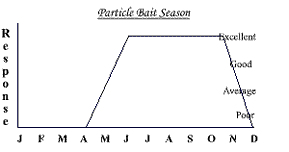
A wide number of baits come under this header...Particles, from basics like sweatcorn and Hemp through to groats, peanuts etc... Some of these are perfect as feed baits others are more suited as hook baits and some can even be used for both. The key to the majority of these baits is preparation. Infact some badly prepared particles can actually cause allot of harm to Carp, badly prepared peanuts have actually killed Carp! Particles are especially effective during the summer months:-
There are so many different particles that you can catch Carp on, we will try and describe some of them here.

Particles are a devastating bait for carp but they can also be dangerous and in some cases fatal. Any carp angler who cares even the slightest about his/her catch should pay attention to this warning. Particles need to be properly prepared; that means no skimping on the soaking or cooking process. Particular care should be taken when using peanuts as these are deadly to Carp when they have been badly prepared. Well after we have warned people about the dangers, lets talk about the good points.
Good Points about Particles:-
Particle baits can be devastating as a feed bait, hook bait, and holding bait! When presented correctly on the right occasion particles can and do out fish boilies! Also particles are majorly kind to your pocket, particles are very cheap if you get them from the right sources. Never turn your nose up at alternative baits, it's worth a shot!
The Price Advantage:-
You can get particles from most good Carp tackle shops, but if you buy in bulk you can get your particles much cheaper from pet stores! Strange as it sounds these particle baits are often fed to animals as well as Carp. To prove my point I recently got quoted:-
 12.5kg of Hemp for £11.00
25kg of Groats for £11.00
20kg of Pigeon Conditioner P1 for £10.00
"Hinders - the particle specialists" do similar deals but unless you can pick your particles up your self, then it's cheaper to buy from your local pet store. I think Hinders charge about £5 to deliver up to 15kg of Particles.
Disadvantages of fishing with Particles:-
The only problem I have fishing with particles is that they are quite difficult to catapult out, especially the smaller particles (Hemp is a bas*ard).
To combat this problem most people use what is called a 'Spod', this is basically shaped like a rocket; you tie it to the end of the line; fill it with whatever bait you want and then cast out. You can get various sized spods which range from about 2oz-12oz spods. You can generally use normal carp rods (2.5 T.C.+) for spods that weigh under 4oz when fully loaded (Gardner's Pocket Rocket is excellent) but for any spods that weigh more than this and to be honest quite allot do, then maybe it may be worth buying a rod dedicated to spodding.
You can get specialist spod rods, these start at about £66, but in my opinion if you don't want to spend that kind of money then you should try and get a strong beach caster. A word of warning though! Be careful not to cast a loaded spod which seems a bit to heavy for the rod, because I know people who have snapped perfectly good Carp rods trying to cast heavy spods!!!
Commonly Used Particles for Carp and Preparation Guide Lines:-
I have devided all the particle baits up into three section>>>
Particle Mixtures
Small Seeds
Large Particles
This may help to catogarise the particle and it's use.
WILD
BIRD SEED
Add two parts water to one part seed and boil. No soaking required. Pour mix
into a bucket, seal lid and leave to cool. You can use it straight away but
I prefer
to leave it for two or three days giving the oils and milks chance to mix together.
PIGEON CONDITIONER P1
Add boiling water to seed; add half a capfull of aniseed flavouring for a really stinking bait. Leave to stand for 24 hours and drain water off.
BLACK
EYED BEANS
Soak for 12 hours until they have begun to swell up. Bring to the boil and simmer
for 20 minutes after which they’re soft enough to hook.
BROKEN
BRAZIL NUTS
Soak for 14 hours in cold water, bring to the boil and simmer for 30 minutes.
CHICK
PEAS
Place a small amount of dry chick peas on a damp towel and cover. Place a tray
in a warm place for 48 hours. The peas will sprout, providing the towel is kept
damp. Place peas in water to soak for a further 24 hours and add required flavour/colour.
Bring chick peas to the boil and simmer for 20-30 minutes.
MAPLE
PEAS
Soak for 12 hours, bring to the boil simmer for 30 minutes.
MAIZE
Soak for 12-14 hours then boil. Simmer for 20 minutes. Pour into a bucket, seal
the lid and leave to ferment.
MOTH BEANS
No soaking needed with these. Just add water and bring to the boil. Turn off
and let them cool.
PEANUTS
Soak for 12-18 hours allowing the nut to re hydrate. The skin stays on and expands
with the nut. Bring to the boil, simmer for 20-30 minutes..
RED
KIDNEY BEANS
Soak for 14 hours, bring to the boil and simmer for 20-30 minutes. Ready when
they are soft.
TIGER
NUTS
Put the required amount of nuts into a bucket, soak for at least 24 hours. When
soaked, bring to the boil and simmer for 30 minutes. Pour the whole contents
into a
bucket and put the lid on. Leave for three days to ferment. Use when the liquid
is thick and gooey. Excellent fished over wild bird seed or hemp during the
warmer
months.
Small Particles:-
BUCK
WHEAT
Soak for 12 hours then just bring to the boil. Allow to cool in the water it
was cooked in.
GROATS
No pre-soaking required, just put into a pan of cold water and just bring to
the boil. Turn off water, drain some of the water, the residue is very milky
which is highly attractive to the Carp.
HEMP
The best way of preserving the goodness is to soak for 12 hours in cold water,
boil and simmer for two minutes, then tip into an air-tight bucket. The splitting
should
occur in the bucket, not in the saucepan.
LIMA
BEANS
Soak for about 12 hours in cold water, simmer for 20-30 minutes. Ready when
swelled.
LINSEED
Soak for 8 hours in cold water and just bring to the boil.
MAIZE
(FLAKED)
Soak for 12 hours in cold water, bring to boiling point.
PINTO
BEANS
Soak for 12 hours, bring to the boil and simmer for 20 minutes. They do work
well flavoured but also have a distinct flavour of their own.
RED
DARE
Soak for 12 hours in cold water, bring to the boil.
SOYA BEANS
Soak for 12-14hours in cold water, bring to the boil and simmer for 20 minutes.
TIC BEANS
Soak for 12-14 hours in cold water, bring to boil and simmer for 20-30 minutes.
They swell slightly when cooked and the brown skin stays on.
WHEAT
Soak for 12 hours, bring to boil. It turns quite milky when ready. Flavouring
should be done while the wheat cooling in the water it was boiled in.
TARES
Soak for 12-14 hours. Bring to the boil, simmer for 20-30 minutes. Once they
cool they are ready to use.