 |
| undefined |
|
|
|
| Top | Bibliography | Famous Quotes | Grading Rubric |
| Joseph Stalin Iosif Vissarionovich Dzhugashvili 1879 to 1953 |
|
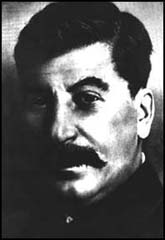
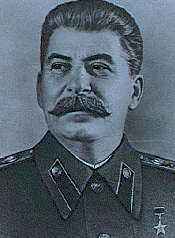
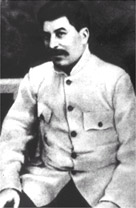
Joseph Stalin was the powerful leader of World War II Soviet Union. In his rule, he encoraged violence, especially to inocent citizens. Estimates of his killing range from four to fourteen million people, mostly Russians. At his funeral, hundreds, possibly thousands of people were trampled to death. But somehow, he managed to be loved by some Russians.
Stalin's Early LifeIosif Vissarionovich Dzhugashvili was born on December 21, 1879 in Gori, in the state of Georgia, in the USSR. He was the only of two other children to survive birth. His father, Vissovion Ivanovich Dzhugashvili was a poor shoemaker, who often drank. He would sometimes beat little Joseph and his mother, Ekaterina Djugashvili. Joseph nearly died of smallpox, which left his face disfigured. He also nearly died of blood poisoning after wounds recieved from his father. His left arm is three inches shorter and never regained full functionality. One time, when Joseph was nine years old, he threw a knife at his father to protect his mother. The knife missed, and Joseph stayed at a neighboor's house for some time. Stalin's father died in a bar fight while Stalin was still a child.
Stalin's mother had high expectations for Joseph. He was a choirboy at the school he attended. He even sang a solo at the birthday of Czar Alexander the Third. He graduated at the top of his class in 1894. She sent him to Tiflis Theological Seminar, at age 15. He learned about Russia's currently communist government, and read literature by Vladimir Lenin. Five years later, he was kicked out for encouraging the Marxism political party. He beings work at the Tiflis Physical Observatory.
In 1901, Stalin's belongings at the observatory are searched by the police. He soon leaves Tiflis. In the same year, he becomes a member of the RDSLP, or Rossiiskaia Sotsial-Demokraticheskaia Rabochaia Partiia. He is sent to establish a social-democratratic group in Batum.
Political ProtestHe would write documents protesting communism under the name "Stalin", which ment "man of steel", or other fictious names. Joseph would also write under the name "Koba", a hero from Georgian folklore. His first published article, under the name Koba, was entitled "The Russian Social Democratic Party and Its' Immediate Tasks". It was in the underground Russian newspaper Brdzola. This article encouraged violence, especially to innocent bystanders.
In the following years, he orginized workers' protest at manufacturing plants. His popularity grew with every sucessful protest.
His public dislike of the communist government system landed him in Siberia many times. He even recieved a letter from Vladimir Lennin. In 1912, Stalin is elected a member of the Bolshevik political party.
The Great PurgeStalin was becoming a popular figure in underground Russian politics. He was eventually elected secretary general of the communist party in 1922. He eliminated any rival in the communist party, by claiming they were deviationalists. They would later be executed. Stalin continued to rise in political power, when he launched The Great Purge in the 1930's. He would kill or torture anyone in the communist party. He appointed himself as the leader of Russia.
World War IIHe would convert farms into state farms, requiring farmers to work. As soon as the farmers heard about his plan, they began slaughtering their animals, creating a large famin. When World War Two started, Stalin had some generals, the others were killed in The Great Purge. He signed a peace treaty with Hitler in 1939. Hitler ignored this treaty when he invaided the USSR on June 22, 1941. Stalin held the invaiding troops, eventually pushing them back. Stalin had an interest in expanding the USSR's control to Asia, especially the Kurile Islands, halfway between the coasts of USSR and Japan. He joined the war to take the islands from Japan.
After Hitler's defeat, Stalin extended the USSR's rule into countries west of the USSR. Concerns about Europe's democratic countries cause him to eventually built a wall of military forces, stopping news getting in or out of the USSR.
Stalin's Last YearsAt the age of 70, Stalin finally allowed North Korea's dictator, Kim Sung, to attack South Korea. Kim Sung felt that Russia might attack if he didn't ask permission first. Stalin died three years later on March 5, 1953.
| Accuracy of Information | |
| Depth of Research | |
| Importance of Information | |
| Appearance |

