From Buffalo to Alaska. Day 20 - 9/5/96
Our last day, although it didn't start out that way.
Morning in St. Ignace looked an awful lot like the previous evening -- clear, cloudless sky, but a haze so thick that Mackinac Island only 5 miles off shore was only a distant shadow. This kind of weather looks great if you want to enjoy summer weather outdoors and on the ground, but is miserable for VFR pilots. In aviation lingo there is special VFR, and marginal VFR, but no specific word for this weather. We decided ugly VFR was appropriate.
It was particularly difficult for us. After spending two weeks west of Chicago, we'd become used to the clear skies and the visibility of 40+ miles. Today the forecast along our route was "clear skies, 5 miles visibility, in haze". That translates to legal VFR flying conditions, but not fun VFR flying conditions.
We started out with a good omen. Yesterday when we landed at Mackinac County airport, we could find no signs of civilization, and more importantly, no signs of a fuel pump. We were resigned to having to takeoff this morning, fly 10 minutes to Cheboygan, and refuel. When we arrived at the airport this morning, life had returned, and we found fuel was available at the far end of the runway. In our case, a happy aviator is an aviator with full fuel tanks, so we were able to leave Mackinac County happy.
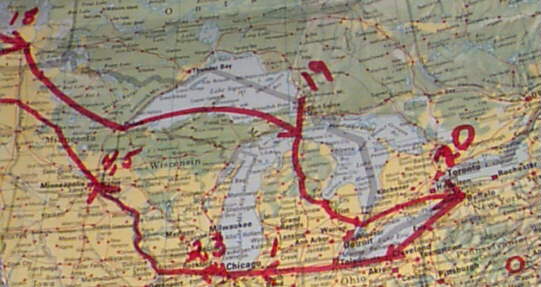
Immediately after takeoff, we turned left and crossed the 4 mile long bridge over the Straits of Mackinac. The wind was dead calm, and the water of Lake Michigan was crystal clear.
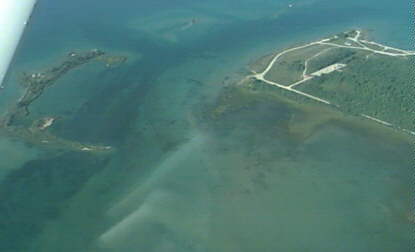
This is a photo of the small park on the southernmost tip of the upper Michigan peninsula, at the Straits. As you drive north across the Mackinac bridge, this will be on your left. This should be a picture of the 4 mile long bridge, but the haze was so thick that we couldn't get any pictures except straight down (and neither of us felt comfortable circling over bodies of water more than a half mile wide in a single engine aircraft).
We flew for 30 minutes, and finally decided the haze was too thick for comfort. We could see about 8 miles ahead on the ground, but when you're trying to spot small airplanes flying at you, 8 miles in the air does not give a big margin for error. And at this hour (10 am) we were flying almost directly into the rising sun in the southeast, which made the haze that much more difficult.
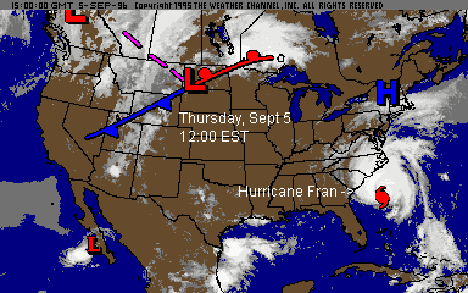
We landed at Roscommon County airport, near Houghton Lakes, a resort area northwest of Saginaw. We decided to wait 2 hours until 1:00 pm, to give the sun a chance to get behind us. We knew that we had only a small window of opportunity to get home before the remnants of Hurricane Fran shut down Buffalo for the weekend, and left us stranded only a few hundred miles from home. See weather map. So we checked with Flight Service, learned that the weather enroute was forecast to be no worse than 5 miles visibility in haze, and pushed on.
We landed for fuel in Romeo, Michigan, a small town with a bustling airport, northeast of Detroit. From there it was only 188 miles to home. We flew over Southern Ontario, from Sarnia to Fort Erie, but did not have to clear Canadian customs since we took off from and landed in the United States.
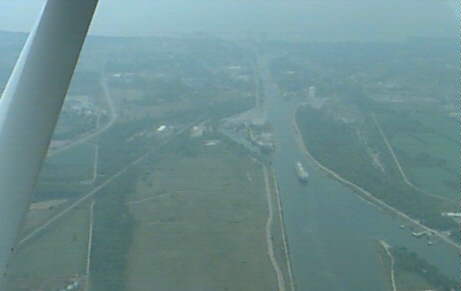
The sure sign that we were home was crossing the Welland Canal, just west of Buffalo. The Welland allows Great Lakes shipping traffic to get from Lake Erie to Lake Ontario without having to travel over Niagara Falls, and it hosts some large lake freighters. One of them is visible (through the haze) in this picture, travelling south from Lake Ontario to Lake Erie (at the top of the photo).
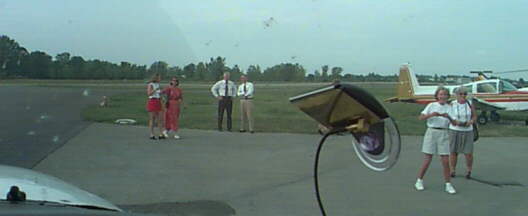
In less than 15 minutes, we were on final approach for our home airport, Buffalo Airfield, where the crowd of well wishers had begun to gather.
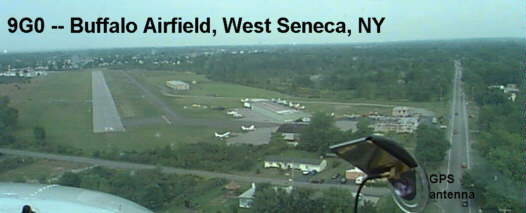
The marching band was delayed in traffic, so does not appear in this picture.
The crowd was even bigger for our return than for our departure. They raced toward the plane to greet us almost before we had shut down the engine, and then posed for a group photo.
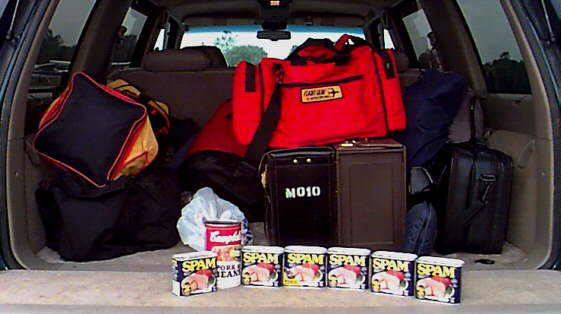
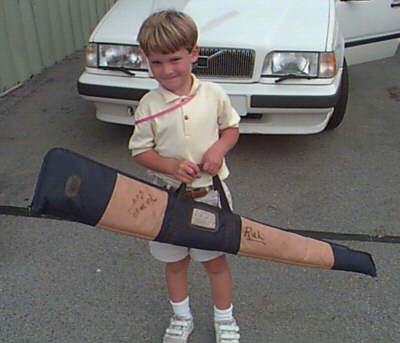
We had taken months to plan the trip, with careful thought being given to all the gear we brought, how much it weighed, and where we would stow it in the plane. We were fortunate we didn't have to use two items we brought with us -- the survival food rations and the shotgun.
We put N96751 to bed in her hanger for the first time in 3 weeks, and said goodbye. She had served us well, and neither of us will ever forget her.
Sign Guestbook
View Guestbook
|  Previous day |
  Return to home page|