
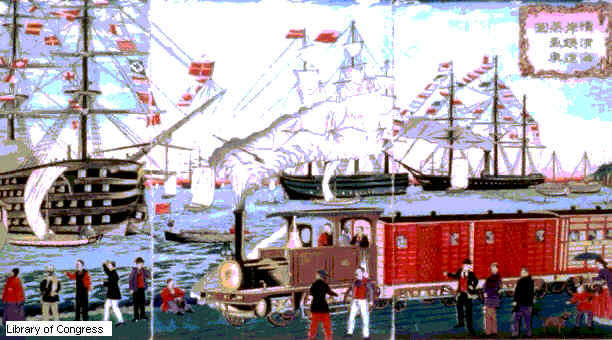
China and Japan, however, took separate paths in their reaction to the Western powers. Many Japanese were alarmed at these events and anti-foreign sentiment grew among samurai (the warrior class) and the daimyo (feudal lords) who had already resented Tokugawa rule. The Tokugawa clan, headed by the shogun, (the military leader) had ruled Japan since 1603, and was now blamed for the shame which the unequal treaties had inflicted upon Japan. In the end, the Tokugawa shogunate was overthrown and a new group of leaders emerged at the same time a new emperor ascended the throne. Every emperor of Japan is known by a title named "for the era during which he would rule". Thus was born the Meiji Era, which means "enlightened rule." The emperor served mainly as a figurehead and a small group of men, who would become known as the Meiji oligarchs, ruled the country. What followed, from 1867 to 1912, remains unparalleled in history.
As deeply humiliating as the western show of force had been, many realized that until Japan caught up with the west technologically, the unequal treaties and their own perceived inferior status would remain intact. While culture and the arts had flourished during the period of isolation, the scientific and industrial revolutions had raged around the blissfully unaware Japanese. This had to change for Japan to compete in the modern world. Accordingly, the oligarchs set the nation upon a course of modernization which would produce dramatic results. The first step was to foster a sense of nationalism and unity. Until then, most Japanese had identified themselves as loyal to their daimyo first. The emperor was a revered but very distant figure. The oligarchs placed the Meiji emperor upon a high and sacred pedestal and every reform was carried out in his name. Education in this highly literate nation promoted patriotism and the military were taught the virtues of "unquestioning obedience and sacrifice".
With this sense of national pride in place, the oligarchs were ready to administer sweeping reforms, the first of which ended the status of the samurai. By 1876, samurai were forbidden to carry their traditional swords and the warrior class evolved into bureaucrats. Peasants who had previously been forbidden to carry arms were conscripted into a centralized army. The old class system of Japan was abandoned. With astounding speed, universities were founded, telegraph and railroad lines cross-crossed the country and a national postal system was set up. The shipping and textile industries took off, as shown by the facts that "by the end of the Meiji period, more than a third of the world's supply of silk came from Japan" and the percentage of exports carried on Japanese built and owned ships rose from 7% in 1893 to 52% by 1913. How was such progress at such a rate possible? The answer lies in the Japanese traits of flexibility and adaptability. Simply put, they borrowed the best of the West and molded it to fit Japan's needs.