|
Welcome to
|

|
The southern French city of Carcassonne was founded on an important trade route between the Mediterranean and the Atlantic. Because of its strategic location, the city was often conquered and has known many rulers. As a result of this varied history, the city is famous for its unique mixture of Roman and Medieval fortifications. -From the back of the box. Carcassonne is a clever tile-laying game by Klaus-Jurgen Wrede. I got my copy in December 2002 as a Christmas gift from my in-laws. (Marrying into a family of gamers is pretty sweet at gift-giving time.) Recently, Carcassonne has become my pick-up game of choice, I’ve bought a couple of expansions and even hooked my sister on it. I know a game is top notch when I can get my sister and/or my wife to play it. This criterion puts Carcassonne in the same category as Illuminati and Fluxx. |
Why I Like Carcassonne Reason the First: Like most German games I’ve encountered, Carcassonne has impeccable production values. The tiles are solid, non-flimsy, and feel good to handle. The little wooden guys are a decent size and the paint on them is even and has a nice glossy finish. Reason the Second: The medieval theme certainly helps sell the game to this Dungeons & Dragons nerd. The teensy weensy farms and the walled cities are cute. Had Carcassonne been released as a typical pipe game, I doubt it would appeal to me quite so much. Reason the Third: Carcassonne is very easy to teach newbies. The tile laying aspect basically teaches itself. Since it plays fast you can run through a throwaway game and still have time to get serious. Even if, like me, you keep your expansion tiles fully integrated in your set, you can still play the basic game. Ignore inns and treat cathedrals as 4-sided cities and suddenly the tiles are much simplified. You can put the double-value men, king tile, and robber tile back in the box and the newbies are none the wiser. Reason the Fourth: Although
some people agonize over it, I really love the “draw it and you’re stuck with
it” nature of play. In that way it
reminds me of my favorite aspect of poker: the game doesn’t hinge on drawing
good cards, it hinges on your ability to make the best use out of bad cards. “Making lemonade out of lemons” as it
were. It’s for this reason that I am
skeptical of any Carcassonne variant for which tiles are visible before drawn
or in which the players maintain hands of tiles from which they can choose a
play. |
|
A Tiny, Tiny Carcassonne Variant |
|
|
I call this variant River Plus One. I usually play with the River expansion but I hate to see a perfectly good tile like the original starting tile go to waste. For people who draw tiles from a bag integrating the old starting tile (with its inversely-colored backside) is a piece of cake. I prefer neat little stacks on the table, with the agreement than anyone can draw from anywhere in any stack. You can still keep the basic starting tile in play by mixing it into the stack for the River. Having a non-River tile in use during the River phase of the game strikes me as a tad bit inelegant, but I like the added possibility of getting a tile that can be placed somewhere besides downriver. |
|
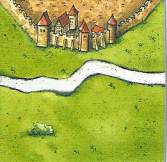
A Missing Tile? |
|
|
A crude mock-up, I admit. My only graphic manipulation program is MS
Paint. |
Not so much missing, more like “an obvious permutation not already in the tileset”. Maybe it’s the fact that I grew up on a farm or that I’m a completist, but I really think that an all-green piece ought to be in the tile mix. After all, there are all-city pieces and fourway road intersections, right? Also I think an all-green tile coming up in the midgame could serve as a great heads-up to players that they need to be paying more attention to their farmers. Sure, the tile would be kinda boring to look at. I guess the artist could add a little farmhouse or a cow or something. |
Never “Throw Off” During my first or second game of Carcassonne someone (possibly me) drew a tile that had no obvious use to them. After some discussion as to where the tile could be advantageously placed the player, not finding a good play, laid the tile in an out-of-the way locale and snorted something about “throwing off”. After seeing this phenomenon several times I’ve given some thought to the idea of throwing away a piece because it was off no use to you. I call shenanigans. Upon further meditation on the subject I have come to the conclusion that it runs counter to the spirit of the game to throw a tile away. If you’ve examined the board and decided that no play will improve your position, then ask yourself the following two questions:
Given virtually any situation, the answer to at least one of these questions will be yes. I think. |
Markers, an Equipment Suggestion I’ve found it useful to have a handful (say 20 or so) markers. I use colored glass stones of the sort that collectible card gamers often employ. These can be found in pet stores (for fistank bottoms) or general hobby stores (for filling glass vases and such). I purchased a big jar of them at Big Lots. Alternatives markers include pennies, wargame chits, Icehouse pyramids, or wooden pieces from other German games. My original use for the markers comes at the end of the game, when the farming points are tallied. After scoring each city we mark it with a stone, to avoid omissions or duplications. Since getting the King & Scout expansion I also use two during the game, to clearly mark the biggest city and longest road. |
Links The entry for Carcassonne at Boardgamegeek.com Rio Grande Games, American publisher of Carcassonne Buy Carcassone at the RPG.net Shop. |