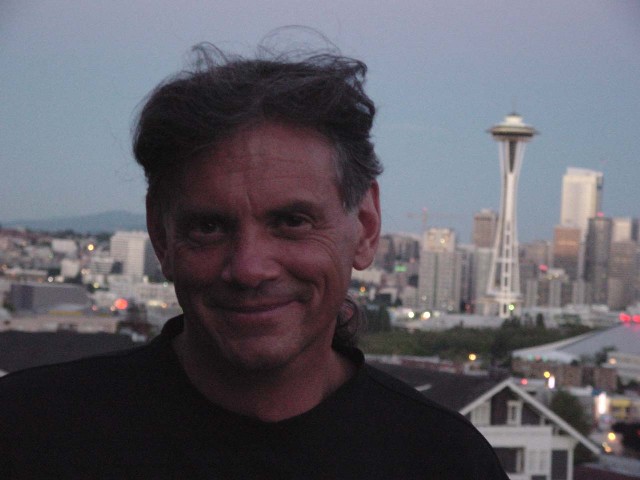
Alan Hart
Class of 1969
Alan Hart -- Biography
Once a goalie, always a goalie … Alan has translated his passion for teamwork into the leadership of an award-winning international architectural practice. After graduating from JRH, Alan attended McGill University and then the UBC School of Architecture, and has lived on the west coast since 1974, first in Vancouver and now in Seattle since 2001.
Alan continues to love sports, especially skiing, swimming, working out, and watching his 18-year old son Brandon, who has inherited the Hart goalie genes. Together with his wife Catherine, Alan also loves the vitality of Seattle's music community and attends concerts whenever possible. Living south of the border has given Alan a special appreciation of the Canadian way of approaching life … or "Stay calm and be Canadian", as the recent headlines read, and he is thrilled to be contributing to the upcoming 2010 Winter Olympics in Vancouver.
The first SkyTrain line through Barb Wright's Vancouver, B.C., neighborhood brought a gray box of a station: a gigantic overturned filing cabinet that towered over the discount pharmacy and the poster-plastered phone poles on Commercial Street.
So when Wright heard a second line was coming through, she dreaded the worst. Maybe this one would be a giant Dumpster in the sky.
Her fears, though, didn't materialize. And that may be a good sign as Seattle begins designing the 19 stations along its monorail line.
For the lead architects of the second set of SkyTrain stations, Alan Hart and Graham McGarva, the process begins with what they call the "archaeology of architecture." And that's where Hart is starting as he begins overseeing the design of the stations for the West Seattle-to-Ballard monorail line.
Hart, though, won't be dusting for fossils among the shattered Old English bottles in Pioneer Square. By archaeology, he simply means the architects will begin by learning what they can of the places where the stations will sit, and asking the neighborhood questions as esoteric as, "What are your aspirations?"
For Wright and her neighbors, the aspirations were simple when Hart and McGarva got to work. The problem the first time around, she said, was that Canadian authorities were rushing to build SkyTrain in time for Expo '86. They had none of the say they'd get with Hart and McGarva.
"There was no public input at all," said Wright, sitting behind the block-watch pamphlets stacked on the counters in the small neighborhood association office she runs.
"What did we want the second station to look like?" she asked, frazzled on this particular day while trying to keep troublemakers from putting handprints into a neighborhood mural.
"Something that wouldn't look like the first one." But neighbors wanted a lot more.
The station was going to sit atop a ravine filled with trees that had divided the neighborhood. They wanted the station to be a bridge of sorts. A sordid pool hall also sat on a triangular piece of land nearby. "All sorts of things used to go on in there," Wright said. "We wanted that place gone."
Where the pool hall once stood, commuters now rush home from work, past the HUB Station Pizza, the Booster Juice and the Zesto's Subs. After passing the flower cart in front of the station's entrance, they cross a glass bridge over the ravine to the platforms.
"You can see who's on the platform from the street because it's glass," Wright said.
"There's a feeling of security, like no one is going to be in the shadows."
Architects, though, say they like to tell stories through their designs. And as the team tossed out ideas, "somebody said they saw a treehouse" over the ravine, McGarva said.
The question, then, was, what does a station like a treehouse look like?
McGarva searched for inspiration in words, composing a poem he hoped would evoke images of the design.
"Trestles and flyovers
Bridge ravine with soft firmness
Tendrils reclaim the shaped earth.
Rendezvous at the junction,
The soaring canopy of shelter
Among cascades of tracks and paths,
Fresh footfalls of occupation
Re-stitching the fabric of community."
What emerged, next to the big filing cabinet of a station, were wooden pillars like tree trunks and round beams like branches lifting a green roof over the platforms.
His "soaring canopy of shelter."
Kevin Carl cares as much about Pioneer Square as Wright does about Commercial Street.
He's so protective of the neighborhood's history that when he saw a road crew putting in what appeared to be a disproportionately large sidewalk, he stopped and glared.
Sidewalks in the neighborhood are made up of concrete squares, 4 feet by 4 feet. Drying in front of him were rectangles, an appalling 8 feet by an astonishing 12 feet. "They look like sidewalks in Bellevue," said Carl, himself an architect and neighborhood activist.
Now the monorail is adding to his worries. Only with great care is something so futuristic going to fit in with the turn-of-the-century brick buildings built after the Great Fire of 1889 burned down everything made of wood.
Heather McIntosh, a historic preservationist at Historic Seattle, was worried too, when she pointed to the boarded up buildings along Second Avenue by Smith Tower. Businesses may suffer if shadows from the monorail render the sidewalks uninviting. "It would be a shame," she said, if more of the old buildings are covered up with plywood and graffiti.
Not far from where they walked, Hart sat at one of the tables outside the Torrefazione Italia coffeehouse in Seattle's Occidental Square.
One of Pioneer Square's stations will sit just to the north at the concrete parking garage at Second Avenue and Yesler Way. The garage is known as the Sinking Ship because the slope in the hill gives it the appearance of sinking. The other station would sit just to the south of Occidental Park by the King Street station.
Hart spends his Sundays digging into the history of the neighborhoods. Many of the bricks in Pioneer Square's buildings come from Japan, he explains. Turns out, Japanese ships sailing here to take home lumber used bricks as the ballast on the way over.
"Graham is the poet," says Hart, sporting a long, black ponytail and thick biceps. Hart's approach is to ask question after question until the "story" he wants to tell through the stations emerges.
The most important questions will be posed to the neighborhoods when he begins meeting with them next month: "What does the community want to express about its identity in a monorail station?"
All along the line, the archaeology will bring discussions and maybe some soul-searching. What is the essence of West Seattle, or Sodo, or Queen Anne or Ballard?
Still, how can a monorail possibly fit in with the neighborhood's historic buildings? Hart pointed out how the people who built the century-old buildings on Occidental Square made sure the cornices lined up. Just as they were "considerate of each other," Hart said the monorail line must be considerate of them.
But he thinks those early settlers would embrace the coming monorail.
"They were creating a future."
The question of the night: What is the essence of Ballard?
"Lutefisk!" someone yelled out. And the 20 or so people sitting in front of an easel with a big piece of white paper in Ballard High School laughed -- among them, Alan Hart, the architect in charge of designing Seattle's monorail stations.
Briefly, an image flashed of a monorail station that looked like white, gelatinous cod.
The monorail project was entering a new phase that night a couple of weeks ago. Details such as on which corners the stations will sit are still being studied. But architects were beginning the process of imagining what they might look like.
Searching for inspiration, Hart and other architects sat in high school auditoriums and Benaroya Hall the past two weeks, asking small groups such questions as what does your neighborhood feel like?
It's what Hart did a few years ago, when he led the design of Vancouver, B.C.'s latest SkyTrain line. That led to stations that looked like tree houses and dragonflies sitting on rocks. It's too early to tell what imagination will conjure here.
"This is like the first time you meet with your architect and you have to tell them if you want a formal dining room or a family room," Hart said.
After the lutefisk remark, the group got down to the business of figuring out the essence of Northwest Market Street and 15th Avenue Northwest. One man said it lies in the century-old brick buildings that line some of the quiet tree-lined streets. "Permanence" was how he described it.
But another noted that the intersection has always been a "crossroads. It could be a crossroads between the past and the future."
Certainly, said another, the spirit of Ballard is its fishing heritage. The side of the station could look like a fishing net, he said, except of course the fish hanging from it wouldn't be real.
"You can't make this stuff up," Hart said.
Last Tuesday night, Hart -- who has the ponytail of an artist, the body of a hockey goalie and has been both -- was in the lunchroom at West Seattle High School with Delridge residents.
"Industry," a man in flannel said of his neighborhood, thinking of the steel plant in the neighborhood.
But a woman with a bicycle helmet thought of Longfellow Creek, which goes under the plant in a pipe, then emerges to wind past lush trees and trails.
Delridge's essence? "The natural setting," she said.
Years from now, when people wonder why the Delridge monorail station looks as it does, they may point to exactly 7:33 that night, when a City Light conservation officer named Mike Little said, "It's the combination of nature and industry."
Hart beamed. "That's an 'aha,' " he said.
Mulling it over for a few seconds, he said, "The strength of industry combined with the softness of and gentility of nature."
The next night:
"Retail."
"Commerce."
"Tourism."
Hart was in the auditorium at Benaroya Hall, listening to a group of people dressed for business trying to describe the essence of Fifth Avenue and Stewart Street, a block from Westlake Mall and across the street from the Westin Hotel.
Stephen Koehler, who said "retail," and whose company runs Westlake Mall, pointed out the station would be at the confluence of the monorail, a bus tunnel station and possibly the trolley line Mayor Greg Nickels wants to build from South Lake Union to the same intersection.
Another pointed out that the corner is dark at night -- "you wouldn't want to have to catch the last train from there." So the man said the station should be lit up at night. "Beacon of transit," Hart said to himself.
The discussion may get even more esoteric at the last session in this series of meetings on Thursday. The debate rages between running the line around or through the Seattle Center. Last Friday, the authority released a depiction of what the trains and the track might look like crossing the campus. But the architects, continuing to work in case there is a station, will ask, what is the essence of the Seattle Center?
There will be more community meetings this month and next. Then architects will make conceptual sketches of the stations.
But how do you draw "permanence," "the connection of industry and nature" or "commerce?"
"Sometimes it comes in a flash," Hart said. But most of the time, it'll come as he and architects from eight firms the authority has hired sit around a table.
"It starts with just doodles and sketches," he said. "Then more sketches on top of the sketches, and more sketches on top of that. It's pretty cool to see. It grows out of the paper."