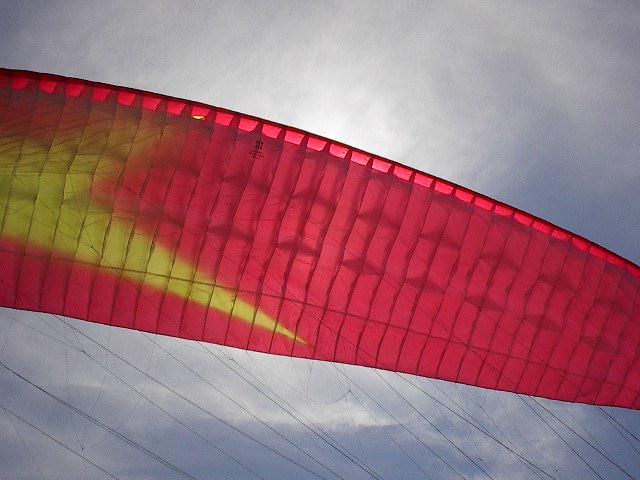
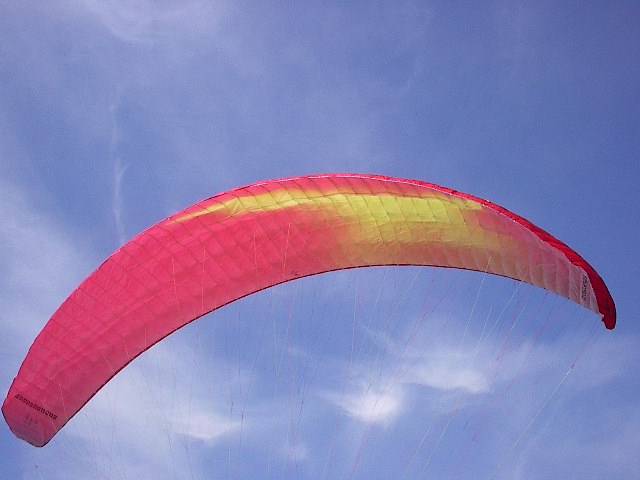
Click on an image to see it full size!
About Me and My Previous Glider
I've been flying the Flight Design S2vt paraglider for the last 3 1/2 years so that is my point of reference. It's a DHV 1-2 glider with 1998 technology. I was ready for a crispy new bag, a better sink rate, a better glide ratio, and something sportier. I am a relatively new P4 pilot with about 130 hours of airtime. A little less than 1/2 of that time is thermal flying. I'm the typical "Weekend Warrior". I fly my local coastal and thermal sites when I get a chance, and I try to go on a couple of longer flying trips per year.
Other Paragliders I Tried
Recently I had the opportunity to fly the following gliders: Advance Sigma 5, Swing Mistral 2, and the Windtech Quarx. I finally decided to focus on a DHV 1-2 glider because I really value stability in a wing. My S2vt was fairly stable, but it didn't turn very fast. This is partly due to the fact that I was lightly loaded on the glider.
Wing Size and Wing Loading
I choose to get the Medium Size XIX Inter 2. I hook into the wing at 102 kg. The XIX size "M" has a total hook-in weight range from 85 - 110 kg. This puts me near the top of the weight range but still comfortably within the range. Many other gliders are sized with the Medium top at 105 kg. The XIX range worked very well for me and my size. I wanted to be on the heavy side of the range, but I didn't want to be right at the very top.
XIX Inter 2 Paraglider Overview
XIX is a Swiss based company. They're a well-established paraglider company in Europe, but are just now starting to market gliders in the United States. I was willing to try something new, with statistics that I liked, that matched what I was looking for. I choose the XIX Inter 2, which is their DHV 1-2 glider.
Test Conditions for My XIX Flights
I flew the Inter 2 in both strong cross wind conditions at the coast as well as my local thermal site. I also hope to get some additional airtime at Marshall Peak next weekend.
Riser Configuration of the XIX Inter 2
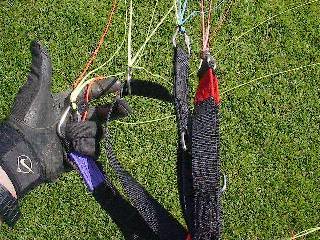
The Inter 2 has 4 risers, with split A risers for ease of big ears. The C riser "floats" at the connection point as you can see in the photo. The brake handles are magnetic, which so far I prefer over my old snap on brakes.
Launching and Kiting the XIX Inter 2
My old glider had a tendency to hang back while kiting if not helped aggressively overhead. I found that the Inter 2 is much easier to kite and launch than my old glider. I could more easily keep the glider overhead and adjust with the brakes without the glider falling back down as I tried to correct it. I found the glider easy to control launching in 15 mph cross winds at the coast. At the mountain, I reverse launched in very light crosswinds with little effort. Overall, I found the XIX Inter 2 easier to kite and launch than I expected.
Flying Characteristics
The first thing that I noticed while flying the Inter 2 was light handling. The brake lines are shorter than I'm used to, but I could still take one wrap on the brakes with a bit of room to spare. (The lines on my old glider did seem a bit long). Basically the Inter 2 turns very easy. It's much more responsive than what I'm used to. But what really surprised me was the energy retention of the wing. Doing some small wing-overs you really could get that glider swinging! Regular turns were easily initiated.
Big Ears
The split A risers made big ears easy. I was curious if the ears would stay in when I released. I thought that being more heavily loaded on the glider they might pop right out. Some pilots prefer that they pop out, but I prefer that they stay in. The ears did in fact stay in until I pumped them out, even in strong 15 mph+ winds at the coast. This is what I was hoping for.
Overall Impression
I really like the feel of this glider. It's easy to launch and fly, and feels very stable overhead. The DHV report actually shows the Inter 2 is easier to fly than my old glider, but the Inter 2 is much more sporty! I'm looking forward to thermalling in the XIX with much less effort than I'm used to. I'm excited to fly it more. I hear that they have been getting to 11,000 feet at Marshall Peak in Southern California lately. I'm headed down there with my new glider to get my share of the thermals this Thursday!
 Related Links: