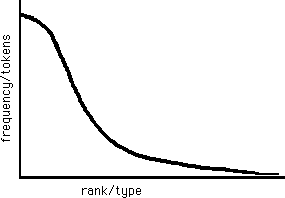
 fig. 1
The Problem
In a study published in 1982, Higgs and Clifford pointed out a phenomenon that has been ignored by many, commented on by several, but resolved by no one. That phenomenon is fossilization, and it creates an upper limit of learnability, or a "terminal" level of proficiency. U.S. Government language teaching agencies such as the Foreign Language Services (FSI) and the Defense Language Institute (DLI) use a proficiency rating scale to determine the language ability of an individual to serve in a particular post calling for that language ability. There are times when individuals enter an agency language program with, say, an Interagency Language Roundtable (ILR) rating of 2, yet, despite the intensive language training they receive, can never advance beyond a 2+. These people are referred to as "terminal 2s". An ILR rating of 2 or 2+ represents limited working proficiency, on a level at which the appointee is able to satisfy routine social demands and limited office requirements. Why is it that these people, who come in with this proficiency, cannot move up to level 3, in which an acceptable but nonnative control of the structure of the language and a broad vocabulary are required?
The answer, according to Higgs and Clifford (1982), is that "the grammar weaknesses that are typically found in this profile are not missing grammatical patterns which the student could learn or acquire later on, but fossilized incorrect patterns" (p. 67). Terminal 2s cannot seem to reach the acceptable standard in communication represented by 3 or 3+. Usually they have a wide vocabulary but control a low level of grammar. The real problem, as Higgs and Clifford point out, is that "experience has shown again and again that such fossilized patterns are not remediable, even in intensive language training programs or additional in-country living experience" (p. 67).
They also talk about the terminal 1+ individual who has usually learned the foreign language on the streets. They point out that "street" learners do not need accurate grammar to survive. As a result, they develop and internalize their own communication strategies. Even though most of these strategies are not linguistically correct, they are adequate for low-level communications and succeed for such Level 1 tasks as satisfying routine travel needs and minimum courtesy requirements. These communication strategies do not, however, work at higher functional levels, when more sophisticated communication is required. This means that these inaccurate strategies, which normally consist of fossilized lexical and grammatical structures, have to be unlearned before the functional language ability can be improved. But, again as Higgs and Clifford point out, "remediation in these cases is seldom, if ever, successful" (p. 67).
This may be true for "street" learners, but surely we in a school setting have not condemned our students to the mediocrity of a terminal 1 or terminal 2 level, have we? Apparently we have. Higgs and Clifford (1982) point out that foreign language classrooms have also produced terminal 1+ speakers.
Rivers (1986) for example, uses the fossilization phenomenon to condemn Krashenâs theory. She points out that "street" learners usually learn the language in unstructured overseas work or study settings, usually in a conversational interaction with "native speakers" of the language, so they are getting authentic discourse. She continues, "in Krashen's terms, they had acquiredâ their knowledge of the language through purposeful activities providing comprehensible input" (p. 6). Her solution is to combine comprehension and production. Valette (1991) also uses Krashen's theory against him. She points out that Stephen Krashen makes a distinction between "acquisition" and "learning". She then points out that "it would appear that the inaccurate fossilizedâ forms have been acquiredâ and, consequently, that further learningâ has little remedial effect except in those rare circumstances when the monitorâ has sufficient time to function (such as on written grammar tests)" (p. 326).
Case studies of "street learners" do shed some light on the subject. Schmidt (1983) describes a typical example of a "street learner" who has discourse fluency, but his language has minimal accuracy in grammatical structure. Ioup et al. (1994), on the other hand, describe a "street learner" who has done exceptionally well. Their subject, Julie, achieved almost native proficiency in Egyptian Arabic, even though she had no formal schooling in the language and did not begin to learn the language until she was an adult. What was the difference between these two cases? Wes, the individual studied by Schmidt, had a very casual attitude toward structure. He normally ignored grammatical corrections from native speakers. His primary concern was the content of the message, and he employed a number of communication strategies to help him when his inadequate syntax led to misunderstandings. Julie, on the other hand, lived with her husbandâs family and learned the language only through the sound medium. For the first 45 days, before her husband arrived, she was totally immersed in Arabic with no English translations available to her. From the very beginning, however, she consciously manipulated the grammatical structure of the language. She paid attention to morphological variations because she saw it as necessary for successful communications. Her attitude toward grammar was that it needed to be mastered correctly.
After her husband arrived she again spoke in English with her husband within the family setting, but continued to listen to Arabic from other family members and on trips outside the home. By the third year, Arabic became the language used all of the time within the family. Julie claimed that effective communication was her only goal and that she was therefore not concerned with grammar except as a means to achieve this end. She did realize, however, that grammatical correctness would facilitate the expression of meaning. Julie apparently did not fossilize at a low level of proficiency, but Wes did. Can we learn from them and others how to avoid premature fossilization and language mediocrity?
Analyzing the Problem
I have been concerned with the problem of fossilization for over 20 years. My first introduction to it came about as a result of a conversation with Val Postovsky at the Defense Language Institute. In an experiment that lasted 8 weeks, Postovsky provided his students with the sounds of Russian, but without the meaning. The materials were developed by F. Rand Morton, and the idea was to "sensitize" the students to the "Russian language". All of the Russian was "comprehensible" to a native Russian but the experimental Russian students were not given any meaning for the sounds they were hearing. Their task was to identify similarity and differences in sound pairs (minimal pair training) and differences and similarities in intonational patterns (statements, emphasis, questioning, etc.) but they were not informed of the differences of meaning of the various sounds while they were listening to them. After this initial training, they were placed in a regular Russian course (at that time, a course based on the audio-lingual approach). It was thought beforehand that the exposure to the sounds of the Russian language would help them to learn Russian better and faster. Before the experiment they believed that these students in this special experimental group would do better than the other students who just started the course fresh without any prior exposure to Russian (Postovsky, 1970, pp. 24-26).
They did not do better. They did worse. They did worse, not just at the beginning, but all the way through. Indeed, they never recovered, and never were as good at Russian as those who came into the course "fresh". Postovsky tracked a couple of these students later in the field (i.e., stationed in Russia) years after the "experiment", and found they still were not as good as his other students. It was as if the process of listening to non-comprehended language input had immunized them against learning the language. They had "fossilized" a very rudimentary Russian and were never able to recover. He told me later that he would regret what he had done to those students to his dying days and he knew he was dying of cancer at the time (personal communication).
Why had this happened? What was the mechanism that caused it? Was it similar to what happens to most street learners? Is there any remediation possible? Postovsky wondered and worried about this until his death. I have continued the quest. I now believe I have a better understanding of it. My understanding would support Riversâs and Valetteâs condemnation of Krashenâs approach, but it would equally condemn Riversâs solution of encouraging people to talk. One point that stands out clearly is that meaningful comprehension is critical and that grammatical correctness facilitates meaningfulness. Both listening to uncomprehended input and speaking before the second language is fully and firmly learned (particularly the grammar) are causes for fossilization and should be avoided where possible. The premature emphasis on fluency before accuracy is assured, is dangerous for both listeners and speakers. The early introduction of "authentic" listening is a dangerous practice. The premature encouragement of students to "talk", "talk", "talk" may be even more dangerous. If we want to avoid condemning our students to mediocrity we had better think twice about how we are teaching them the language. We had better learn more about how we learn languages, and how we control our language behavior after we learn the language.
In the middle of this century, a major paradigm shift began in the sciences. It rippled through the various disciplines and occasionally in some of the professions. In psychology it has caused the shift from the behavioral learning paradigm to the cognitive learning paradigm. This is what I was referring to when I said the comprehension approach was part of a new paradigm (Nord, 1980). This major paradigm shift in science has created the present-day "information age" and was instrumental in the development of the modern computer and other major communications technologies. It has had almost no effect upon linguistics, which seems to have continually followed the Stoic philosophy of 400 B.C. (Yngve, 1996). In order to understand the fossilization problem, and hence how to overcome it, it is important, I believe, to understand this paradigm shift. I am referring to the change from an open-loop cause-effect analysis of behavior, to a closed-loop cybernetic analysis. It is a shift from a reductionist paradigm to a systems paradigm.
Systems epistemology begins with the recognition of the complementarity of the observer and the observed. Systems are generally considered to be of two basic sorts or types: matter-energy systems and information systems. Matter-energy systems are presumed to be part of the "real" physical world that exists before and after any observation and hence are "independent" of an observer. Cybernetic systems deal primarily with information. Information systems involve an observer in a critically intimate way. If there is no observer, there can be no information. Most communication technologies can be seen as cybernetic systems. Language can also be viewed as a cybernetic system. A cybernetic system is more interested in how "things" are organized than in the "things" themselves. But defining such a system involves a complementary interaction between an observer and the observed. When the observed "thing" is a "matter-energy" thing, it requires an observer to divide the "observed thing" from the rest of the physical universe and identify it as a system. The first act of any system definition is to convert the observed "physical thing" into a discrete, "informational" system in the mind of the observer. This informational system is like a "cognitive map" of the physical "territory". When the observed "thing" is "information" it cannot exist without an initial observer. Cybernetic systems are thus like "maps" of "maps". The Hindu-Arabic numeral system could be seen as a cybernetic system, but so could the Roman numeral system. Which is the "real" system? Which is the "more useful" system?
The essence of systems thinking is not the discovery of "real" systems, but the mental creation of helpful ones. Looking at man as a system, or looking at language as a system, will not reveal any great "truth". On the other hand, one can look at man as a system, and language as a system, in ways that can be very helpful for understanding both, and this new viewpoint can help us improve our language teaching.
New Views on the Nature of Man
Cybernetic epistemology sees humans as self-organizing and self-controlling systems. "It represents a rapidly emerging paradigmatic shift away from the concept of a clockwork universe and cause-effect explanations of behavior to one which acknowledges the fundamental self-correcting capacity of all life at all levels from cells to societies. . ." (Byers, 1985, p. 38). Humans are seen as living systems that self-organize themselves by mapping their environment and building up internal informational models of that world. These internal models of the world are then used to guide and control our behavior in the world through cybernetic feedback control systems. This epistemology believes we live in an analog, continuous, spatial environment that we map or fixate: i.e., make permanent "in memory". We develop the "maps" through three stages of growth.
First we must "cognize" some element of the external world. This is the initial stage of learning. Once this occurs, we "project" this map as if it is part of the world. As Piaget (1967) has put it, "Once a concept is constructed, it is immediately externalized so that it appears to the subject as a perceptually given property of the object and independent of the subject's own mental activity" (p. xii). Once we have "learned" something, we "re-cognize" it. When external stimuli, or configurations of stimuli (light radiations from an object) direct our attention to the matching maps in our heads, we have a sensation we call a "recognition" of the object. We are, however, only aware of our maps, not the actual territory. When the strength of our memory is strong enough, we can attend directly to the map, without the stimuli of the external world. This action we label as "recall". We can recall our maps directly, such as remembering what our mother looks like. We can also begin to "manipulate" or edit our maps, and we can create or "imagine" what can be called "blueprints". This is not done willy nilly, but rather follows certain basic constraints that are also learned in the process of map making. In language these constraints are often referred to as "grammar".
We "learn" by taking in stimuli that "make sense" to us. That is, we only learn what is "meaningful" and "useful". Initially we "learn" to filter out from the vast buzzing, blooming variety surrounding us only those things that are of immediate importance. We "select" from all of the sensations, only those we find useful. With these, we create a model of critical essentials, a cognitive map. Our cognitive maps are continually checked through physical responses with our environment, and our cognitive maps are used to control our behavior through negative feedback loops. Most of our initial learning was accomplished before we were conscious of it, and before we had a language to describe it. Language, in cybernetic terms, is seen as a secondary derived relationship between analog-derived concepts held in memory and sound signals digitally coded. In other words, language is seen as a map of a map, a verbal mapping of a cognitive map of a territory we are never fully aware of.
"Cybernetic theory views the individual as a feedback system which generates its own activities in order to control specific stimulus characteristics of the environment" (Smith & Smith, 1966, p. viii). Rather than viewing the individual as a time-oriented, open-loop mechanism that responds somewhat passively to stimuli and reinforcement as it encounters them, cybernetic theory sees the behaving person as a space-oriented, closed-loop system that uses the processes of sensory feedback continuously to detect and define stimuli in the environment and to control its own behavior on the basis of previously learned models.
Let us make sure we understand this clearly, because although the word feedback originated with cybernetics, it has been used with a different meaning in most of the language and linguistic literature. We must learn to recognize that feedback control is an internal factor, not an external one. When people say they give feedback, they are not using the term in its technical sense. No one can give feedback. Feedback control requires a receiver with a goal perception and sensory information relating to that goal perception. The sensory inputs of the actual situation are "fedback" to the "fedforward" goal perception and compared. Our behavioral control systems continually try to maintain a zero difference. Feedback, like systems, is an observerâs term, and the observer in this case is the behaving organism. Teachers can NOT provide feedback. Computers can NOT provide feedback. No one can "give" feedback. Feedback in cybernetic terms is an inherent part of a closed-loop process that involves only the system and its relationship to its environment. Feedback is the mechanism by which the organism controls its own behavior.
Consider for a moment how you pick up an egg. Your brain does not tell your muscle to push or pull anything. Your arm is directed toward the object, an egg, through a series of eye-hand coordination feedback loops, which are continually trying to zero out the difference between the goal (the egg) and the fingers. Once the fingers are around the egg, the tension in the muscles is controlled by the sensing of the pressure on the fingers and the thumb. If the muscles contract too much, the egg will be crushed. If the muscles do not contract enough, the egg will slip out of the fingers and fall. The "appropriate" pressure was "learned" and "mapped" by prior experiences as a child. The actual sensed pressure is fedback and compared with the fedforward desired or appropriate pressure (goal), and any difference then controls the next movement of the muscles. The desired or appropriate pressure was learned as a child and carried in our brain as a perceptual "goal". We behave in order to control this perception, i.e., make sure the actual pressure stays the same as the desired pressure (Powers, 1973). All behavior is the control of perceptions previously learned. Speech is controlled through feedback by the model or mapping we created through sound learning, i.e., the sound memories we hold in our head. We can NOT learn by doing, since doing is controlled by an existent map. We can only learn through our senses, as we take in information in order to build (or modify) the mental maps that control our behavior through feedback.
Feedback in cybernetic terms refers to, and must include at least four features: (1) a sensory goal setting---a reference condition, a mental perception or mapping---in the head of the operating system (the language user) (2) a sensory input as to the actual environmental condition (the sound of the language in the ear); (3) a mechanism (within the system) for comparing the reference condition (1) with the actual condition (2); and (4) the automatic use of this difference or discrepancy to trigger a behavioral change to reduce the discrepancy to zero. By understanding this new vision of man and language, we will be able to understand why speaking a second language too soon, or listening to uncomprehended input of the second language, can create problems for language learners and create the condition referred to as fossilization.
Fossilization in Second Language Learning
First we will deal with the problem of "meaningless" listening. Reflect for a moment about what happens when we hear sounds we do not understand, when we listen to sounds that have no meaning for us, when we are exposed to non-comprehended input. We treat it as noise. We learn to ignore it. If these sounds, like the sounds of a train that runs near our house, are continually repeated, we become functionally deaf to these sounds. The essence of our learning process is to reduce the vast variety of potential input to the raw essentials. Anything that is "meaningless" we learn to ignore. This can have long-term detrimental effects. This, I believe, is the basic cause of fossilization: functional deafness. For Postovskyâs students the functional deafness was to the very sounds of Russian. To "street learners" and those who are forced to speak too soon, the functional deafness tends to be focused on the unstressed grammatical aspects of the language.
The people in Postovskyâs experimental group were fossilized early on. They were fossilized by being made functionally deaf to many aspects of the Russian language. They learned through the experiment that anything that sounds "Russian" is "meaningless". It is therefore to be ignored, not heard. Tomatis (1963) has shown that this is not a particularly surprising result. Most people who only learn one language become functionally deaf to certain sounds of other languages by the time they are adults. There are whole ranges of frequencies that tend to become ignored by people using a particular language. Tomatis refers to this phenomenon as the "ethnic ear". These various deafnesses in adults learning a second language can be identified and verified. They often do not make up a "critical" part of the language. There is usually sufficient parallel sounds across language borders, for most people to be able to "hear" enough of the new language to begin the process of learning it through listening. But there are normally specific areas of functional deafness for adults learning a second language and these are often the areas that cause accents to develop. They can also lead to some forms of grammatical fossilization if not recognized.
When one deals with adult learners of a second language, one must acknowledge that they have already learned one language, and therefore listen with an already biased ear. They have already learned to ignore certain differences in the sounds they hear. They have become functionally deaf to certain sound differences in their own language. We technically call these differences allophones. This is one reason a Japanese has difficulty with the L and R distinction in English. In English, these are meaningfully distinct phonemes. In Japanese, they are allophones with no meaningful distinction. The Japanese learner of English has spent a good part of his life learning to ignore the sound distinction between the English L and the R (which happens to be a difference only in the third harmonic), and become functionally deaf to the difference. The pronunciation and spelling used by Japanese who have learned English often reveal this functional deafness. We can try to overcome the existing areas of functional deafness created by the native language of the learners. Much of the work of Tomatis (1963) in the second language area, is to try to overcome these areas of functional deafness before a new second language is taught. We can also avoid creating new functional deafness in the second language learner. This is what happens when we drown new language learners in a sea of meaningless sounds.
When we listen to a language, we listen for meaning; we listen to understand, to comprehend. Without comprehension, we dismiss the sounds we hear as noise. This, it appears, is what happened when Postovskyâs students spent a long time listening to Russian sounds without comprehending them. How long does it take for this to happen? We donât know, but Postovskyâs shock at the consequences of giving his students meaningless Russian for too long, should give us pause to reflect on what we are doing to our students through inappropriate listening exercises that they cannot understand.
Krashenâs emphasis on "acquisition" of the language by exposure to "comprehensible input" has led to a rash of listening programs and listening exercises that, I believe, may lead to the same results (functional deafness), for at least a portion of the language, the grammatical portion. The predominant mode of the current listening programs is for fluency, rather than for accuracy. The thrust is on getting the "gist" of the message, rather than on getting the details. This is similar to how a "street learner" learns his language. Because one can listen and comprehend the "gist" of a message by means of a sound vocabulary only, some comprehension can be identified and even measured. Apparent success with this approach, spurred on by media hype generated by the new awareness of listening, has led to more and more emphasis on "communicative listening" and listening to "authentic materials" and the building of listening fluency through bigger and bigger sound vocabularies, a typical strategy of the "street learner".
This approach has the major danger of allowing (indeed often forcing) the listener to ignore, as noise, the unstressed and semantically redundant aspects of the language. This can produce what I have called the "doughnut effect". Most of the redundant unstressed parts that are ignored, are function words like a, of, the, at, on, etc. and word endings such as plural markers, possessive markers, verbal suffixes etc. These not only constitute the grammatical core of the language, they also constitute the most frequently expressed portions of the language. Ten words make up 25% of English text, and 50 words make up close to 50% of the language. These are almost all unstressed grammatical core function words. If we plot on a graph the distribution of words to reflect the frequency of use/ranking relationship, sometimes known as token/type ratios (see fig. 1), we find a very high frequency use of a few key words such as a, the, it, of, on, at, etc. These are the function words, the words that are the foundation of the "grammar" of the language. Then as we move further down the rankings of words used we come to commonly used words such as come, go, put, man, woman, stop, etc. As we continue out we will eventually come to very-low-frequency words like amnesty, exploitation, and brazen.
fig. 1Put this word distribution data into a three-dimensional plot to reflect the many topics covered by language, and you get a mound shape (see fig. 2).
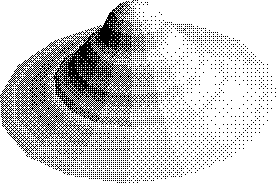
This figure illustrates the way language is actually used. In the center we have a very high frequency use of function words and inflectional endings that reflects the grammatical core of the language. If we push listening fluency before accuracy, we are in danger of encouraging or even forcing students who have not yet learned the central core, to ignore the central core as noise and to become functionally deaf to it. Most of this central core, including inflectional endings, are heard as "unstressed". Many would also appear to be "redundant" and not necessary for comprehension. Some texts that teach "listening strategies" will tell the student to "ignore" these parts of the language. However, if these core function words and common inflectional endings are not "heard", they soon become subconsciously treated as noise and the student will "learn" to become functionally deaf to them. The result will be language competence that looks more like a doughnut than a mound (see fig. 3).
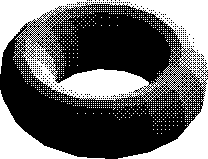
This, I believe, presents a graphic illustration of fossilization, and this is why it is so difficult to remedy. The grammatical "knowledge", the cognitive core, the central schema that controls language usage, is blocked out, and the person is left with a doughnut not a mound. Street learners, and people forced to speak prematurely, develop a functional deafness to the central grammatical core of the language; they develop a doughnut-shaped language model. All behavior is the control of perceptions previously learned (Powers, 1973). Speech is controlled through feedback by the model or mapping we create through listening. If the model is a doughnut, we speak like a doughnut.
If listening to non-comprehended input is bad, speaking prematurely, before the new language is learned accurately and solidly, is worse. First, we must understand that speaking a language is a result of learning the language, not a cause. People who advocate speaking as a means of learning the language are simply continuing to use the old behavioristic theories of language learning, the conditioning of verbal behaviors. They do not understand the distinction between the behaviorist "learning by doing" approach and the cognitivist "learn by viewing" approach that has come out of the cybernetic paradigm change in psychology. Many who claim they support the "cognitive approach" and reject the "behavioristic approach" still emphasis talking. As Postovsky put it,
Cognitive teaching is stimulus-oriented teaching. In a stimulus-oriented approach, performance or a motor response is not considered as essential to learning as it is in a behavioristic response-oriented approach. Performance is considered the product or indicator of learning. The learning itself occurs when the perceived stimuli become related to each other. In teaching foreign languages by a stimulus-oriented approach, practice in overt speaking is not required in order to learn to speak.
In a cybernetic systems view, learning a language is assumed to occur when the sound patterns of the language become related to each other phonetically and grammatically as well as related to other stimuli or stimuli traces semantically. Speaking is seen as an overt demonstration that the language was in fact learned. Cognitive teaching is stimulus-oriented teaching. In this stimulus approach a "motor" response is not considered essential, because what is learned is a perception not an action. On the other hand, a "selection" or "decision-making" response is considered essential. This can be either conscious or subconscious. Recognition is a decision-making process. Comprehension is a decision-making process. Recall is also a selection or decision-making process. Speaking, as an overt behavior, is controlled through feedback, by the model in the head. We "recall" in our head the sounds we want to hear our lips say, and then we use these sound images to control our speech. Practice speaking may help us "retain" the language, but it will not help us learn it. The expressive speaking stage should not be rushed. It should wait until the new language is learned. Premature speaking will simply freeze, fossilize, or habituate the language spoken, to the level learned at that point. This is because in a closed loop, whatever we say is also what we hear, and what we hear we say, and speaking errors provides us with error-filled listening. When repeated enough, our error-filled speech "sounds right".
All of this is obvious if we observe someone learning their first language. Children begin by conceptualizing and understanding their environment first. They learn how to move their body and overcome gravity. They learn visual distinctions. They see their father and their mother as different people, etc. They also listen to the sounds they hear and make connections between the sounds they hear and the concepts they are learning. They take in the sights and sounds of their environment and try to put them together in some meaningful way. As they begin to associate certain sound patterns with certain meanings, they gain some understanding, or what might be called initial listening comprehension. After gaining this understanding, they then may try to use the words as expressions for these meanings. And we should be clear on this: children learning their first language never spontaneously express a word they have not first meaningfully comprehended through their ears. The reason for this again is that it is the perceptual/conceptual sound/meaning pattern/model/schema built up during the comprehension process that guides their speaking behavior. This point is most dramatically demonstrated in the negative, when it is discovered that a child is deaf. Since a child cannot "hear" the sounds he is babbling, he cannot control his speech mechanism through feedback. Unless and until an internal mapping is made through sensory imput, there is no "reference condition" for feedback signals to be compared to. We cannot express what we have not taken in, because it is what we have taken in that controls our behavioral responses through cybernetic feedback control mechanisms. All "new learning" is taking in new information. Exercise or usage of that "new learning" requires that the "new learning" occur first. Children learning their first language are automatically limited to expressing only what they have already learned.
When we learn a second language, however, we already have a vast store of meaningful concepts as well as sound signal patterns in our head. In many cases, the learning of the second language involves a learning largely of a few new sounds, since many of the old sounds will transfer. It may also involve the learning of a few new concepts, since many of the old concepts will transfer. It is, however, in the combinations of sound patterns and the relationships between the sounds and the meanings that there is often a major difference. This is in the area we call syntax and grammar. Some syntax and grammar may transfer (particularly in cognate languages), but some new syntax and grammar must always be learned. In other words, second language learners must "cognize" certain parts of the verbal map such as "minimal pairs", certain parts of the cognitive map such as "social relationships", and probably a large part of the "relationship" or "grammar" between the two maps. Anything they do not immediately "recognize" they must first "cognize".
However, if speaking is required or even encouraged early, problems can be created. The individual can probably use some of the new sounds learned where they have been learned, and some of the new sound/meaning relationships where they have been learned, to behaviorally guide his speech through feedback looping, but this is limited to what he has already learned. When pressed to express himself beyond this limited learning, the second language learner is forced to substitute/transfer the old sounds and sound/meaning relationships etc. to express his ideas. Remember it is the model in the head that controls the speech. When the new model is insufficient, a second language learner can always resort to the first language model for feedback control. In fact, it will happen without conscious thought. If the only point of the speaking is communicating ideas (as with the "street learner" or the "classroom focused on talk"), then the speaker will be continually switching back and forth between old and new language models as a behavioral control device. This is why a Japanese will say "I had very fun". They have never heard a native speaker use that expression. It was "generated" through a "translation" process from their own Japanese language map. Three out of the four words get the point across. Communication has been achieved. The fourth word is ignored by a kind native speaker, and the student is never corrected. But as Mackey (1965) has pointed out,
Interlanguage is an unnecessary burden on the language learner. It is a potential source of error-plagued fossilization. Interlanguage is created in the first place because the adult second language learner is forced or encouraged to speak the second language before he or she has learned enough of the second language, particularly the core language. All behavior is the control of perceptions previously learned. Speech is controlled through feedback by the model or mapping we create through listening. If the model is a doughnut, we speak like a doughnut.
I believe the central core, the unstressed grammatical essence of a language, is a crucial part of the language. It is also clear that grammar is directly related to meaning. This meaning is often redundant and hence can be ignored when listening, but it is crucial when speaking. "Grammar" can and should be taught and learned through meaningful listening. It is not enough to provide the student with "comprehensible input" (teacher defined). We must insure that the student experiences "comprehended intake" (learner defined). This comprehended intake must include the grammatical core, the central high-frequency center of the mound image of language. While this may be difficult, or perhaps even impossible, in the present-day classroom arrangement, even in many of the existing LLs, it is clearly possible with a CALL system. Well-designed language learning through listening comprehension techniques may well be a perennial teaching problem that finally has a technological solution. At the end of the 20th century, in the middle of the "information age", after the tremendous changes brought about by the cybernetic systems paradigm shift, how can we continue to teach languages the same way we have been teaching them for hundreds of years, i.e., forcing our language students to speak?
CALL, Comprehension, and the Cure for Fossilization
How can we possibly believe that speaking a language before it is learned through listening will help someone learn the language? Speaking just forces students to listen to their own as yet incomplete and hence inappropriate model of the language. We must learn that it is in the studentsâ best interest to tell them to "shut up and listen" until they have internalized a solid core of the language. On the other hand, how can we possibly believe that simply listening to the sound language will result in language competence if it is done through haphazard exposure? If we are to avoid fossilization from drowning our students in a sea of sound, we must present listening exercises in a very systematic manner.
How can we possibly believe that listening to the sounds of a language that can not be comprehended will help someone learn the language? Listening to uncomprehended sounds turns them into noise, and noise we learn to become deaf to, functionally deaf. When students listen to speech that is too rapid for them, they are just hearing a lot of noise. Many students will try to overcome this by repetition. They will listen over and over again. This may be more harmful than beneficial. Zhao (1997) has demonstrated experimentally that as far as comprehension is concerned, repetition is not nearly as effective as slowing down the rate of speech. Where students have individual control over the rate of speech input, they can improve their comprehension and this improvement is much greater than if they can only control the repetition. The key to good language learning is progressive comprehension of the language, not just hearing the sounds of the language repeated over and over again.
In the audio-lingual days, speaking materials were very carefully and systematically presented. There are many reading programs today, in which the reading materials are carefully and systematically developed, sequenced, and presented. There are even writing programs that are systematically planned, carefully sequenced, and individually presented to students. The listening part of a language teaching program, since it should be the initial introduction to the language, should be even more carefully and systematically developed, sequenced, and presented to students in order to ensure that complete and accurate comprehension occurs every step of the way. At the beginning, the rate of speech input should be keep slow enough, with clear pauses, so that the learner can actually comprehend the meaning, not just hear the sounds. Later, as the presentation gets faster, there should still be a safety net for those who who can not understand at the faster pace. That safety net should be a way an individual learner can slow the speech down, not just repeat it.
If this requires a technological solution, so be it. If it requires a Computer Assisted Language Learning (CALL) system, then letâs create one or borrow one, or at least encourage our students to use one. If we start our students off with a systematic comprehension approach, we can teach the language more effectively and efficiently (Asher, 1977; Blair, 1982; Byrnes, 1984; Gary, 1981; Winitz, 1981), and we may avoid condemning our students to mediocrity. If we donât, are we willing to accept the moral responsibilities for the consequences? What we have done through ignorance and habit were not moral decisions. Once we have some understanding of the consequences of our actions, however, we must make a choice. Can we in good conscience continue to drown students in the incomprehensible sounds of a foreign language? Can we in good conscience continue to encourage them to talk, when we know they are not yet ready? Now that we do have the technological capacity to help students learn a language without speaking it, why donât we use it? How much longer will we continue to condemn our language students to mediocrity?
Asher, J. (1977). Learning Another Language through Actions: The Complete Teacher's Guide. Los Gatos, Cal.: Sky Oak Publications.
Bandura, A. (1977). Social Learning Theory. New York: General Learning Press.
Blair, R. W. (Ed.). (1982). Innovative Approaches to Language Teaching. Rowley, Mass.: Newbury House Publishers, Inc.
Byers, P. (1985). Conversation: A Context for Language. Nagoya Gakuin Daigaku Gaikokugo Kyoiku Kiyo, 13(Sept.), 27-40.
Byrnes, H. (1984). The Role of Listening Comprehension: A Theoretical Base. Foreign Language Annals, 17(4), 317-329.
Gary, J. O. (1981). Caution: Talking may be dangerous to your linguistic health. IRAL, 19(1), 1-14.
Higgs, T. V., & Clifford, R. (1982). The Push toward Communication. In T. V. Higgs (Eds.), Curriculum, Competence and the Foreign Language Teacher Skokie, Ill.: National Textbook Company.
Ioup, G., Boustagui, E., Tigi, M. E., & Moselle, M. (1994). Reexamining the Critical Period Hypothesis. Studies in Second Language Acquisition, 16, 73-98.
Mackey, W. F. (1965). Language Teaching Analysis. London: Longmans.
Nord, J. R. (1980). Developing Listening Fluency before Speaking: An Alternative Paradigm. System, 8, 1-22.
Piaget, J. (1967). Six Psychological Studies. New York: Random Press.
Postovsky, V. A. (1970) Effects of Delay in Oral Practice at the Beginning of Second Language Learning. Ph.D. Dissert., U. of California Berkeley.
Postovsky, V. A. (1975). On Paradoxes in Foreign language Teaching. , 59(1-2).
Powers, W. T. (1973). Behavior: The Control of Perception. Chicago: Aldine Publishing Company.
Rivers, W. M. (1986). Comprehension and Production in Interactive Language Teaching. The Modern Language Journal, 70(i), 1-7.
Schmidt, R. (1983). Interaction, acculturation, and the acquisition of communicative competence: A case study of an adult. In N. Wolfson & E. Judd (Eds.), Sociolinguistics and language acquisition (pp. 137-174). Cambridge: Cambridge University Press.
Smith, K. U., & Smith, M. F. (1966). Cybernetic Principles of Learning and Educational Design. New York: Holt, Rinehart & Winston.
Tomatis, A. A. (1963). L'Oreille et le langage. Paris: Editions du Seuil.
Valette, R. M. (1991). Proficiency and the Prevention of Fossilization:An Editorial. The Modern Language Journal, 75(iii), 325-328.
Winitz, H. (Ed.). (1981). The Comprehension Approach to Foreign Language Instruction. Rowley, Mass.: Newbury House Publishers, Inc.
Yngve, V. H. (1996). From Grammar to Science. Amsterdam: John Benjamins Publishing Co.
 Return to Nord Home Page