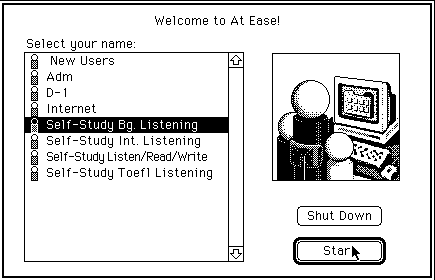
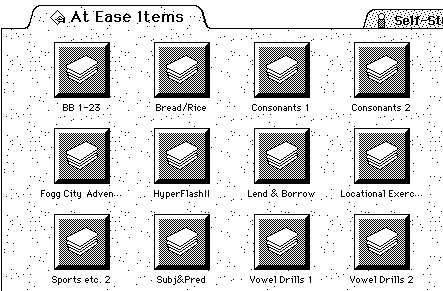
After clicking on the start button, the student will see the variety of individual programs available in that category. All of the programs in each category are displayed on a separate At Ease Folder.
The computers in JB-23 and JB-26 are being
used as teachers, language teachers, English language teachers. These
computer teachers teach primarily listening comprehension along with some
reading. This use of the computer is known as: Computer as Tutor.
The computer can be used in many ways. The way the computer is used
is determined by the application, program or courseware (software) used.
One of the most common ways the computer is used is known as: Computer as
Tool. In many of these cases the computer user uses software that
allows the computer to be used primarily as a tool such as a word processor,
i.e., a modern typewriter. There is also software that allows the computer
to be used as a communications tool. Web browsers such as Netscape,
allow users to seek out information on the World Wide Web (WWW), while e-mail
client servers such as Eudora and AL-Mail allow users to exchange messages
and information with each other. But when the computer is used to
encourage the students to “use” or “practice” the language, this may be
considered skill development, but it is not task learning. Students
can practice the language they have already learned, but should we not be
using the computers to help them learn the language in the first place?
Many of the human English language teachers
now use the computers as a language using tool. In many of these cases,
the computer is being used to enhance a previously developed curriculum.
For example, the computer is being used as a word processor in the courses
that teach composition. In some cases the computer is being used to “motivate”
students to practice and use the language they have already learned.
E-mail and the internet are often used to help motivate students into “using”
the language more. These are examples of language usage, language practice,
however, not language learning. In addition, these uses of the computer,
all involve primarily, the written form of language rather than the sound
form. While some learning may take place in this “practice” mode, it is neither
systematically presented, nor deliberately verified.
Is it not possible to use the computer directly
as a teacher also? Can we not use the computer as a tutor in areas
students need special attention? Can we not discover learning areas human
teachers have difficulty teaching and provide a technological solution?
This has been done very successfully in the teaching of the sciences, where
microscopes, time-lapse movie sequences, etc., are used very effectively
to teach concepts that human teachers find difficult to present with only
words as their communication tools.
A computer can be used in many ways.
Word processing, accounting and even the internet, are primarily valuable
ways businesses have used the computer and that’s why these uses of the
computer as tools have been given high publicity in the popular press. We,
at a university, should I believe, be concerned more with the computer’s
educational value. We should, I believe, be asking “How can we use
computers to improve education?” “How can we use computers to enhance
student learning?” “How can we use computers as teachers?”
Using computers as language teachers is
generally known as Computer Assisted Language Learning (CALL), but the word
“assisted” or sometimes “aided” is, I believe, somewhat misleading if not
down right demeaning. After all, we do not refer to programs in which
human teachers teach language as TALL (Teacher Assisted Language Learning)
even though that is what it is. CALL is thus an equivalent of TALL, or SALL
(Student Assisted Language Learning), a way an educational institution can
help students learn a language, a sound language.
This paper will report on one attempt to
create a CALL system at Nanzan. It has been in the development stage for at
least four years. It is now ready to be examined and used by a wider audience.
The primary focus of the CALL program is to teach the task of listening
comprehension. Listening comprehension is an area of great need for
most students. Because comprehension is a private and individual process,
it is an area which most human teachers find difficult to teach easily or
effectively. Even the present LL has some difficulty in this task.
When computers are equipped with sound capability and supplied with the appropriate
educational courseware, they can be used to teach the exacting task of developing
accurate listening comprehension.
When computers are used to teach listening
comprehension, they can be used directly as language teachers, not as add-on
tools to help the human teacher. When they are used directly as teachers,
as private tutors, the students can learn on their own. This is the
most cost-effective way of using the computer in an academic setting: as
a self-instructional teacher. Computers used as language teachers can save
both the students learning time and the school money.
And the students like the computer as a
tutor.1 They like the programs.
Some like the programs because they are fun. Some recognize that they
can learn things through the computer, that they can not learn in class
or in the LL. Some recognize that learning is their own responsibility,
and therefore come in often on their own, studying during their out of class
periods Others are encouraged to do so through a homework program
that directs them to specific programs aimed at their individual problems.
Many students are now being given computer assignments as a regular part
of their weekly homework. The is true not only of the Eibei students, but
also some of the students in the Integrated English classes. CALL programs
can be created for languages other than English as well. It is hoped
that the English CALL program can act as a stimulus to the other language
departments to start their own CALL programs by providing a working model.
The computer can, does and, I believe, should act as an effective language
teacher for the students at Nanzan for many years to come.
Creating a CALL program
The self-access English language teaching program was established for the practical purpose of helping students at Nanzan learn English more effectively and efficiently. It was also established to demonstrate the value of a CALL program to the faculty and administration. It is advisable, therefore, to review the rationale and purpose, i.e., the thought process, which led to the establishment of the program in the first place. As an educational technologist by training and profession, I have been conditioned to ask the following two questions when contemplating the use of educational technology in an educational setting: (1) Is it pedagogically sound? (2) Is it economically viable? I therefore pondered these two questions, attempting to answer them satisfactorily to myself, when I first contemplated the CALL project.
Pedagogical potential
When I considered the pedagogical potential
of the CALL system I reflected on two factors. I wanted to use the computer
in a way in which it could be effective, and I wanted to avoid duplicating
something a teacher or the LL was doing or could do. For pedagogical reasons,
I selected listening comprehension as the focal task for the CALL project.
This is based upon my belief in the pedagogical value of the comprehension
approach2 as the most effective and efficient means for language
learning. It is also based on the fact that is it difficult for teachers
or the LL to apply the comprehension approach, but very easy for the computer
to implement it.
The potential pedagogical value of CALL
for teaching the language through the receptive mode is generally well known
and accepted. The computer has the capacity to provide (1) the language
sounds of native speakers; (2) graphic images of the meaningful situational
context of the sound language; and (3) student control over the rate and
amount of input. The computer can present meanings in very direct
powerful ways, and always with each individual student. It can check
for accuracy of comprehension every step of the way. It can therefore
help the student build an accurate basic cognitive mapping of the language
and it’s meanings, without resorting to translations, or appealing to premature
language expression.
Teachers have trouble teaching the language
through listening comprehension. Most human teachers, who have only
their voices as communication tools, and who must usually teach a group of
students rather than individuals, find it difficult to ensure comprehension
through either listening or reading. They can usually present
the audio sounds of the language, but they can not present the meaning except
by indirect means through translation, drawings, acting, etc. Their ability
to judge the accuracy of comprehension of each individual student is also
limited. Human teachers can not deal with individual students on anything
but a superficial basis. The comprehension of each individual student must
be judged indirectly by insisting that the student respond in some way in
order for the teacher to observe them.
Even the existing LL has difficulty teaching
accurate listening. It is not difficult, of course, to expose student
to the sounds of the language in either the classroom or the language laboratory.
It is even possible to provide the students with what a teacher may believe
to be “comprehensible input,” but because every student is different, it
is not as easy to ensure that each student has absorbed “comprehended intake”,
i.e., achieved accurate comprehension.
The comprehension approach is a sound pedagogical
approach to language teaching. It is difficult to achieve with human teachers,
or in the LL, but it can be done quite effectively through the specially
developed courseware used in CALL. It was therefore the pedagogical strategy
of choice for the initial CALL project.
Economic potential
When I considered the economic potential
of the CALL system I reflected on two factors. I wanted to use the computer
in a way that would not require any additional funds from the university
until the pedagogical value was clearly demonstrated and I did not want
to require to involvement of a teacher in the process. I therefore used
only the existing computer facilities and I made the program a self-access
system. When teachers are directly involved in the use of the computer,
as when the computer is used in a composition class, then the costs of the
computer are additive, that is, they are costs in addition to the teacher’s
costs. When computers are used in a self-access manner, there are
no additional costs to the university. The computers exist waiting to be
used. Economically, a self-access listening comprehension CALL program at
Nanzan can be considered to have an excellent cost-benefit ratio.
The CALL program at Nanzan
In an attempt to demonstrate how the pedagogical
and economic potential of CALL can be transformed into a realistic program,
now and without additional costs, two rooms, JB-23 and JB-26 on the Nanzan
Yamazato campus have been transformed into self-access CALL rooms. JB-23
has the new PowerPCs and although they have a large hard disk, they can not
run some of the better educational software. The earlier versions of the
computer, if they have a large hard disk are more suitable to the existing
CALL program. Nevertheless, these new computers are used to provide many
of the educational programs for the students and can be used to provide newer
and better programs such as those on CD-ROM sometime in the future.
JB-26 operates as a fully useful self-access
CALL laboratory. This room contains a total of 30 computers. Twenty-three
of these computers were originally made available to the public about 10
years ago. As a result, they were originally equipped with only 40 megabits
of memory on their hard disk. This restriction has required some extra effort
to create a working CALL program, but it has been done. The seven computers
in the back row of JB-26 have greater hard disks capacity(150mb) and therefore
provide the basis for an excellent CALL system. The existing self-access
program in JB-26 with its mix of different size hard disks, does not represent
an ideal situation, but rather a realistic attempt to actualize the potential
that does exist. These computers have been used over the past five years,
primarily by students in the Eibei Gakka. They should be useful as language
teachers for at least another 5 to 10 years. As the value of the self-access
CALL program becomes recognized, by more and more administrators, faculty
and students, then upgrading some of the older computers in JB-26, by replacing
only their hard disks, would, at a minimal cost, provide the same program
for all computers that exists in those computers with larger hard disk in
the back row today.
While the CALL project is self-access, this
does not mean that the students have or should have complete freedom of
choice, i.e., of whether to use them or not and which language programs
to select. In the second year Oral Communication courses in Eibei,
students are assigned homework that includes using the CALL material.
The students are required to turn in evidence of their having done their
homework on a weekly basis. Thus the CALL program supplements the
classroom and the LL listening training without any additional costs in
personnel. To help individual students overcome certain individual
listening problems, teachers can assign other CALL homework specifically
designed to help the individuals improve their own specific language deficiencies.
Finally, students, once they are aware of what is available, can, on their
own, use additional CALL programs. For example, the TOEFL listening
practice materials have proven to be a favorite “voluntary” CALL program
for students who are scheduled to take a TOEFL test.
The task is not over. Additional courseware
should be collected, assembled and made available to students. Students
should be made aware of the courseware and be able to use them with a minimum
of extra effort. Teachers should create incentives to encourage the students
to use the courseware available. The stage has been set. It is now
up to the Nanzan language teachers to help the students take advantage of
the CALL potential.
What is available today at Nanzan
in JB-23 and JB-26 are computers with appropriate courseware that can act
as teachers to help students learn English directly on their own, at their
own pace and at their own level. These facilities are now available
to any student on campus who would like to improve their English ability.
All that is required for the students to use the new CALL courseware is a
knowledge of their availability and an incentive to use them. We also ask
students to bring an earphone, both to hear the sounds better, and to avoid
bothering their neighbors.
The friendly user interface of the computers
and courseware programs in the computers with the larger hard disks, allow
almost any student to access the programs and use them, with a minimal set
of instructions. For those totally new to the use of these computers, there
is a simple introduction, which tells them how to turn the computer on and
off, and how to navigate through the computer to start the program of choice.
(See appendix A and B.) Because of the easy graphic user interface (GUI),
this is about all a student needs to help them use the programs in computers
with the larger hard disk, although there are also guides to many of the
specific programs themselves. (See appendix C and D.) The use of the
programs on the older computers with the smaller hard disks in JB-26 is a
little more complex.
To help the students through the mechanics
of the program using the computer facilities with less hard disk capacity,
a number of additional guides have been created. These sets of printed handouts,
guide the student through, step by step, the basic procedures for finding
and obtaining the specific teaching program, i.e., transferring the programs
from the main frame computer (with its larger storage capacity) to their
own personal disks so that they can also use these older computers in JB-26.
(See appendix E)
Programs available in the JB-23/JB-26 CALL facilities
English language teaching programs have
been divided into a number of sub-categories. The following is an opening
view in one of the computers with the larger hard disk capacity.
After clicking on the start button, the student will see the variety
of individual programs available in that category. All of the programs in
each category are displayed on a separate At Ease Folder.
One category of programs includes those
programs designed to teach the students how to improve their pronunciation
by careful and precise listening. These programs generally involve teaching
minimal pair distinctions. Students can listen to these pairs, and practice
them any time and many times. There are “pure” listening programs,
both at an elementary level and an intermediate level. At the elementary
level there are simple listening programs to help the students build their
sound grammar and practice their core vocabulary.
At the advanced level, there are listening programs that challenge
some of the best listeners. There are advanced programs designed specifically
to help students improve their listening ability to improve their score on
the listening portion of the TOEFL test.
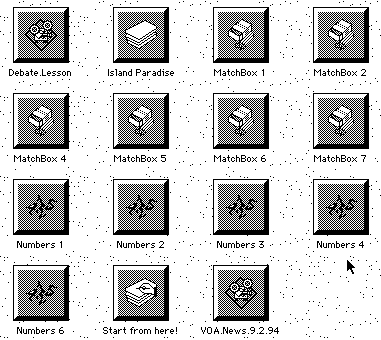
There are some programs that combine listening
and reading exercises. Many of these use interesting stories or unusual
articles from a newspaper. Some of these have proven very popular with
the students. They all have listening components along with a number
of other comprehension exercises.
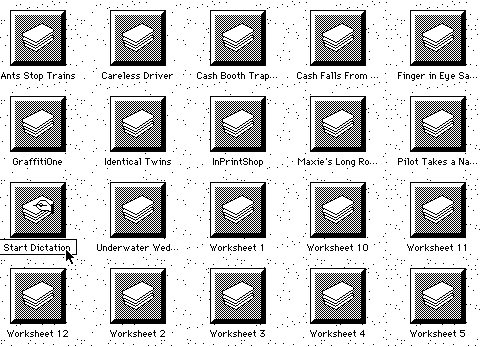
There are dictation exercises. These normally
include the three skills of listening, reading and writing.
But in this CALL facility, there are a range of levels of dictation programs.
There are lower level dictation programs in which the student does not have
to write anything, but rather selects the answer from a set of written alternatives.
There are also standard type dictation programs in which the student listens
to something and either writes down what they hear, or types in the correct
response to a question.
Dictation A - A sample CALL program
Appendix C provides a tutorial introduction to
the use of the Dictation series that forms the heart of the present Oral
Communications homework program, and which can be used by other English teachers
with equal ease. Pedagogical, the material has been specifically designed
to (1) provide useful conversational exchanges in common situations and (2)
focus on specific language reception problems such as reduced speech, use
of modals, and word endings. There are four major programs, A, B, C
and D. Within each, there are 8 lessons, and within each lesson there
are two basic exercises, a CLOZE exercise and a Dictation exercise.
Each lesson can be done within a 10 minute period by a native speaker although
most students seem to take about 30 minutes, and some as long as 45 minutes
per lesson. If two lessons are assigned each week, then the entire
series will be completed in a little less than two semesters.
From the teacher’s standpoint, the ease of administering
the homework is a strong plus. When a student completes a lesson,
the student can have their “score” printed. This can then be turned
into the teacher as proof of having done the assignment, as well as a record
of how well it was done and what parts caused difficulties. Teachers
can determine from these records whether students need more or different
type listening programs assigned or not. It can help the teacher determine
the level of other listening programs that should be assigned.
Where do we go from here?
Of course, this is only the beginning.
As new CALL programs are discovered or created, they will be added to the
inventory. Some of the existing English language programs available
to Nanzan students are, freeware or shareware, but some are products of some
of the Nanzan graduate students. More of these “home-grown” programs are
already on the drawing board. While the existing CALL facilities are presently
focused on English as a Foreign Language (EFL), there is no reason the same
approach can not be used to expand the CALL system to include programs for
Spanish, French, German or Japanese as a Second Language. Indeed,
a number of these programs have already been collected by the author, and
he is very willing to share these programs with anyone interested in building
up their own CALL program.
The use of the computer as a teacher is a natural
role of the computer in an educational institution such as Nanzan. This
role will expand as the pedagogical and economical advantages become more
evident. The CALL system created for the teaching of English as a
foreign language at Nanzan that was described in this paper is a simple
beginning. It can, however, serve both as a stimulus and as a model for
larger more effective and efficient CALL systems in the future. But the
future does not just happen. We create the future. We invent the future
with our decisions and our actions today. The future of CALL at Nanzan is
up to all of us.
NOTES
1. The following are a few typical comments made by students in evaluating
the programs. These are unedited, exact reproductions.
“In language teaching, computer is very helpful for learners to develop
their skills of listening and reading. Each learner wants to learn
different things and has each different level, so in classroom, it is very
difficult to matach all of their levels or to teach what each person wants
to learn. But, with computers, learners can select the program that
is appropriate to their levels and they can also learn what they want to
learn. In addition, a lot of learners can learn language through one
program whenever they want to learn with computers. It is very efficient
and convenient. For the reasons mentioned above, computer is one good
method in language teaching, in other words, it is a good teacher.”
“What I liked best was Listening program. When I knew Mac has
many programs to learn Englich, I couldnot help introducong my friends to
such a fascinating programs!”
“In classrooms of junior high school and high school, it is impossible
for teachers to adjust them to all student’s level. In terms of adjusting,
computers are better English teachers than human beings.”
“I think the computer is a good teacher for students to study. In
the class, one teacher cannot adjust to the levels of all the students.
However, by using computers to study English as a teacher, students can study
at their appropriate levels.”
2. The Comprehension Approach was first suggested by Palmer (1917). It was focused on in the 1970’s by people such as Asher(1969, 1981), Gary (1978, 1981), Nord (1975,1980,1981), Postovsky (1970,1974,1975) and Winitz (1973, 1981) It is based upon the principle that all task learning including language learning is perceptual learning, not response learning, and that overt expressive motor behaviors such as talking are controlled through feedback, by the perceptions learned. see for example (Bandura,1977) (Brown,1982) (Fairbanks,1954, 1955), (Grossberg, 1982,1986,1987) (Nord,1983,1985,1986) (Powers,1973) and (Wiener, 1948,1950). It should not be confused with “the input hypothesis” (Krashen,1985) which emphasizes exposure to “comprehensible input” rather than the comprehension approach’s insistence on “comprehended intake”. Since speech rate (not repetition) is a primary variable in comprehension (Griffith,1990,1991) and beginning language learners comprehend at different speech rates, it is difficult to ensure comprehension when the student can not control his own speech rate. Students can control the speech rate with a computer and it produces a significant improvement in their comprehension. (Zhao, 1997)
 Return to Nord Home Page