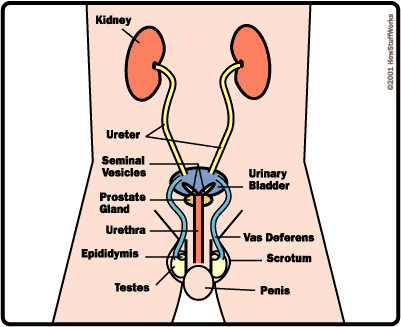
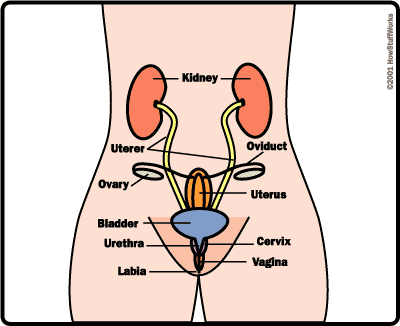
The man's brain sends nerve impulses to the blood vessels in his penis and tells the arterioles to dilate and the venules to constrict. The blood flow engorges the spongy tissue of his penis, causing it to become erect. As the couple engages in intercourse, the man inserts his erect penis into the woman's vagina. As intercourse continues, the man reaches a point at which muscle contractions in the epididymis, prostate and seminal vesicles propel semen from the penis into the woman's vagina (ejaculation) at the base of the uterine cervix. Muscle contractions in the woman's body periodically dip her cervix into the semen.
Once the semen is deposited at the base of the uterus, the sperm begin a long journey to fertilization.
The long journey to fertilization must be completed
within 12 to 48 hours, before the sperm die. They must first cross the barrier
of the cervix, which will be thin and watery if the woman has just ovulated (for
our purposes, we will assume that sexual intercourse has occurred within a
couple of hours after ovulation).
Once the sperm have traversed the cervical mucus, they travel up the moist
lining of the uterus into the Fallopian tubes (only one of the Fallopian tubes
contains an egg, so many sperm travel in the wrong direction). Fewer than 1,000
sperm out of the millions in the semen actually reach the Fallopian tubes.
Many sperm surround the egg in the Fallopian tube. The head of each sperm (acrosome) releases enzymes that begin to break down the outer, jelly-like layer of the egg's membrane, trying to penetrate the egg. Once a single sperm has penetrated, the cell membrane of the egg changes its electrical characteristics (depolarizes). This electrical signal causes small sacs just beneath the membrane (cortical granules) to dump their contents into the space surrounding the egg. The contents swell, pushing the other sperm far away from the egg (cortical reaction). The other sperm die within 48 hours. The cortical reaction ensures that only one sperm fertilizes the egg.
The fertilized egg is now called a zygote. The depolarization caused by sperm penetration results in one last round of division in the egg's nucleus, forming a pronucleus containing only one set of genetic information. The pronucleus from the egg merges with the nucleus from the sperm. Once the two pronuclei merge, cell division begins immediately.
The dividing zygote gets pushed along the Fallopian tube. By approximately four days after fertilization, the zygote has about 100 cells and is called a blastocyst. When the blastocyst reaches the uterine lining, it floats for about two days, finally implanting in the uterine wall by the sixth day after fertilization. Once implanted, the blastocyst secretes hCG, which rescues the corpus luteum and signals that a successful pregnancy has begun.