|
|
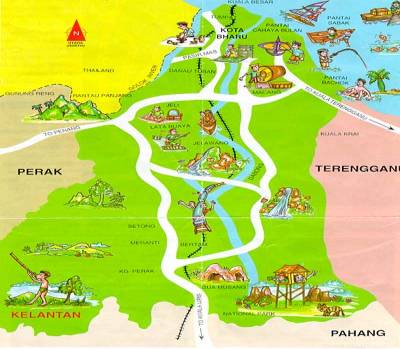
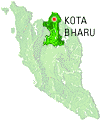
Kelantan is
located in the northeastern corner of Peninsular Malaysia.
It has an area of 14,931 square kilometres. Kelantan
can boast of a rich and colourful history. Often intriguing, some times
controversial, but always fascinating.
For centuries, Kelantan was all but separated from the rest of the country
by the Main Range, a series of mountains running from north to south
through the peninsula. Weeks of hard travel were required to reach
Kelantan. The "easy way" to Kelantan was to sail around the
peninsula, braving the sea and pirates. For this reason Kelantan's history
often involves the sea, and boats. Even today, many of its people are very
much tied to the sea. A discussion with many coastal residents will
confirm that their ancestors as far back as they know, were "of the
sea."
|
 Kelantan which means 'The Land of Lightning', faces the
South China Sea on the east, shares a common border with Thailand in the
north-east, Perak in the north-west, Pahang in the extreme west and Terengganu
in the south-east. The state is noted as the cradle of Malay culture.
Kelantan which means 'The Land of Lightning', faces the
South China Sea on the east, shares a common border with Thailand in the
north-east, Perak in the north-west, Pahang in the extreme west and Terengganu
in the south-east. The state is noted as the cradle of Malay culture.
Primarily
an agricultural state with padi, rubber and palm oil as the main economic
activity, life-stock breeding and fishing are equally important. Kelantan is
also renowned for its traditional cottage industries chiefly gold and silver
brocade weaving, brassware and batik printing.
The
people of Kelantan, peace loving and friendly by nature, are rich in tradition
and have such exciting pastimes as kite flying, top spinning, shadow play
theatres and bird singing competitions, to name a few of the more popular
sports. Due to its closeness to Thailand and having been under Thai domination
intermittently until 1909, a lot of Thai influence can be seen in the customs
and traditions.
Brief
Kelantan History
History
of Kelantan dates between 8000-3000 B.C. Chinese historical documents chronicle
the existence of a government which had links with China, when Kelantan was
referred to as 'Ho-lo-tan'.
 The
early history of Kelantan is rather obscure. The territories of
Kelantan
and Patani came under Siam in the 14th century. Around 1411, Raja
Kumar, the ruler of Kelantan, became independent of Siam and Kelantan
became an important centre of trade by the end of the 15th century.
The
early history of Kelantan is rather obscure. The territories of
Kelantan
and Patani came under Siam in the 14th century. Around 1411, Raja
Kumar, the ruler of Kelantan, became independent of Siam and Kelantan
became an important centre of trade by the end of the 15th century.
In
1499, Kelantan was conquered by forces of the Malacca empire and became
its vassal state. With the fall of Malacca in 1511, Kelantan was
divided up and ruled by petty chieftains.
With the
conquest by the Siamese in 1603, most of the Kelantan chiefs became subject to
Patani. Around 1760, a petty chieftain of Kubang Labu in Kelantan succeeded in
unifying the territory of the present Kelantan. Soon after in 1764, Long Yunos
seized the throne and proclaimed himself Raja of Kelantan. With his death,
Kelantan came under the influence of Terengganu.
In 1800, Raja Muhammad declared
himself as the first Sultan of Kelantan. In 1812, he broke from Terengganu's
influence and became a separate tributary state of Siam. In 1831, Siam divided
up the old Malay Kingdom of Patani into 7 provinces each under a Siamese
Governor. Siam played an important role in Kelantan throughout the 19th century.
In the 1909 Anglo-Siamese treaty, Siam surrendered its claims over Kelantan,
Terengganu, Kedah and Perlis in exchange with the British government for
territorial claims in Siam. Kelantan thus came under the control of the Straits
Settlements as one of the Unfederated Malay States.
Kelantan was occupied by the Japanese on 8th December, 1941. After the defeat of
Japan on August 1945, Kelantan and the rest of Malaya came under the British
Military Administration in September 1945.
Kelantan became part of the
Federation of Malaya on 1st February, 1948 and together with other states
attained independence on 31st August, 1957. On 16th September, 1963, Kelantan
became one of the component states of Malaysia.
Kota Bharu
Kelantan
is perfect for the traveller who wants a laid back holidy. Let us begin our tour
of the state from the state capital of Kota Bharu (New Fort).
Situated
on the north bank of the flood-prone Sungai Kelantan (Kelantan River), it is the
centre of the fertile rice basin and home of the traditional Malay arts and
crafts and traditional pastimes. Kota Bharu can be reach by air, rail, road and
sea. The recent opening of the scenic East-West Highway has greatly reduce the
travelling time from the West Coast to the East Coast.
If
one should travel by road in Kelantan one will not be surprised to see yet other
women at work, cooking sweet corn by the roadside, tilling rice and tobacco
fields, ballering fish on the beaches, weaving silk and painting batik in
traditional style.
Kota
Bharu is also the home of the Kelantan Royal family. Situated between Jalan
Hilir Kota and Jalan Hulu Kota and protected by a high wooden wall whose gates
are elaborately carved, is the Istana Balai Besar (The Throne Room), the
Audience Hall and the Royal Palace. It is also houses the State Lagislative
Assembly Hall. Built in 1844, the palace presently serves as the venue for the
important royal funtions and ceremonies.
Around Kota Bharu
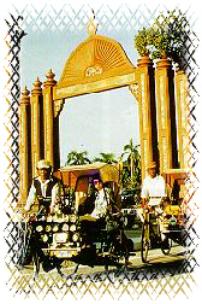
Trishaw in
Kota Bharu better known as “teksi” by
local
The center of Kota Bharu, hugging the eastern bank of
Sungai Kelantan, is based on a grid pattern, with a busy roundabout sporting a
curious pink rocket-like clock tower marking the junction if the three major
roads; Jalan Hospital, Jalan Sultan Ibrahim and Jalan Temenggong. The area
surrounding the clock tower is where you’ll find most of the shops, banks and
offices, while around Jalan Padang Garong, a few block to the north, are Kota
Bharu’s markets.
Further north still, close to the river, the quiet oasis of Padang Merdeka marks
Kota Bharu’s historical center, a compact square of fascinating buildings.

With so much to see on the streets themselves, it’s
easy to overlook the State
Museum and the Gelanggang Seni (Cultural Center), south of the clock tower,
which give a rather more ordered visual documentation of Kota Bharu’s cultural
inheritance. Most of these sight are within easy walking distance of each other
and, at a stretch, you could complete a tour in a day, perhaps taking in a show
in the evening.
ROAD MAP OF KOTA BHARU
PLACES OF INTEREST
CULTURAL
ZONE
1. Cultral
Centre
13. Istana Jahar (Royal Custom Museum)
2. State Museum
14. Royal Museum
3. Silversmith
15. Islamic Museum
4. Batik / Songket Centre
16. War Museum
5. Semasa Batik Factory
17. Handicraft Village & Craft Museum
6. UDA Shopping Arcade
18. Istana Balai Besar
7. Antique Shopping
19. Merdeka Square
8. Buluh Kubu Bazaar
9. To Cottage Industries Area/PCB/Kite Making Area
10. New Central Market
11. Old Market
12. Night Food Stall / Night Market
IMPORTANT
PLACES TRANSPORTATION
20. Tourist Information Centre 32. Malaysia Airlines (MAS)
21. Cultural and Arts Office 33. Local Bus Terminal
22. Kota Darul Naim (State Assembly Hall)34. Mini Bus Terminal (To PCB)
23. Police Station 35. External Express Bus Station (SKMK) Langgar
24. Custom Office 36. External Bus Station
(Ipoh, Seremban, Malacca
25. General Post Office
- Jalan Hamzah)
26. Telecom / Telegraph Office 37. Internal & External Taxi Stand
27. Federal Office Building / Immigration Office
28. Royal Thai Consulate
29. General Hospital
30. Women's Institution
31. Public Dentist
The
Tourist Information Centre
 The Kelantan Tourist Information
Centre, also known by locals as TIC, is the best place to begin a trip to
Kelantan.The Tourist Information Centre (TIC) is located at Jalan Sultan Ibrahim in Kota
Bharu; a short distance from the clock tower, and next door to the Kelantan
State Museum.
The TIC is the place for
obtaining maps, schedules of upcoming events, such as demonstrations at the
Culture Centre, and arranging for licensed guides .
The Kelantan Tourist Information
Centre, also known by locals as TIC, is the best place to begin a trip to
Kelantan.The Tourist Information Centre (TIC) is located at Jalan Sultan Ibrahim in Kota
Bharu; a short distance from the clock tower, and next door to the Kelantan
State Museum.
The TIC is the place for
obtaining maps, schedules of upcoming events, such as demonstrations at the
Culture Centre, and arranging for licensed guides .
Here you can make arrangements
for a river safari to the upper reaches of the Kelantan River or "Ulu",
jungle trekking or participate in the "Homestay Program"
This is the best place to begin
your trip to Kelantan.
Always available are maps, brochures and schedules of upcoming special events,
such as traditional games competitions and festivals. In addition to obtaining
schedules for the Cultural Centre and you can even obtain bus schedules here
too. The knowledgeable staff is always ready to answer questions, and provide
guidance to help make your stay in Kelantan much more enjoyable.
On display (and for sale) are many traditional crafts that you will come across
during your journey here in Kelantan such as silver jewellery, woodworking,
bamboo weaving, batik, Songket, and pottery.
Phone (609)748-5534
Fax:: (609)748-6652
Cultural
Zone
Many of the tourist attractions in Kota Bharu are conveniently located
in the cultural zone, thus making it easily accessible.Take a leisurely
stroll down Jalan Sultan and Jalan Hilir Kota and
check out these places. They offer an invaluable insight into
the history of Kelantan.
Opening hours are from 10.30 am to 5.45 pm daily except Fridays. The
admission fee is RM2.00 for adult and RM1.00 for
children.
Admission
is free except for the Royal Museum, Islamic
Museum,
Syura Hall, Royal Custom Museum and Craft
Museum.Please also note that the Istana Balai does not admit visitors.
Handicraft Centre
(Gelanggang Seni)
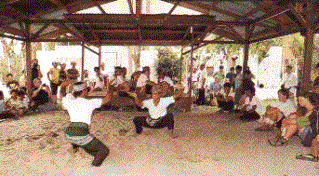
The Kelantan Arts
Centre is a
must on every visitor's itinerary. Here one can see tantalising performances and
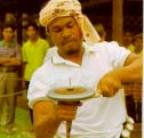
demonstrations of top-spinning (gasing), kite-flying (wau), shadow puppet-play (wayang
kulit) and silat (malay's martial arts), the traditional Malay arts of self-defence
on Wednesdays and Saturdays. Also available here are the traditional art forms
of Dikir Barat and Rebana Ubi. This is specifically Kelantanese music and
different to anything never heard before. One can also see exhibits of Islamic
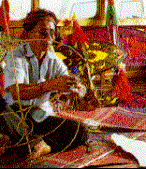
architecture and witness demonstrations of ceramic manufacture, textile and silk
weaving.
 Kelantan
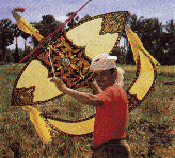
is hailed as the cultural haven of Malaysia. It is here, at the Cultural Centre
or Gelanggang Seni that you can witness Kelantan's rich culture heritage. Watch
giant kites chase each other playfully in the azure sky, see tops the size of
dinner plates spin rantically for hours and listen to the rich resonance of the
rebana ubi (drums).
Kelantan
is hailed as the cultural haven of Malaysia. It is here, at the Cultural Centre
or Gelanggang Seni that you can witness Kelantan's rich culture heritage. Watch
giant kites chase each other playfully in the azure sky, see tops the size of
dinner plates spin rantically for hours and listen to the rich resonance of the
rebana ubi (drums).
In the evenings,
cultural performances such as the Malay Traditional Music
and wayang kulit take centrestage. The wayang kulit or shadow play, is a
unique form of theatre inspired by the great Hindu epics, the Flamayana and
Mahabrata. The tok dalang manipulates the puppets (made from buffalo hide and
mounted on bamboo sticks) and modulates his voice to create drama and suspence.
Showtimes: 3.30 pm -
5.30 pm (Sat, Mon & Wend)
9.00 pm - 11.00 pm (Sat & Wed)
Admission: Free
THE HISTORICAL PLACES
Merdeka Square (Dataran
Merdeka)
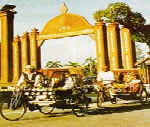
This is actually a World War 1 memorial to the unknown heroes
and is located between the
Masjid Muhammadi and the Balai Besar. Originally known as Padang Bank
(Bank Field), it took on its new name Dataran Merdeka (Merdeka
Square) when the country achieved its independence from British Colonial in
1957.
Previously known as Padang
Kelupang, Merdeka Square is one of many such central civic spaces in Malaysia.
The British built most of the country's padangs as central open spaces around
which revolved the buildings, and the life, of the colonial administration.
Merdeka Square rose to prominence in 1844 after the completion of the
Istana Besar.
Istana Balai Besar

This palace was built by Sultan Muhamad II in 1840 to replace
his riverine palace on the Kelantan river. It now serves as the venue for
ceremonial functions and investiture ceremonies.
In
close proximity to the Balai Besar is yet another imposing palace built in
1887 by Sultan Mahmud II. The palace displays carved wooden panels and
intricate wooden framework. It was recently renovated and converted as
the Royal Custom Museum and houses many valuable historical and cultural
artefacts. In the same vicinity is the Muzium Di Raja (Royal Museum). It is
housed in massive blue-white concrete building and is commonly referred to as
the Istana Bata (The Brick Palace). This
museum displays a variety of royal arts and artefacts as well as historical
paraphernalia.
State Mosque

Along Jalan Sultanah Zainab is the Masjid Muhammadi
(State Mosque). This mosque took
ten years to build, i.e., from 1916-1926 during the reign of Sultan Ismail.This mosque is a hive of activity on Fridays when
thousands of Muslims throng the prayer halls. The streets outside are busy with
hawkers peddling a variety of wares, from religious books, chanting beads,
headgear of sorts and traditional medicines.
Visitors are required to seek the permission of the
caretaker before entering. They should be properly attired and should remove
their shoes.
Masjid Kampung Laut
Believed to be one of the oldest mosques in Malaysia. The mosque was actually
dismantled and rebuilt piece by piece from its original site at Kampung Laut
because floods from the nearby river threatened its structure. The mosque was
built entirely without the use of nails. It is located at Nilam Puri.
Buddhist
Wat (Buddhist Temple)
On the outskirts of Kota Bharu one can see a number of
Buddhist Wat (Temples) which are reminders of ancient Thai influence in the
State.
One of the most famous wats is the Wat Phothivihan, situated in the
village of Kampung Jambu in Tumpat which has sizeable number of Thai followers.
This temple houses a 40-meter long, 11-meter high reclining Buddha which is believed to be one of the largest statues in the world and the largest reclining
Buddha in South-East Asia. One can see swallows freely nesting in the ear lobes
of the statue.
At Repek in Pasir Mas, Kelantan is the oldest and
prettiest Thai temple, the Wat Uttamara. This colourful wat has fanciful
flame-like upturned-roof ridges and an orange and green multi-tiered roof. Large
dragons entwine the veranda columns.
MUSEUMS
Museum
Of Royal Traditions And Customs
Built
in 1887 by Sultan Muhamad II for his grandson Long Kundur, this former palace,
Istana Jahar, is now a museum. The intricate wood carvings are testimony to the
superb craftsmanship of the Kelantanese. Photographs, artefacts and exhibits on
Kelantan's rich cultural heritage will keep visitors enthralled.
Royal
Museum / Istana Batu
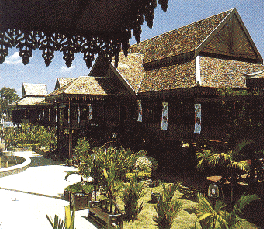
Istana
Batu was designed and built in 1939 during the reign of Sultan Ismail I. It was
used as a venue for royal weddings as well as to house royal guests. Today, it
has been converted into the Royal Museum where regalia and palace items
belonging to former Sultans are on display.
These include
silverware, bedroom items and furniture from the royal household. There is also
a photographic exhibition on the life of the late Sultan of Kelantan. Admission: RM2.00
Islamic Museum / Syura Hall

Adjacent
to the mosque is the State Religious Building which also doubles as an Muzium
Islam (Islamic Museum). Built in 1924, this building sprouts a unique
Pattani (Southern Thai), style roof.
The history of Islam in Kelantan is well documented in the artefacts and
inscriptions exhibited here. The setting-up of the Islamic Museum is timely as
Kelantan is one of the centres of Islamic Learning.
War
Museum
The War Museum occupies
the oldest brick building in Kelantan, dating back to 1912. This historic
building now houses Japanese memorabilia and documents relating to World War
Two.
KAMPUNG
EXPERIENCE
Savour
the hospitality of a typical Kelantanese family by opting to stay with a family
of your choice. This unique homestay programme enables you to get an insight
into the culture and lifestyle of these simple folks. You can choose to be
"adopted" by any of these: potter, fisherman, kite maker, batik
manufacturer, silversmith, top-spinning crafts-man.
Get in touch with
the Tourist Information Centre or your hotel receptionist who will be able to
make the necessary arrangements.
Fishing Village
No visit to Kelantan would be complete without a trip to a fishing village
dubbed "the soul of Malaysia's East Coast". Two of the most well-known
village are Sabak Beach (approx. 14 km from Kota Bharu) and Kuala Besar (15 km
from Kota Bharu).
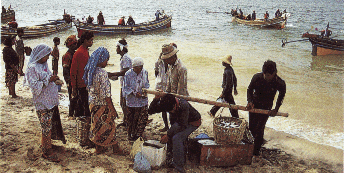
If you wish to fully capture the moment, you should arrive
no later than 2.30 pm, when the boats laden with the day's catch are first
spotted on the horizon. As they come ashore, their intricately carved prows are
a riot of colours. Then the bargaining begins between wholesales and the
fishermen - a noisy but interesting ritual.You will also be able to witness
other related activities such as fish-curing and the mending of nets.
 Buses no 8 and 9 depart
every half hour from the old market terminal to Sabak Beach.
Buses no 8 and 9 depart
every half hour from the old market terminal to Sabak Beach.
Bus no 28 leaves from the new central market to Kuala Besar every half hour.
Kelantan Silver
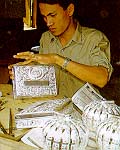 Kelantan
silver is renowed or it intricacy of design and superior workmanship.
Silversmiths use two kind of techniques - filigree and repousse. Item range from
the functional to the purely ornamental and include fruit bowls , tea sets , ash
trays, brooches and bracelets.
Kelantan
silver is renowed or it intricacy of design and superior workmanship.
Silversmiths use two kind of techniques - filigree and repousse. Item range from
the functional to the purely ornamental and include fruit bowls , tea sets , ash
trays, brooches and bracelets.
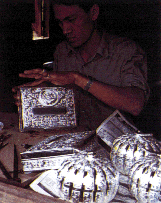
You
can visit the silvercraft factory at Kampung Sireh (along Jalan Sultanah Zainab),
Kampung Marak or at Kampung Badang on the road to Pantai Cahaya Bulan.
Open
from 8.30 am to 5.00 pm daily except Fridays.
Songket Weaving

Songket
, aptly dubbed Malaysia's "cloth of gold" is a proud legacy of the
Kelantan and Pattani courts. Once strictly reserved for royalty, songket is now
used for ceremonial occasions and weddings . Richly woven with gold or
silverthreads, songket was the dramatic consequence of the region's early trade
with China (which supplied the silk) and India (gold and silver threads)..
You may like to visit a Songket - weaving factory at
Kampung Penambang , about 4 km north of Kota Bharu
|
Songket belongs to the brocade
family of textiles. It is a rich, luxurious, ceremonial fabric, handwoven in silk or cotton, and intricately patterned with gold (and sometimes
silver) threads which stand out in subtle relief on the background cloth. The interplay of light and gentle shadow on the fabric creates a gorgeous shimmering effect, making
it undoubtedly, the 'queen' of handwoven fabrics.
The
term 'songket' comes from the Malay word menyongket, ‘to embroider with
gold or silver threads’. Strictly speaking, songket is not
‘embroidered’.
It is woven using what is
commonly referred to as the supplementary weft technique. In the songket
process, extra (supplementary) metallic threads are inserted in special
lengths in between the silk weft (latitudinal) threads of the main
background cloth.
These special lengths - or
weft ‘floats’ - pass over three, five, or seven silk warp
(longitudinal) threads and under one on the loom to form designated
patterns which contrast in colour and texture with the ground cloth. It is
these even-sized metallic floats forming distinctive patterns, which
distinguish songket from other types of hand-woven textiles. On antique
pieces, the contrast in texture between
the
background cloth and the songket weaves is more pronounced since the gold
threads was usually rounded and made by winding the gold filament round a
thick core thread.
The amount of gold patterning
in each length of cloth varies. Some pieces are completely filled with
intricate designs and are known as songket penuh (literally, ‘full of
gold thread’). Such pieces are usually worked on a darkish red silk
background which highlights the complexity of the gold patterning. Others
have relatively little gold songket decoration, perhaps a sprinkling of
motifs on the main body of the fabric, but, with more heavily decorated
borders.
Up until the early years of
the twentieth century, an even more sumptuous woven fabric, kain limar,
sometimes referred to as kain limau, was part of the weaving tradition of
Peninsular Malaysia.
Although the beginnings of
songket and kain limar weaving in the Malay Peninsula remain obscure,
historical accounts point to a long tradition of weaving in the Peninsula,
stimulated no doubt by the flourishing trade that had been going on
between the East and the West since at least the thirteenth and fourteenth
centuries. While traders from Europe, Persia, Arabia, and China sought
ivory, tortoiseshell, hardwoods, resins, waxes, rattan, and tin from the
Malay Peninsula and its rich hinterland, these were traded for basic
necessities, such as pottery, rice, and sugar, and luxury items, such as
silver, gold, and skeins of Chinese silk for weaving.
Since the sixteenth century,
at least, trade in textiles was active, both on the East Coast and West
Coast of the Peninsula. Kelantan and Terengganu on the East Coast were not
only trading with China, India, and Europe, but also had two centres of
limar weaving under the influence of Indian immigrants.
The place of origin of songket
weaving remains a mystery. Most Kelantanese interested in the history of
songket weaving believe that the technique came from the north, around
Cambodia and Siam, and then travelled south, via Patani, to Kelantan and
then to Terengganu. However, the belief in Terengganu is that songket
weaving was introduced from India via the Sumatran kingdoms of Palembang
and Jambi, where it probably originated during the time of Sri Vijaya.
During the Second World War,
songket weaving naturally suffered a decline owing to the scarcity of silk
and of gold threads and the lack of demand for luxury fabrics during hard
times.
Today, songket weaving is
largely confined to the East Coast states of Kelantan and Terengganu, and
to a lesser extent, Pahang, where it is organised as a cottage industry.
It is also carried out in the tourist centres of Johor and Selangor.
The traditional selendang, or
shawl, was made mainly lightweight silk tied-and-dyed kain limar with gold
songket borders at the warp ends and occasionally narrow gold borders
along the complete length of the fabric. Sometimes the body of the kain
limar selendang was woven with scattered gold songket flowers. But,
generally, a kain limar selendang was not as heavily encrusted with gold
embellishment as the kain panjang (long shawls),and was usually without
borders along its length.
In former days, in Kelantan,
some of the women wore a songket sarong with a kemban (breast-wrapper) for
special festive and ceremonial occasions. The kemban was an untailored
garment, formed from a soft kain limar selendang, which passed under the
arms and wrapped around the upper parts of the body. At the waist, the
kemban was held in position with a broad songket or gold belt, and
fastened in the middle with a buckle or pending. Another soft selendang
was modestly draped over the shoulders. This style was made famous in
Kelantan by the legendary queen ruler of Kelantan during the sixteenth
century, Cik Siti Wan Kembang, and this style thus named after her.
However, today only dancers use this costume for traditional court dances
and in dramas.
The Malay women weavers of
Kelantan and Terengganu are surrounded by nature. They live in kampongs
(villages) near the sea, rivers, and hills, and are surrounded by trees,
fruits, flowers, chickens, ducks, birds, bats, grasshoppers, butterflies,
and other elements of nature. Their looms are usually situated under their
houses, which are built on stilts and are open to nature, or on the airy
verandahs, or in their homes near low windows. Nature is thus very much
around them - indeed, just a glance away.
Although it
is difficult to predict the future of the songket weaving industry, there
still exists an impressive songket weaving tradition in Malaysia supported
by skilled and talented weavers. Even though much of the modern songket
cannot compare in design and craftsmanship with the earlier pieces,
weavers will continue to incorporate new design elements into their
products in order to meet changing demands. It is hoped that songket will
continue to be a treasured part of the contemporary aesthetic life of
Malaysia.
|
Batik Printing
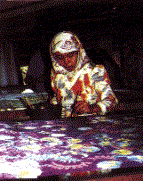 Batik
is indigenous to Kelantan . The first cotton sarungs were printed using the
stamp block method but since then newer methods and diffrent materials have been
employed.
Batik
is indigenous to Kelantan . The first cotton sarungs were printed using the
stamp block method but since then newer methods and diffrent materials have been
employed.
A visit to the Batik factory gives an insight into the entire process of batik
printing . Some of the bigger factories are at Kampung Puteh , Kubur Kuda and
Kampung Badang.
Open
between 8.30 am - 5.00 pm everyday except Fridays.
Wood Carving
Kelantan's woodcarvers
are some of the best in the region. They produce lovely mirror frames, panels,
lamp stands and headboards. Floral motifs are the norm.
Kite Making
Kelantan is the home of giant kites that soar through
the air with nary a care in the world. Kite-flying usually takes place after the
harvest when farmers have time on their hands to fashion and fly these wau. There
are many different types - wau kuching ( cat kite ), wau merak (peacock kite),
wau bulan (moon kite ) to name of few.
Kite making require tremendous skill and patience . The
art is usually handed down from father to son . Along the road to Pantai Cahaya
Bulan , there are many such establishments producing these gaily-decorated
kites.
These establishments can be reached by boarding Bus No
10 in front of New Central Market.
Boat Building
The
Kelantanese are masters of the art of boat-building and the secrets of this art
are normally passed down from father to son. The little fishing village of Tumpat
is synonymous with expert boat builders of the country. Here boatman build their
boats from the experience and intuition. In order times some of these boats used
to have some strange and fantastic forms attached to the prows. These
could be in the shape of Bangau (Cattle Egret) or Garuda (a Demonic Birdman).
However, the introduction of engines since 1950's began to spell the demise of
the 'bangau' and 'garuda' but some of them still remain as exhibits to this day.
Shopping
Kelantan is a shopper's heaven with not only traditional
handicrafts on sale but a wide selection of goods from across the Thai border as
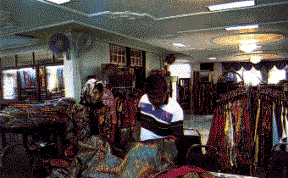
well. Gorgeous silk kaftans,
batik scarves, silver trinkets and rich songkets all vie for attention. Baskets
of every hue, handbags woven from mengkuang and place mats are also on sale.
The shopper will find endless delights to captiveate him.
Bargaining is part of the excitement. Often, a little patience will get you the
best prices. You can stop at the bazaar, shopping complexes and the New Central
Market.
New Central Market (Pasar Besar Siti Khadijah)
The heartbeat of the town is at the central market where
women traders sell cakes, spices, sweetmeats, preserved food, dried seafood,
fresh fruits and vegetable, Kelantanese cuisine, local batik and
handicrafts. Kelantan's Central Market is one of the most colourful
markets in Malaysia to this day. The smell, the colours, the hubbub, the
abundant variety of goods sold, and the dynamic entrepreneurship of the women
traders give the central market a unique character.
It
is an unusual place because on will see row upon row of women, dressed in batik,
adorning gold jewellery, their heads carefully veiled in Muslim style, chewing
betel-nut and haggling over prices of the great variety of wares, from colourful
fruits and vegetables, pink lotus shoots, feathery ferntips, scarlet chillis to
prickly durians, the 'King' of Malaysian fruits.
It may surprise you that a majority of them are women .
Perhaps this is a throwback to the fact that Kelantan was once ruled by a
princess, Cik Siti Wan Kembang. Kelantanese women remain fiercely
entrepreneurial and have been known to be hard bargainers
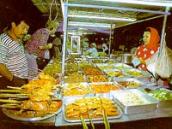
If you want to savour a truly Malaysian dining atmosphere,
this is it. Go upstairs and we will be bewitched by the numerous food stalls
selling Kelantan style dishes, rice and meat curries rice (nasi dagang) and tuna
(nasi kerabu), rice with vegetables and herbs (nasi campur/nasi sayur). Yet
other stalls sell spices, dry goods and local biscuits and cakes.
Bazaar Buluh Kubu
Head to this bazaar if you're looking for bargains. This 3-storey shopping
complex is stocked with miniature souvenirs, which offers good buys in
souvenirs, knick knacks, local batik and songket woven with gold and silver
threats make lovely gifts.
Jalan Temenggong
All along this street are tastefully - decorated shops offering their treasures
of gold, jewellery, rich textiles and brassware. The quality is good whilst
prices remain competitive.
Free-Tax Area.
The Kelantan Airport of
Sultan Ismail Petra Airports is situated at Pengkalan Chepa. It only
caters for domestic flights. Another place of repute is in the Rantau Panjang,
border with Golok Thailand, where we can obtain Thai goods at bargain prices and
find the prettiest Malay women in Rantau Panjang on the Malaysia side. Here is
the free-tax area. Another free-tax area is Pengkalan Kubur which is
border with Tak Bai, Thailand.
Kelantan
boasts unique cuisine with specialities like ayam percik, nasi kerabu or nasi
dagang enjoying pride of place. Be adventurous and try the local fare. Restaurants and food stalls abound and hawkers
selling snacks can be found almost
anywhere.
At the junction of Jalan Padang Garong and Jalan Pengkalan
Chepa, you will find Kota
Bharu's Chinatown. Wan Tan Mee, Curry Mee, Fried Kway Teow are readily available
here.
Dining out in the open, under the stars, makes a pleasant
change. Night food stalls situated opposite the main bus terminal are open from
5.30 pm to midnight and serve a delectable array of dishes. If you want to
savour a truly Malaysian dining atmosphere, this is it!
Night
Food Stalls
The Night Market,
opposite of the central market is worth a visit for those who want to sample
Kelantanese fare. Food stalls open in the evenings and dining is under the
stars. Specialities include barbecued chicken with spicy coconut gravy, fried
rice with herbs and Kelantanese cakes.
For more elegant dining, air conditioned Malays restaurants serving local
delicacies abound in many parts of the town.

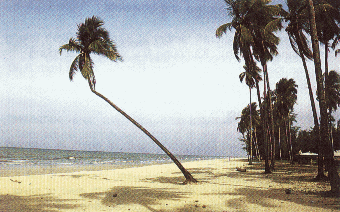
Kelantan the northern most state on
the East Coast of Peninsular Malaysia, boasts of romantic beaches which have a
poetic ring to their names. Invoked by the gentle waves lapping the golden
sands, tall swaying coconut palms and lush green casuarinas whispering in the
wind, the intricately v\carved prows of the fishing boats and the pervasive mood
of peace and tranquillity along the beaches are too inviting for one to ignore.
The beaches of Kelantan
are among the least developed in Malaysia.
In keeping with the state's general air of being lost in time, one is morely
likely to share the sands here with the occasional fishing boat than with other
bathers.
|
Pantai Cahaya Bulan (PCB) (Te Beach of Moon Lights)
Pantai Cahaya Bulan is located 10 km north of Kota Bharu, Kelantan. This
lovely stretch of shimmering sand is perhaps Kelantan's most famous beach.
The beach is shaded by the tall casuarinas and cocount palms, it is the
perfect getaway for the world-weary and providing an ideal setting for
picnics and relaxation. The road to PCB is dotted with interesting cottage
industries, including batik printing, songket weaving, kite-making and
coppertooling. This place is accessible by taking SKMK bus no 10 which
departs from the central market every 20 to 25 minutes.
|
|
|
Pantai Dasak Sabak
Became world famous when the
invading Japanese soldiers landed here in December 1941 (during World War
II) and made their way south by bicycles.
A bunker has been erected here to mark the historical spot. It
distances about 10 km from Kota. It is a quaint fishing village where the
traditional way of life still goes on. The local fishing village, a rustic
Malay Kampung, is worth a visit. Buses No. 8 and 9 depart every half hour
from the old local bus terminal to Sabak Beach.
|
|
Pantai Dalam Rhu
This beach also know as Pantai Bisikan Bayu, which means "Beach of
Whispering Breeze", is fringed by tall casuarinas and lush. It seems like
offer restful shade where families can enjoy a picnic.
The crystal clear waters are cool and inviting!
It offers a range of water sports viz, swimming, snorkeling or scuba
diving. One can try ones hand at angling too. The beach is located
near Semerak in the district of Pasir Puteh, about 50 km away from Kota Bharu.
From the main terminal, you can take bus no 3 to Pasir Puteh. Then take bus no
96 to Kuala Besut.
Pantai Irama
It
also name as Beach of Melody whose exquisite beauty has inspired a lyrical name.
It situated in the district of Bachok about 25 km south of Kota Bharu. Its
clean, white sands and casuarina groves make it a favorite place to camp.
Pantai Irama is believed by some to be the most beautiful beach along the
entire east coast! It is a hit with picnickers and campers alike.
To reach here , take bus no 23 or 39 to Bachok.
|
Pantai Sri Tujuh
This beach means as Beach of Seven Lagoon. It is the venue of the
international kete festivel. It is an unspoilt fishing village which one
can explore at leisure. Here one can witness the fisherman going about
their daily chores at leisure, mending their nests or repairing their
boats. The crystal blue waters here is ideal for snorkeling or deep sea
fishing.
This beach lies on the border of Thailand and
Kalantan at Kampung Tujuh in Tumpat, about 15 km from Kota Bharu. To reach
this beach, take bus no 43 from the main terminal and enjoy the scenic
ride along the way.
|
Wateffalls
Kelantan's emerald forests is home to a number of
picturesque waterfalls. Many of them are in the Pasir Puteh district, about 35
km form Kota Bharu.
Jeram Pasu
This is the most popular waterfalls by far. It is situated off the Kota
Bharu-Pasir Puteh road at Kampung Pak Amat and is accessible by car. Or board
bus no 3 from the main terminal to Padang Pak Amat. Then take a taxi from there
to the waterfalls, about 8 km away. A dip on the crystal clear icy water does
wonders to the spirit.
Jeram Lenang
This is another favourite among the locals. The waterfalls is only 12 meters
high but nonetheless draws the crowds. Bus no 3 will take you to Pasir Puteh
from where you can board a taxi to Jeram Lenang.
But
the jewel in the crown is undoubtedly Lata
Beringin. At
120m, it is also one of the highest waterfalls in the country. The pool at the
base provides a rejuvenating dip. The magnificent view and lush surroundings
make this a popular camping spot. Lata Beringin is near the Sungai Pas Kesedar
Land Scheme. It is accessible via a dirt track leading off from the Kuala
Krai-Gua Musang highway.
MINI
ZOO KUALA KRAI AND MINI MUZIUM KUALA KRAI
Situated in the
district of Kuala Krai. It has more than 30 species of mammals and birds. Its
large grounds and facilities makes it a suitable place for picnics.
Opening hours: 9.00am -
6.00pm
(Open Daily)
Admission : RM2.00 - Adult
: RM1.00 - Child
RIVER
CRUISE AND JUNGLE TREKKING
The ecotourist will
find much to delight him were he to take an upriver cruise of Sungai Kelantan
into the virgin rainfor-ests of Kelantan. The secrets of the jungle will unfold
itself if he looks and listens;
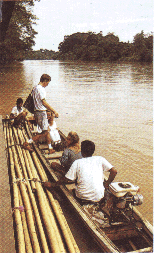 and
the little villages along the bank is an added bonus.
Take Bus No. 5 which
leaves the main terminal at 7.45 every morning for Kuala Krai. At Kuala Krai,
take the boat which leaves at 10.00 am for Dabong. The 2-hour boat ride affords
ample time to take in the grandeur of the rainforests.
and
the little villages along the bank is an added bonus.
Take Bus No. 5 which
leaves the main terminal at 7.45 every morning for Kuala Krai. At Kuala Krai,
take the boat which leaves at 10.00 am for Dabong. The 2-hour boat ride affords
ample time to take in the grandeur of the rainforests.
While waiting for the
17.45 pm train back to Wakaf Bharu, you can take a stroll around the village and
observe the villagers at their daily chores.
Alternatively, you can
venture up to Jelawang to stay the night in one of the chalets (RM25.00
including meals). A one and a half-hour jungle trek brings you to the Jelawang
Waterfall, spectacular and every bit worth the effort.
If you decide to return
to Kuala Krai on the same day, you can catch a taxi from Kuala Krai to Kota
Bharu. Please note that there are no boats available on Fridays. The southbound train
from Dabong brings you to Gua Musang in two and a half hours. Here is where the
majestic Lata Beringin is located. Gua Musang also lies within the National Park
amidst the splendour of the world's oldest rainforests. Explore the many
limestone caves, cascad-ing waterfalls or enjoy a river boat safari.There are similiar
trips organised by the Travel. You are advised to book in advance.
KUALA KOH- NATIONAL PARK
Kuala Koh the entrance
to the National Park. Popular for its fishing spots for fish like 'Indian
Masheer' or locally known as 'Ikan Keloh' Fishing enthusiasts will find this a
thrilling experience. Visitors are advised to book in advance through travel
agents or fax no: 609 - 9122940.
ACCOMODATION
IN KOTA BHARU
|
ACCOMODATION
IN KOTA BHARU
|
|
HOTELS
|
No
of rooms
|
|
Hotel Berling
326 - A, Jalan
Tengku Putra Semarak
Tel: 09 -
7485255/7485359
|
35
|
|
Hotel Aman
236 C-D, Jalan
Tengku Besar
Tel: 09 – 7484042
|
20
|
|
Hotel Merry
6011, Jalan Hamzah
Tel: 09 - 7446722
|
14
|
|
Hotel Anda
2529-A, Jalan Kebun
Sultan
Tel: 09 - 7446722
|
36
|
|
Hotel Intan
5581 – 5586,
Jalan Dato’ Pati
Tel: 09 - 7481277
|
24
|
|
Hotel Kami
204, Jalan Pasir
Puteh
Tel: 7446260
|
25
|
|
Hotel Tokyo Baru
3945/46, Jalan Tok
Hakim
Tel:
7449488/7444511
|
24
|
|
Hotel Sentosa
No 3180-A, Jalan
Sultan Ibrahim
Tel: 09 - 7443200
|
16
|
|
Kencana Inn
Jalan Padang Garong
Tel: 09 - 7447944
|
52
|
|
Hotel Perdana
Jalan Mahmud
Tel: 09-7485000
Fax: 09-7447621
|
176
|
|
Kencana Inn City Centre
Wisma Suara Muda,
Jalan Doktor
Tel: 09 - 7440944
|
34
|
|
Perdana Resort
Pantai Cahaya Bulan
(P.C.B.)
Tel: 09 - 735011
Fax: 09 - 739960
|
120
|
|
Hotel Temenggong
Jalan Tok Hakim
Tel: 09 - 7483844
Fax: 7441481
|
36
|
|
Pantai Cinta Berahi Resort
Pantai Cahaya Bulan
(P.C.B.)
Tel: 09 - 732307
Fax: 09 - 732605
|
43
|
|
Hotel Murni
Jalan Dato' Pati
Tel: 09- 7482399
|
38
|
|
Hotel Indah
Jalan Tangah Besar
Tel: 09 - 7485081
Fax: 7482788
|
43
|
|
Juita Inn
Jalan Pintu Pong
Tel: 09-7446888
Fax: 09 - 7444411
|
67
|
|
Dynasty Inn
2865 - D & E,
Jalan Sultanah Zainab
Tel: 09- 7473000
|
47
|
|
Hotel Ansar
Jalan Maju
Tel: 09 - 7474000
Fax: 09 - 7461150
|
78
|
|
Safar Inn
Jalan Hilir Kota
Tel: 09 - 7478000
Fax: 09 - 7479000
|
31
|
|
H.B. Village
Pantai Cahaya Bulan
(PCB)
Tel: 09 - 7734993
|
24
|
|
Hotel Mawar
Jalan Parit Dalam
Bandar Kota Bahru
Tel: 09 - 7448888
Fax: 09 - 7476666
|
21
|
|
Mohani's Inn
Lot 3761 Jln
Temenggong
Tel: 09 - 7477899
Fax: 09 - 7471736
|
25
|
|
|
ACCOMODATION
OUTSIDE K. BHARU
|
|
HOTEL
|
No
of room
|
|
Perdana Stong Hill Resort
Kg. Jelawang,
Dabong
Tel: 09 - 7476100
|
15
|
|
Kesedar Inn
Gua Musang
Tel: 09 -
9121229/9121491
Fax: 09 - 9122131
|
33
|
|
Hotel Gua Musang
Bandar Baru Gua
Musang
Gua Musang
Tel: 09 -
9122121/9122929
Fax; 09 - 9121044
|
23
|
|
Chalet Sri Ketitir
Bandar Baru Gua
Musang
Gua Musang
Tel: 09-9121235
Fax: 09- 9121044
|
4
|
|
Pantai Irama Motel
Bachok
Tel: 09 - 7788462
|
18
|
|
Hotel Tanah Merah
Jalan Tasik,
Tanah Merah
Tel: 09 -
9557682/9557398
|
10
|
|
Sri Chalet
Taman Tasik Sri,
Tanah Merah
Tel: 09 - 9556626
|
26
|
|
Chalet Sri Tujuh
Pantai Sri Tujuh,
Tumpat
Tel: 09 - 7211753
|
17
|
|
Hostel Pantai Timur
Lot 391, Seksyen
27
Jalan Kebun
Sultan
Tel: 09 - 7483753
|
35
|
|
KB Inn Town Centre
Jalan Padang
Garong
Tel: 09 - 7441786
|
40
|
|
GUEST
HOUSES
|
|
|
Johnty's Malay Villa
Lot 882, Jalan
Kebun Sultan
Tel: 09 - 7448866
|
40
|
|
Menora Guest House
Wisma Chua Tong
Boon
Jalan Sultanah
Zainab
Tel: 09 - 7481669
|
54
|
|
Town Guest House
Jalan Pengkalan
Chepa
Tel: 09 - 7485192
|
60
|
|
TRAVEL TIPS
Malaysia
Airlines links Kota Bharu to the major towns in the peninsula. Trains are
available at the Wakaf Bharu Station and Sungai Golok Station. There are
adequate taxis and buses plying between the capital and outlying districts.
Car rental agencies are plentiful. Travel agents can easily plan a hassle-free
holiday for you.
BY AIR
Daily
flights are available to and from Penang, Kuala Lumpur and Johore Bahru. For
reservations please contact Malaysia Airlines: Tel: 09-7447000 /7443482/7443346
Airport Tel No: 09-737000
BY TAXI
Taxi
services are available on a basis of four passengers to a taxi. Time of
departure will depend on its full loads. Daily taxi services, plying between
Kota Bharu to Kuala Terengganu and Gua Musang charge between RM12.00 to RM15.00
per person. Taxi services are also available to Kuantan, Kuala Lumpur,
Butterworth, Penang, Ipoh and Gua Musang. Rates vary from RM25.00 to RM40.00 per
person according to the distance travelled.Airport transfers are RM10.00 per
person.
BY BUS
Air-conditioned
bus services are available from Kota Bharu to various major towns within
Peninsular Malaysia and up to Singapore at reasonable rates.
BY RAIL
There
are two stations in Kota Bharu. Both stations are accessible by bus No: 19 or
27. Visitors are advised to use Wakaf Bharu Station. Express trains depart daily
for various destinations throughout Kelantan and major towns in Peninsular
Malaysia right up to Singapore. Train schedules are subject to alteration at
short notice. Please contact the nearest station master for further details. For
enquiries please call: 09 - 796989, 966168, 966169. (Traffic Division).
Fishing Village
Sabak
Beach (Japanese army first landed in Malaya (Malaysia) during World War II –
14 km from town centre). How to get there: Bus No. 8
and 9 departs every half an hour from main terminal.
Reclining Buddha
Wat
Phothivihan at Kampung Jambu, Tumpat. How to get there: Take
Bus No. 27 at the main terminal to Cabang Empat From here, hire a taxi to
the temple – 3.5 km.
Boat Building
At
Pantai Sri Tujuh Tumpat (Beach of Seven Lagoons). How to
get there: Bus No. 43 from the main terminal.
 Silvercraft
Observe the craftsmen at work at Jalan Sultanah Zainab (walking distance from Tourist Office) or visit the silversmith at Kampung Morak).                                                                                                                                                                                       How to get there: Bus No. 43 stops at Kampung Paloh.  Walk about 15 minutes to the area.
Market Place (Central Market)
Immersed
in a swirl of local colour, sound and activities, most of the traders are women.
Cultural
Zone
Explore
our cultural heritage:
Royal
Museum – Istana Batu
Islamic
Museum / Syura Hall
War
Museum
Royalty
Tradition and Custom Museum
Handicraft
Village and Craft Museum
Palace with the large Audience Hall (Istana Balai Besar)
Merdeka Square
State Mosque
Buluh Kubu Shopping
Bazaar
Cultural Centre (Gelanggang Seni)
To
every visitor, A VISIT TO THE CENTRE IS A
MUST.
Witness our Cultural games and pastime programme scheduled on every Saturday,
Monday and Wednesday from March - October each year.
Showtime
: 3.30 pm – 5.30 pm (Afternoon)
: 9.00 pm – 11.00 pm (Evening) Location
: Jalan Mahmood (near Perdana Hotel)
Admission : Free
Note:
No cultural activities during Fasting month and on the every of major
muslim calendar. Date, time and venue are subject to change out without prior
notice. For more information, please consult your hotel/guest house/travel agent
or please enquire at TIC Counter.
Night
Food Stall / Night Market
Enjoy
our delicious Kelantanese cuisine at this open air eating area. Location –
opposite the main Bus terminal along Jalan Padang Garong.
Cottage
Industries Area
Observe The art of
making;-
Songket Weaving. Batik Printing –
P.C.B, Kg. Penambang. Kite
making
– Kg. Redang (Kg. Penambang), Kg. Kijang. How to get there : Take Bus No.
10 or 28 to P.C.B. Beach – departs every half an hour infront of Central
Market.(Visitors are advised to inform the bus conductor/driver to stop at this
area).
Wood Carving – Pakatan Jurukir Tradisional,
bersebelahan Sek. Men. Maahad (Lelaki), Batu 1½,Jalan Pengkalan Chepa, 15400 Kota Bharu, Kelantan. Tel: 7485235
How to get there : Bus No. 8 and
9 departs every half an hour from main terminal.
Copper Tooling at: Farajuca Copperkraf, DS 30/1, Bangunan Letak Kereta, Jalan Petra
Semerak, 15000 Kota Bharu.Tel: 7743368.
Beaches
P.C.B. Beach
How to get there : Bus No. 10
departs every half an hour infront of central market.Where to stay:Perdana Resort (Tel: 7744000)
H.B. Village (Tel: 7734993)
P.C.B. Motel (Tel: 7732307)
Beach of Whispering Breeze (pantai Bisikan
Bayu)
– 50 km from Kota Bharu How
to get there : Bus No. 3 to Pasir Puteh departs
from main terminal. Take Bus No. 96 from Pasir Puteh to Kuala
Besut. Stop at Semerak – 15 minutes walk from the mainroad Where
to stay : Komplek
Rumah Rehat (Visitors are advised to contact Pasir Puteh Town Council Tel:
7861011for reservation during office hours – 8.00am – 4.00pm)
Beach of Melody (Pantai Irama), Bachok
– 25 km south of Kota Bharu.How
to get there : Bus No. 2A or 2B to Bachok,
departs from main terminal.Where to stay : For
reservation please call: Restaurant Motel Bachok. Tel: 7788462.
Beach of Seven Lagoons (Pantai Sri
Tujuh)
– 35 km northwest of Kota Bharu)How to get there : Bus No. 43
departs from main terminal.Where to stay : Chalet
Sri Tujuh – for enquiries and reservation. Tel: 7211753.