Ricoh GR1 & GR1s User Comments
Updated with a few additional comments: 3/09/00.
As
you probably know Ricoh has stopped importing 35mm cameras into the United
States. If you are shopping for a GR1, you may find the supply dwindling
fast. Most of the larger mail order companies do not have it in stock.
B&H and Cameraworld.com no longer stock the GR1. You can find it in
the UK at Robert White Camera
Specialists Here's what he said recently about his inventory: "I run
a camera store in the UK and within the photo.net site. I have been
recommended as a possible place to buy the [GR1] camera. I started
selling the camera after I had trouble with my own Contax T2 and then experiencing
disappointment with the Minolta TC1. We have sold lots and lots.
I recently purchased every GR1 camera Ricoh UK had in stock and currently
have about 100 mixed Silver/Black Date and Non-Date cameras left. The new
GR1s is due to arrive in a couple of months but they have warned me of
a significant price difference."
[email protected] writes: Just
one thing - Robert White's a pro dealer, selling Hasselblad, Rolleiflex,
Horseman, Noblex, Contax, Leica - and GR1. But I've never seen an R1 advertised
there. Kamera Direct & West Base are advertising R1s; I got my GR1
and my son's R1 from branches of London Camera Exchange. Walters Photo-Video
sometimes has them advertised too.
The R10, if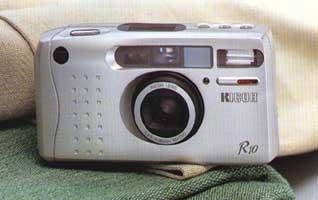 you haven't seen one, is a good alternative though it looks fat compared
to the R1. Notice how it tapers from the wider grip side all the way across
the front in a line.
you haven't seen one, is a good alternative though it looks fat compared
to the R1. Notice how it tapers from the wider grip side all the way across
the front in a line.
[email protected] writes: I have
made up an HTML page plus /images showing GR1 Program Lines for each film
speed from ISO 25 to 3200. The only value I suppose is to show why to pick
or not pick a certain film depending on the light levels wherever one is.
Indoors, in low light, also helps show how far below the 1/30 sec threshold
ambient light is, if you can measure it with a separate meter, for decisions
about slow synch. For instance, the brightest light level here, on a Kodak
grey card, measured with a Zone VI spot meter, is under EV 14. The charts
show not to use a film speed higher than ISO 800 for my local sunny winter
day. Obviously, it would not be prudent for a person in California in summer
to use ISO 400, because the camera's capabilities top out at EV 15.
Other possible sources are discussed on the Photo.net
Q&A Forum under this thread: Finding
a Ricoh GR-1 - B&H is Out of Stock
You can search the Rec.Photo newsgroup since 6/1/99 for similar discussions
by clicking here.
You can now use the new search engine on PhotoNet
for threads on the GR1 by clicking here.
A Compilation of Favorable and Unfavorable
Comments from Ricoh GR1 Users
The comments expressed here are based on facts and subjective impressions.
Where possible I have tried to provide clarification by other users or
myself. As they say, your mileage my vary.
Threads on the Photo.Net
Q&A Forum Relating to the GR1
Favorable Comments
- Minor Updates 9/2/99
Of the cameras you mention, I don't like the 35ti very much; it's big
and the dials on top look silly. The Hexar is a great camera but
so big you might as well use an SLR. The Minilux seems to me to be
just another generic P/S except you pay a lot extra for the Leica emblem.
That leaves the GR1, a beautiful but idiosyncratic camera. I just
got one and like it a lot. The lens is incredibly sharp and I like
the 28mm focal length just fine. In fact I'd get it in 24mm if I
could. I like wideangles. The metal construction really makes the
GR1 feel like a quality instrument. (see Unfavorable Section below
for this user's dislikes.)
The GR1's leather case (sold separately) is very nice so I recommend
getting it. It's a pretty good deal at $12.95 or so. B&H
actually has a package deal where for $20 or so over the base GR1 price,
you get the leather case, a battery (CR2 lithium), and a 2 year extended
warranty from Ricoh. That seems like a bargain to me so that's what
I'd recommend (I went for it and am happy). The leather case has
a small stiff insert in the back to prevent the camera from turning on
in the case accidentally, so you should put the camera in the case with
the lens facing forward.
Filters for The GR1. Answered by Hiroshi Shigematsu ([email protected])
on January 13, 1999 in PhotoNet in the Photo.net
Q&A Forum.
In a message dated 00-03-08 From: [email protected] (Brad Schultz).
Received a polarizing and a yellow filter for my GR1s. Have only
shot a roll of Royal Gold print film to test the polarizing filter.
Cut glare, deep blue sky, higher contrast. It mounts easily to the
lens when the camera is shut off, and can be left on the camera through
the on/off cycle. Taking it to Mexico next week. I'll have
much more information then. Do you know how a polarizing filter would
affect Fuji Velvia? Brad Schultz
According to a Japanese magazine, "Photo Technic" Jan/Feb '99issue,
Ricoh makes filters for its GR1s. You need to buy a filter ring (2,000yen)
to attach the filters to GR1s. The polarlizer filter costs 4,000yen and
the others costs 3,000yen (today's exchange rate is 113yen/dollar.). You
need to compensate the exposure when using the filters.
GR1s is an improved version of GR1 currently sold only in Japan. The
main advantage of the GR1s over the GR1 is it comes with a removable lens
shade. The filter ring Ricoh has introduced is, probably, utilizing the
lens shade mount on GR1s so that I doubt it can be used on the regular
GR1 sold in the U.S. By the way, Ricoh, in Japan, has replaced
In a message dated 99-01-15 From: [email protected] (EA). Christmas
spent in Eastern Europe (Sofia, Bulgaria). Instead of my bulky EOS system
took a GR1 that I had just purchased. I have just got the slides back from
the developers. Film used was Fuji Sensia 100 (Consumer Astia) and Kodak
Chrome 100. Results nothing short of superb. Excellent edge-to-edge sharpness...
the lens is absolutely breathtaking, and the size makes it really the only
P&S I would ever consider. It slips into the pocket easily and you
just know when its time to use the results are going tbe good...I used
to have a Contax T2... fat and ugly compared to the GR1, a camera truly
built by professionals for professionals. I absolutely love it. PS. If
your thinking of buying one... don't think.. just do it.. you'll never
regret it.
In a message dated 99-01-16 10:52:56 EST, [email protected]
writes: I bought my GR-1 as soon as I had read the favourable reviews about
it. I have to say at first I was very disappointed with the results on
print film, they just did not seem to be very sharp and the exposures were
a little wishy- washy. I was convinced that I had a faulty one and was
about to return it to Ricoh when I decided to try a roll of Fuji Velvia.
What a difference! The slides were pin sharp and exposures were spot on.
Following another change of processors my prints greatly improved and if
the shots are of great importance I then send them to a pro lab and the
results are even better. I also own a Contax G1 autofocus rangefinder and
I am sometimes unable to tell the results apart. I do however agree with
some comments made regarding the sometimes poor focusing and the disappearing
details in the viewfinder when used in daylight, but as yet I don't think
there is another camera available that offers such good quality/performance
for the price, unless Ricoh release a GR-2!
For the cost of the arguely black Nikon 28 [The Nikon 28 Ti is discontinued.
The 35 Ti is still in production.], you can buy a Ricoh GR-1 for 28mm
and T2 (or Nikon 35 Ti for 38mm), so you have the interchagable cameras
instead of interchagable lenses. GR-1 is the choice for wide. If you take
people photo, better stay with 35-38mm range. Also keep in mind that people
in Tokyo and NYC like 28mm or even 24mm better than folks in the rest of
the states where space is plenty.
I have owned almost all the small cameras, including GR-1, Nikon, Rollei
35s, Minox, XAs, Olympus and Contax. I think that GR-1 is the most logical
and the best for the photographer (general health, mental health, eye-problems
and moneywise), but the 28mm is too wide for people. Perhaps, best for
landscape slide in the west. So I also carry a camera in 35mm or 50mm in
case I need it for business trips. I do my regular shooting with Bronica
ETRS and Rolleiflex TLR.
The GR1 definitely has the best optics in this group. In fact, the
optics are so outstanding that Ricoh has released a lens for the Leica
M Mount based on the same design. This camera is also much cheaper than
its primary competitors--Minolta TC-1, Nikon 28/35ti, Contax T2, and Leica
Minilux. In terms of value and picture quality, you really can't go wrong
with the Ricoh.
(Forget about the APS cameras if you're serious about photography. The
picture quality is not comparable and the format lacks film variety.) I
recently purchased the Minolta TC-1. I chose the TC-1 over the Ricoh and
Contax because I prefer real-image viewfinders. The Leica is a fine camera,
but the viewfinder is very small and opinions on its image quality haven't
been unanimous. Generally (at least in Japan), this camera hasn't been
considered to be in the same league as the Minolta, the Ricoh, and the
Contax. (The Nikon is not available in Japan).
The Ricoh has all the features that most people will ever need for a
high quality P&S. If you're comfortable with its viewfinder (bright-frame
type), I can seriously recommend it. Only consider the Minolta if you're
not comfortable with the Ricoh's viewfinder and you want a smaller camera.
The Contax is essentially the same as the Ricoh in features but costs quite
a bit more. The Nikon, IMHO, is grossly overpriced.
Some people and some magazines would say that the GR lens is better
than comparable SLR Nikkors. Rumors had it that Leica is going to license
the construction from Ricoh. The GR1 is at least as good as my 24 and 20
mm AF-Nikkors.
Hm.. I've commented on this fairly recently at length but in summary
:
Nice and light; Exceptional 'feel'; Good control; Good technical design;
Incredible lens.
I bought one for my sister's wedding present, but I 'tried it out' for
a couple months before I got around to sending it to her (Australia). I
found the tonality and definition of the lens to be extremely good. Not
that you can't take bad pictures with it, but my good pictures were amazing.
Take a look at my site: http://members.home.net/gpang
The bottom right picture of the exceedingly orange tree is a good example
of the lens's capability. Bear in mind that I had to do VERY little color
correction of the image after scanning. That's really what it looked like
right off the film.. I think I let the camera auto-meter that scene too..
I've got one but I still haven't made any sizeable enlargements so
although the lens seems really good, (from looking at negs with a loupe)
I can't honestly comment further on the image quality. Yet. The ergonomics
are great and make the competition feel somewhat old-fashioned in comparison.
Setting and changing the controls in most ways is pretty fast; you can
set exposure compensation in half a second, and leave the flash switched
permanently off, for example. And it has passive AF so you can focus through
glass. The only downside that I am aware of, apart from some little niggles
that others have had , (like the spot metering area being a bit lower in
the frame than the marks suggest), is that it can get switched on while
still in its case, because the switching is just pressure on a button.
You could always reinforce the leather case with something stiff to prevent
this. [Ed Note: 1/19/99. The leather case now has a protective panel
which covers the on/off switch, flash switch and viewfinder. You can't
switch the camera on, even intentionally, through the case. This problem
seems to be fixed, if you use the case.] Oh, and it projects a very
noticeable focusing beam in some low light situations, so be aware that
clandestine candids might get somewhat compromised. I really like it -
it is incredibly small for what it is. Having a 28mm lens on a compact
makes possible shots that have quite a different feel from those gotten
with the more usual 35mm, or at least that is how I feel about it. And
it has a snap setting that works well in crowds and street scenes- at least
if you want focus set at 7 feet it works well! There is another snap setting
where you actually lock it at a pre-(auto)-focused distance, but it is
rather fiddly to do this and I usually just don't bother. Sometimes I think
maybe it is a bit too small, but when you want to put it in your pocket,
it makes the Minilux, T2, etc, seem like bricks. I can get a Minilux in
my jeans pocket, but it feels somewhat uncomfortable. BTW, I don't think
the oft repeated rumor about Leica buying or licensing this lens is true.
This lens was made in limited numbers in Leica screw mount.
I have a GR1 which I carry with me everywhere (using a mixture of XP2
super, agfa 50 ASA, colour neg and Kodachrome 25) and the results are fab.
I only with I had bought the black one instead on the silver. I wanted
the BLACK one 'cos it is easier to take discreet, soul-stealing photos.
A black GR1 looks like a flip-type mobile phone.
I have a black GR1 also. It is, in my opinion, less attractive to thieves.
It's small size makes it appear more like a drug store camera to most low
life types. The high end luxo cameras in silver or titanium finish seem
to attract more attention.
I happen to think that spending $450 US for a camera like the GR1 can
make extremely good sense. For example: I was getting sick and tired of
lugging around an F3HP system, so I bought a really nice Leica M3 with
a used 50 and 90. Now the M3 viewfinder doesn't accommodate a 35mm lens,
and I happen to intensely dislike that focal length anyway. What I wanted
was my favorite wide angle, a 28. So I looked at the Elmarit-M with an
accessory finder. Now *that's* expensive.
In my quest for cheaper alternatives I remembered the GR1. A bit of
investigation revealed that the lens on that camera is so good that Ricoh
packaged 3000 of them in Leica M mounts as a publicity gimmick. And the
reviews all said that the camera behind it was a fine piece of work too.
So what I ended up with was a 28/2.8 lens of impeccable quality, attached
to a very fine body with good ergonomics and well-thought-out controls.
I don't need to take a lens off my M3 to use the 28, and if I want to go
really light, I can just carry the GR1 in a shirt pocket. All of these
advantages came in a package that actually weighs less than the Elmarit,
and costs less than 1/3 as much. So what may seem crazy to you, can seem
extremely sensible to someone else.
I am in the market for a high quality compact. I borrowed a Nikon 35th,
a Ricoh GR1, and a Yashica T4 and tested them. Shot same scenes, developed,
made photo CD and then enlarged and printed with Epson color 600 (1440
dpi printer). Although similar in results, the Ricoh was the clear winner
for detail and color. I then dropped the CD at a professional shop and
asked for their opinion. I did not tell them which was which and they came
back and said that the Ricoh was the best of the bunch. So, I'm buying
a Ricoh. Answered by Joel Horn ([email protected])
Don't underestimate the quality of the GR1 lens. In sharpness it matches
my Nikkors (20/2.8D, 24/2.8D, 85/1.8D, 105/2.8D) and gives more pleasing
bokeh. I have no experience with the 28Ti/35Ti lenses but they are supposedly
at least as good as the SLR nikkors, so perhaps you are correct anyway.
Rumor from some german photo magazine reported that Leica recently has
bought the GR1 lens from Ricoh (either complete lenses or the construction).
I agree with your assessment that the GR1 doesn't have the feel of the
Nikon's, you get what you pay for. (I paid $325 for my GR1.) Too bad you
had quality problems with the Nikon's, they seem like a good value.
Gives more satisfaction than my Canon EOS system. Sharp lens, easy
to use, a pleasure to take along. I wish the motor drive were quieter.
I owned a Nikon 35Ti for two and a half years and shot many rolls of
film with it. It had several excellent features and a couple which eventually
caused me to get too frustrated with it. Pro - superb exposure control
system, very hard to outguess it. the integrated time/date stamp with the
automatic ability to datestamp the first frame of every roll and the first
frame of every day was excellent. The features list was impressive. cons-
poor ergonomics, too much button press-turn something for my taste, control
buttons small and fiddly. Focus was hard to target accurately, particular
on closeups of complex subjects-I used scale focus a lot. Lack of exposure
lock (although it was still very hard to get a bad exposure). Somewhat
slow operation, a lot of lag between shutter press and exposure. Jammed
and needed an expensive service twice. The Ricoh GR1 is excellent, a lot
nicer than the Nikon [35ti] for my automated compact 35. The focus is faster
and more accurate, the controls are ergonomic and sensible. It's very easy
to figure out. The "stickiness" of your settings is fantastic. I like the
wider angle lens and it's razor sharp. Exposures are not as unbeatable
as the Nikon, but the easy override makes adjustment a snap. Seems to fire
more rapidly than the Nikon, and snap mode is much faster. Excellent feel,
excellent camera.
I have had a GR1 for about a year and love it. I also have a Yashica
T4super for comparison and use an ElanIIe. The "form factor" and ergonomics
of the GR1 are excellent. Feels good in my hand and fits in my pocket without
any difficulty. The fit and finish are superb. The exposure system is more
versatile than on any other P+S of same or lower cost. (Similar flexibility
to Nikon 35/28Ti, Contax T2, etc). Much more versatile than the Yashica
in that there is control of aperture, spot metering and +/- 2EV exposure
compensation.
The lens is outstanding and I cannot distinguish photographs taken with
the GR1 from those taken with the Yashica's Zeiss lens or from the Canon
20mm or 100mm primes. Sharper than the Canon 28-105 I think. Obviously
the camera has a 28mm lens and you must be comfortable with that. I sometimes
wish it were a 35mm but mostly I am glad for the extra coverage of the
28. (That is also why I keep the Yashica around)
I owned 3 other P & S cameras before the GR-1 and hated the flash
of all 3. Same for the GR-1 flash. I only use the flash when absolutely
necessary and then I try to have everything I want flash-exposed in the
same plane, i.e. at the same distance. No matter what camera you use, built-in
flashes are bad. When I must use flash with my 35mm or 645 camera it is
always bounced or used only as fill flash. Perhaps the GR-1's flash is
worse than other flashes.....if you say so. I don't know
Response.... The GR1 goes into slow synch only in the flash ON
mode in Aperture Priority. If the camera is in AUTOflash mode in aperture
priority mode it maintains shutter a speed floor of 1/30 of a second or
so. Daylight flash synch, on the other hand, is flash ON mode with either
aperture priority or program mode. The whole setup makes great sense. You
can avoid slow synch in aperture priority by maintaining AUTOFLASH mode.
You can allow slow synch in the aperture preferred mode by engaging the
flash ON mode.
I did not test my GR-1 like you did, but all my exposures are spot
on. I use the spot meter often and had no badly exposed shots, including
slides, so far.
... I looked around at various cameras from the Yashica T4 on up to
the Contax Tvs (amusing how Contax/Yashica are at both the top and bottom
of the respectable point&shoot cameras) I ended up deciding on a Ricoh
GR-1 because of rave reviews about the lens and it's nice design. Just
before that my previous SLR setup had been stolen so I figured I'd run
a couple rolls of film through the camera before I sent it off to her.
(just to be sure it worked right eh?)
Anyway I ended up running probably about ten rolls through it and I
liked it VERY much.. when you set some mode or turn off the flash then
it STAYS set even after you turn the camera off. The main problem with
the lower end 'nice' point&shoots is that they reset to a kind of base
state when they're turned off. .
-In looking at the pictures I've taken I greatly admire the contrast,
sharpness and color saturation. I was able to generate smooth out of focus
areas in pseudo-macro shots, and pretty much always got what I wanted in
focus.
-The magnesium body feels REALLY nice In fact I like it's body better
than the expensive Contax T2 and Tvs (titanium bodies). It's very light
and quite small as well. Other good choices might include the Yashica T4
Super which has a Carl Zeiss Tessar T* lens, and the Olympus Stylus Epic.
Both of these are quite a bit less expensive than the GR-1 is. I have an
old Olympus Stylus which doesn't even have the weatherproofing of the Stylus
Epic yet it is apparently indestructible.
-Don't get the Leica Z2x at least not without trying it out first in
a shop. It does NOT feel nice at ALL. It barely resembles a Leica in person
although it looks decent in ads. Dunno about the lens quality but no one
has been raving about it so...George Pang [Note:
I have used the Z2X extensively and, although it may feel cheesy, the lens
quality is excellent.]
...I wanted something ultra-sharp with more manual control for the best
possible results with a small camera. After looking, reading, asking, comparing
and tossin'n'turning for several nights I settled on the Ricoh GR-1 with
its sharp f/2.8 lens. One needs to come to terms with one lens, one focal
length shooting. I would rather have 3 good shots of commercial quality
than 30 shots that only my mother will compliment. I never regretted opting
for the GR-1---it produces excellent results AND I am in control.
My partner, a full time professional photographer of 17 years, considers
the 28mm lens on his GR1 to be the best wide angle lens ever put on a 35mm
camera. Yes, he means it and, yes, he's competent to make such a judgement.
I haven't tested it personally but I'm confident that my partner knows
what he's talking about. Both cameras [Contax T2 and GR1] have outstanding
reputations. Good shooting. Fred. Maplewood Photography From:[email protected]
(GSte31415) Date:1998/01/18
I have made an interesting discovery. The lens-mount on my Ricoh GR1
has the property of allowing magnets to stick to it. This is not the case
with the rest of its magnesium body. I purchased a sheet of magnetic material
which I cut to size and mounted some gelatin filters. Voila - B&W filters
for a point and shoot camera. There are magnetic filters made for certain
cameras. Does anyone know if, perhaps magnetic filters are available for
this camera in Japan. Since the camera has + or - 2EV exposure correction,
I can't help but wonder if something more professional isn't available.
I'm going to try the same thing but with 1.25" astronomical filters (which
appear to have exactly the same diameter). I'll just break the threads
off and mount to small magnetic sheets to see if they hold. I'll post another
message if it works.
Regarding filters: Cokin has a filter holder for A size filters that
attaches to the tripod threads. I find this a useful compromise for pocket
cameras that have no filter thread. Also, the old skylight/hood for my
Minox fits the GR1. The hood blocks the exposure meter, though, so I have
to compensate for that.
Regarding Exposure Lock, Peter McIntosh wrote in message in Rec.photo
newsgroup: I tried a little experiment.
-Selected an aperture (f11).
-Set snap mode to a certain distance, and noted viewfinder shutter speed
reading (30 was flashing).
-Released the shutter button.
-Aimed camera elsewhere, at scene with much brighter EV and depressed
shutter halfway. Got a viewfinder shutter speed reading of between 1/60
and 1/125. So, from this, I think you CAN lock AE and AF separately.
... it has been said through a German mag that Leica have made a purchase
from Ricoh . It is unclear as to whether it is the actual lens or the formula
for the lens.
There is a version of the GR1's GR Lens 28mm/F2.8 for Leica which you
can find in major camera shops. Optics design are based on GR1's lens.
Only larger openings.
I would agree with some of the ergonomic objections to the Minilux
though- exposure compensation is a pain and takes a whole cycle of button
pushes, whereas on the GR1 you just turn the dial and it takes a fraction
of a second. Ricoh have really done us all a favor by demonstrating how
to design an AF compact camera properly. Joe B.
Best bang for the buck is the Ricoh GR1. The Konica Hexar is also very
nice, with an f/2.0 lens, but it is bigger than any true P&S and the
controls are not as easy to use.
A programmed exposure or aperture-priority, passive AF camera with
winder. 28/2.8 lens + flash. DX. Has many useful features among them exposure
compensation, two metering/autofocusing patterns, focus lock, time exposure,
sophisticated flash control, prewinding, and is the smallest of all automatic
cameras (slimmer than the lite-touch) with a good layout (unlike its more
expensive competitors). A metal camera, it is among the expensive ones,
but still reasonable (I had no problem to get mine for $435 at B&H).
The lens is said to be great, but I have not seen results yet.
Re: Taking Pictures of People. What's the one piece of electronic equipment
that people no longer pay much attention to? Answer: a cell phone. A GR1
user told me that when he spots a good image on the street or while sitting
in a cafe, he holds the GR1 up to his ear like a cell phone with his right
thumb resting on the shutter release and waits for the opportune moment.
He presets the camera to SNAP mode (AF locked at 2 meters to infinity)
and at the right moment moves the camera as close as possible to a horizontal
position, then shoots. A quick grab shot with the viewfinder at normal
eye level position is also hardly noticed with the GR1; it's smaller than
some cell phone and the black version looks reasonably close to a cell
phone.
I'm so pleased with this great little gem of a camera, I had to put
in a plug for it here. I just took three business trips when I decided
I didn't want to lug a lot around, so I took a deep breath and decided
to limit my equipment to the GR-1 plus a Cullmann Magic 2 tripod (also
sweet).
I went to Guangzhou, China, 4 countries in West-East Europe and Bangkok.
I thought I'd be severely hampered by just the single 28mm lens. What I
found was that the single lens forced me to be more selective about my
subjects/compositions and "freed" me from over-thinking the subjects. This
was especially beneficial because there were plenty of times when other
highly paid managers wouldn't take kindly to being held hostage by my photog
proclivities.
The results are great! The 28mm 7-element lens is super-sharp. The adjustable
aperture was very useful. The bulb function was used to take some very
nice interior shots in Cathedrals that would have been impossible w/o the
bulb (or a tripod; 1-2 minute shutter speeds). What's more, my wife loves
to use it as a simple, hassle-free p&s.
I made the decision to buy the GR-1 after searching this bboard along
with a few other threads. (btw, the other options were the Nikon 28 TI
or Konica Hexar Silver) I couldn't be happier with the GR-1 and PhotoNet
for pointing me in the right direction!! Asked by Joe Johnson ([email protected])
on March 08, 1998.
Answers. Your thread really would be more appropriate as a neighbor-to-neighbor
posting but I'm keeping it anyway because I like the fact that you found
the single focal length helpful (as I do). I've become a real lazy zoom
lens user on my SLR but choosing a focal length just seems like an annoying
extra step on a P&S camera. Answered by Philip Greenspun ([email protected])
on March 08, 1998.
Unfavorable
(and Mixed) Comments
<< I attended a wedding on the Pacific coast on Saturday; late
afternoon, bright sun, 400-speed film. The camera's shutter refused
to operate when I was trying to photograph the ocean and coastal scenery,
or the wedding party members. >>
Response: Hmmm, I've never heard of this happening with the
GR1. Since it's _shutter_ and not _focus_ priority, the shutter should
fire regardless of whether focus has been achieved. I tried to duplicate
your situation by loading ISO 800 speed film and UNDERexposing one stop
(effective ISO 1600), pointing the GR1 at the evening sun and firing.
Although the shutter speed blinked, indicating a speed higher than 1/500,
the shutter did release as it's supposed to.
<>
Response: The infinity mode selection does not affect focus
or firing ability. And, if the GR1 cannot achieve focus, it defaults
to focus at 2 meters and fires anyway.
<>
Response: Now it sounds like a battery/power problem.
Had the flash fully recharged? Is the battery good? Never mind
whether it's new. It could be new and discharged somehow. Try
replacing the battery with a known good one.
<< I'm not even sure that this is a focus problem (although the
landscape mode
would seem to indicate a problem, wouldn't it?). I understand
that it needs vertical lines to set its autofocus, but what good is a camera
that won't autofocus on people?>>
Response: I'm pretty sure it's not a focus problem, as indicated
above.
<< Am I doing something wrong? Is this camera malfunctioning?
>>
Response: It could be malfunctioning, so if all else fails,
send it in for service.
<< I've even set the aperture to f/11 to try to correct for this
problem, but it only seems to be of marginal help. >>
Response: What do you mean by ".. of marginal help?" It
either works or doesn't; changing the aperture should make no difference.
If the problem is sporadic I'd suspect the battery or some other electrical/electronic
component.
I have to say the viewfinder isn't that great. This doesn't bother
me since I'm not that fussy about viewfinders. Much more annoying
is the passive AF system, which a) is easier to fool than active systems;
b) slows down shooting; c) shines this annoying visible red beam on the
subject if the light is low. I'd much prefer an active IR system.
The snap and fixed focus modes help, but with a 28mm lens I don't see why
they used a passive sensor.
I notice another thing, which is there are bright lines and indicators
in the viewfinder that are conveniently backlit by another LED when there's
not enough ambient light to light them through the small frosted glass
panel on the front. This LED is also quite visible from the front
of the camera, when it is lit. So this is another way the GR1 can
call attention to you if you're trying to take a candid shot. Finally
the film advance and motorized rewind are slightly jerky and noisy [Ed.
I haven't noticed the jerkiness on my camera; the noise is less than other
P&S cameras, IMO].
Ricoh USA no longer imports the GR1 or any other Ricoh 35mm cameras
(they are concentrating on digital because they see more money there).
There are none left in the distribution warehouse. Once the ones
in dealer stocks run out, it's over, at least in the US, so if you want
one, you should probably get one now. B&H had some left a week
or so ago (that's where I got mine). [Ed. Check with Ritz Camera
shops, if you have one near you; they are advertising that they have bought
up all Ricoh's stock of 35mm cameras.]
I agree with some comments made regarding the sometimes poor focusing
and the disappearing details in the viewfinder when used in daylight, but
as yet I don't think there is another camera available that offers such
good quality/performance for the price, unless Ricoh release a GR-2!
Parallax correction marks on a GR1 asked in the photo.net Q&A
Forum
I just bought a GR1 and am very impressed with it. But I can't find
a good explanation of the parallax correction marks. I'm not familiar with
this term and there are no explanations anywhere that I can easily understand.
How do these marks work and how do I use them? I read in one of the threads
that a user of this camera had the pillars of the Taj Mahal turning inward
instead of outward. I don't have the same problem with my EOS 28-105 at
28. I did notice, however, that focusing on my refrigerator it had a distinctive
lean to it, but no parallax correction marks appeared in the viewfinder.
Any simple explanation? Asked by Bob Lester ([email protected]) on January
13, 1999.
Answer. Parallax correction is nothing to do with converging
verticals, the other thing you mention. Simply, the parallax problem is
when the subject is very close to the camera (e.g. a foot or two) and the
positioning of the image in the viewfinder is not the same as the positioning
of the image in the lens and thus on the film. (The cause is that you on
your camera you are no looking through the lens which takes the picture,
but another lens (the viewfinder one) which is in a different physical
place. On the EOS there is only one lens and both you and the film are
using it, hence no problem.) Use the marks to "know" what the lens will
see when focusing close.
Have had/used both the GR1 and the Contax T-2. the T-2 is a lot better,
IMHO. True, the Ricoh is smaller, and relatively sharp. But mine had focusing
problems like crazy. Zeiss lenses are only surpassed by Leica lenses in
my opinion, and then only sometimes. ...
There is only one problem with the GR1....If you don't keep it in it's
case it sucks up dust and bits in the front part of the viewfinder. Otherwise
it's perfect.
I think 28mm is too wide for general purpose portrait lens. A 35mm
is a better compromise, in my opinion. I sold my GR-1, because of very
limited use.
Using Filters. Actually, I used the filter from my Minox on
my GR1. A small tightening of the retainer clamps was necessary. On the
plus side, this filter has a rubber hood as well. On the minus side, the
hood blocks the meter, so metering has to be done before attaching the
filter. And the filter has to be removed when powering off the camera.
In the end, I stopped using it. You might want to consider a gel filter.
Fabricate a suitable frame and attach on the front of the lens. Or just
forget the whole idea, I doubt it is worth the effort.
Comment: ... I've thought about the GR-1 - the designers on the right
track - but no matter how good it is, it doesn't have the feel, and I doubt
lens performance, of the Nikon 28ti...
Response: Don't underestimate the quality of the GR1 lens. In
sharpness it matches my Nikkors (20/2.8D, 24/2.8D, 85/1.8D, 105/2.8D) and
gives more pleasing bokeh. I have no experience with the 28Ti/35Ti lenses
but they are supposedly at least as good as the SLR nikkors, so perhaps
you are correct anyway. Rumor from some german photo magazine reported
that Leica recently has bought the GR1 lens from Ricoh (either complete
lenses or the construction). I agree with your assessment that the GR1
doesn't have the feel of the Nikon's, you get what you pay for. (I paid
$325 for my GR1.) Too bad you had quality problems with the Nikon's, they
seem like a good value.
I had been wanting to buy a new p&s camera for some time,
because the one I had (Konica A4 35 mm/3.5) wasn't sharp enough for me
and had terribly much light fall-off at all apertures. I considered the
Yashica T5 (T4 Super), Olympus Mju II (Stylus Epic), Leica Mini 2 or 3
and the Rollei Prego Micron (Ricoh R1 besides the lens). Except for the
Rollei they're all about the same price, so it really gave me a hard time
choosing between them. And then I came across the Ricoh GR1. I knew it
existed and ought be good, but I'd always found it too expensive for a
p&s. Some searching on the web however convinced me that it was more
than worth the extra spend: an ultra-sharp lens (great MTF-chart, never
seen any other I must say), good contrast, Great ergonomics and an unprecedented
amount of exposure control.
So, two weeks ago I bought one (for about US$400, in Holland). So far
I've shot two films: one slide (Sensia II) and one b&w (TMY), and I
must admit I didn't really get what I'd hoped for. The slides are indeed
sharp, but not as awfully crispy sharp as I've read here and there; also
I've detected a slight light fall-off at large apertures (but by no means
as much as the Konica). I don't think it matches the optical quality of
my SLR-lenses (my Minolta MD 50 mm/1.7 is much sharper, the (ancient) 28
mm/2.8 only very slightly). I'm a bit disappointed about all this but perhaps
my expectations weren't reasonable.
As for as the rest is concerned I love the GR1: the ergonomics and controlability
are indeed fantastic. It's so small that I can take it anywhere (for really
bad weather and vacations I bought a Lowepro micro belt-case, I find the
one from Ricoh a bit too soft and open). I also like its looks (I've got
the silver one) and the way the magnesium feels like very much (more rugged
than the Konica). I don't know what the Yashica's etc. optical qualities
are (I've only read about theirs), but I think, despite my slight disappointment,
that the GR1 has a top quality/price ratio.
Surprisingly for a small P&S camera with a fixed focal lens, it
has passive AF. Maybe useful for a few situations (windows), but generally
more likely to fail than active AF, and requires an AF illuminator in low
light. A really good sensor is needed for passive AF to work well (Nikon
got it right only with the N90 !). Response: In regards to the Passive
AF on the Ricoh GR1. The passive focus system is much better at distances
than is the Active style. As for low light focusing problems; yes, I could
see that. However, how often do you use a P&S in low light? The Yashica
T4 is a wonderful camera, although I do agree with the problems listed.
As for the Nikons? I work for a camera store and I always steer people
away from the Nikon P&S cameras. They are the most unreliable things
I have ever seen. Perhaps worse then the Olympus Stylus. Contributed by
Steve Canaan ([email protected]) on September 30, 1997.
The viewfinder has plenty of information (speed, exp comp, parallax
frames, focus area + two warning lights) and is well-lit, but the focus
confirmation indicators at the bottom are not easy to see. No clever metering
(center weighted / average). it is said that the camera can detect backlight
and fire the flash, but this is in program mode only ? No control over
the metering pattern (switches at ev6, why ?). [This is an incorrect
statement based on the instruction book. When you select spot AF you also
engage spot metering.]
... after developing my first couple of films, there's two things I'm
not so happy about: The spot-exposure function, and the flash. The brochure
for the GR1 indicates that the camera has a spot AF and exposure function,
in addition to the average meter system. But when it comes to exposure,
I think it's more fair to say the GR1 has average exposure and centre-weighted
exposure, rather than spot. The area controlling the exposure when spot
is activated, seems larger than the AF marks in the viewfinder when I test
the exposure GR1 proposes when pointed towards a bright area in a dark
motive.
I am not too happy with the GR1 either, and I cannot understand why
there are so many raving fans of it on the net. Most of the pictures taken
with the flash were over-exposed. I sent the camera back to have the flash
checked, but they could not find any problem with it. So after half a dozen
rolls, I gave the camera to a friend and bought the Contax TVS II. May
be GR1 has a nicer set of MTR curves on paper, but the pictures produced
by the Contax is much better in my eyes. A. Chow
Response....Your experience is at such variance with others that
I'd check to see if your developer is at fault. People often blame cameras
when poor processing is the real culprit. The Test reports on the TVS indicate
that its lens is not as good as the one on the T2 nor the GR1. Andre Hassid
sold his TVS because he drew the same conclusion about the TVS.
I have tried the Ricoh GR1 and gave it back because the viewfinder
information was nearly invisible in normal daylight outdoors. They put
all this terrific viewfinder information, but it is difficult to see unless
you're looking at a dark background. The build and other ergonomics of
the GR1 are first rate. The autofocus did seem to get fooled more often
than other cameras I have tried.
The manual not very clear. Some points worth noting, which are not
mentioned, or written in a confusing manner: pressing the shutter half
way will lock BOTH focus and exposure in auto flash mode, the flash will
fire in low light in program AND AE modes if you switch to the spot autofocussing
mode (it is not called this way) then the metering also switches to a form
of spot metering. How small is the spot is not clear, but I can say that
it is definitively more concentrated than the default metering pattern.
This appears to be the only way to get spot metering. Auto flash mode is
NOT a fill-in mode (i.e. the background will not be exposed properly).
To fill-in you must use the flash-on mode.
I am not too crazy about the GR-1 either. Its AF is supposed to have
many, many steps, it must be getting a high precision for its focusing
error. From ft. to 6 ft range, I have to be extremely careful to aim, hold
shutter and check very carefully to get the range indicator read consistently.
When I set the focus to infinity, the pictures look sharp. I am still trying
to "know" this little flash better. At times, it is 1 or 2 stops over.
As far as P&S goes, I got much better pictures from the T4 than the
GR-1. But than again, may be I need to spend more time with this camera...............or
just use on landscape only?
Just a warning about the GR1 (I have an R1 but the GR1 is almost identical):
The camera turns itself "on" when stored in pockets, etc, and can be damaged
if the lens motor comes upon some resistance. Answered by Peter Henderson
([email protected]) on March 09, 1998.
As far as delayed shutter release time is concerned, I have no experience
with other p&s cameras. GR1 also delays the time between triggering
the shutter and actually exposing the film. In most situations I find this
delay acceptable, but in many situations it annoys me. There is a solution
to this, though. You can preset and lock the distance and exposure for
a certain target. Then wait for the right moment to occure and shoot, and
the camera reacts instantly.
Down sides: I have gotten to know the camera well enough to know what
I'd like to change but I should be clear that none of these comments would
make me choose a different luxo-P+S.
One annoyance is that the aperture selection dial sometimes moves (rotates)
when pulling the camera out of my pocket. That means that if I thought
it was set to "P" (program) it may have moved to 2.8 or 4 etc. This can
screw up the exposure if you are using fast film or are
shooting in bright light as the max shutter speed is about 1/750 (not
certain of that but it is not much higher). I wish the exposure dial was
designed so that you had to pull it up to move it out of program mode then
this would not happen.
Another annoyance: I wear glasses and it is difficult to see the shutter
speed indicator in the view finder without looking around for it.
The camera is more adjustable than most point and shoots but this is
a bit of a double edged sword. It is possible to forget between uses exactly
what the different modes are and how they interrelate (eg. spot metering
vs. spot focus). It would be nice if the LCD contained a bit more information
to help out here...people don't usually carry their manuals with them when
using a P+S.
When all is said and done, I love the camera and I take almost half
my photographs with it despite owning a full EOS system (which I love).
It is so convenient to carry and allows sufficient flexibility that it
makes the difficult decision of whether to take a SLR or P+S with you less
of a compromise.
For street/grab shots, I usually use the GR1 for its compactness, quietness
and simplicity, although I do find the film advance motor a bit noisy when
compared with the TVS or Leica Minilux for that matter. Still I have used
it in church without any people noticing. I hope they will improve the
on/off switch, which is my main complaint. A thumbwheel switch like that
of the Contax T2 would be ideal, in my opinion. [Ed Note: 1/19/99.
The leather case now has a protective panel which covers the on/off switch,
flash switch and viewfinder. You can't switch the camera on, even intentionally,
through the case. This problem seems to be fixed, if you use the case.]
If you have comments or suggestions,
email them to me at [email protected]