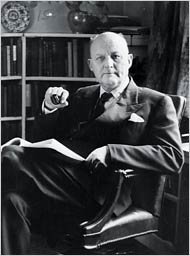
Reinhold Niebuhr
Moral Man and Immoral Society
Culture as a Challenge to Faith
"Man has always been his own, most vexing problem."
Our society is far from perfect. The stories we hear on the news and in the newspaper are solid evidence of the corrupt state of our society. Reinhold Niebuhr believed that while humanity was the cause of the current state of society, he is not necessarily to be blamed for it. Niebuhr suggested that society and humanity is inevitably corrupted by the effects of Original Sin. In his book Moral Man and Immoral Society, Niebuhr said, "Human beings are compromised and prone to immorality, even evil." This is a fact of life that we must learn to accept; it is a part of the human condition. Because man has free will, man has the ability to choose between good and evil, and thus has the capacity to create a corrupt society such as our own.
This idea of the frailty of human beings seems very negative and even condemning, yet Niebuhr thought differently. While he believed that society is unavoidably immoral, he also believed that our highest calling is "to live responsibly in this tension [between our own mortality and desire for transcendent meaning." By this, Niebuhr meant that humans are called to cope with our own inclination toward evil and still strive to do good. Reinhold Niebuhr's message is not meant to instill a sense futility in us, but rather it is meant to compel us to be aware of our own shortcomings and being realistic. Niebuhr said, "Civilization depends upon the vigorous pursuit of the highest values by people who are intelligent enough to know that their values are qualified by their interests and corrupted by their prejudices." This statement says that those who are intelligent are those who know that they unavoidably have a personal bias, which is one of the Five Existential Truths that we talked about this year. We cannot ignore something that is part of the human condition, rather we need to accept it.
Sin is Unavoidable
Original sin is a part of the human condition and causes man to have an inclination toward evil. Man also has the gift of free will, or the ability to choose between good and evil. Niebuhr suggested, however, that man often is not able to choose between good and evil, but rather is forced to choose between an immoral decision or an even more immoral decision. No matter what decision he makes, sin will be present. An example of a decision with two immoral options to choose between is the matter of war, a topic which Niebuhr often thought about. During World War II, the United States was faced with this type of decision. Should they join the war and engage in the immoral act of killing others, or should they sit back and watch as the Nazis murdered thousands of Jews? Regardless of their decision, death and sin would be present.
Once man recognizes that his society is corrupt, he tries to do something about it. There are many individuals who recognize the evils in their society and strive to fix them, strives to do good. But, Niebuhr suggested that even while trying to do good, man will inevitably sin along the way. Niebuhr called this the "Ultimate Paradox." The ultimate paradox according to Niebuhr is that sin accompanies the quest for love and justice. No matter how good man's intentions are or how just his goals may be, he will unavoidably sin along the way. Sometimes this sin is a necessary means to reach the desired end (a decision between immorality and even more immorality) and sometimes it is setback or shortcoming resulting from choosing evil over good.(the result of man's natural inclination toward evil due to original sin)
"Always walk that fine line, engagement but self-critical engagement."
Mr. Richard Wightman Fox
Reinhold Niebuhr's ideas revolve around the necessity of balance and also critical thinking. In Mr. Richard Wightman Fox's book A Biography of Reinhold Niebuhr, he says that Niebuhr "exhorted his readers and listeners to take responsibility for their world while warning them against the temptation to perfect it." Niebuhr encouraged people to act to try and repair their damaged society, but he cautioned them not to be overly enthusiastic as to aim for perfection, as this is impossible. Niebuhr believed that perfection was impossible because humans, who are themselves imperfect, cannot create anything perfect, and thus a quest for perfection was dangerous. Niebuhr even went as far as to say that a quest for ultimate perfection on earth was idolatry. As Ms. Jean Bethke Elshtain said during this Speaking of Faith segment, "[Niebuhr] was insistent that politics is not an ultimate value...It is one good among many. If we assume a kind of ultimacy in our politics, then that is in fact an idolatry, assuming a kind of perfectionist standard that can never be achieved." Niebuhr saw politics not as a goal but as a means to help society become better. However, Niebuhr also again recognized the limitations of politics by saying, "Politics is the art of finding approximate solutions to basically insoluble problems."
Niebuhr warned against hubris, or excessive pride. Hubris is a common theme in ancient Greek mythology and is often the downfall of many heroes. Niebuhr cautioned against hubris because he stressed the frailty and imperfection of humanity. He believed that it was critical that man remember his shortcomings and not to become to proud or confident.
Listen To This Speaking of Faith Segment
Other Interesting Sites on Reinhold Niebuhr
Biography of Reinhold NiebuhrTimeline of Reinhold Niebuhr's Life
Other Segments of Speaking of Faith Concerning Niebuhr
Niebuhr Quotes
Back To My Homepage