


In the fertile, wooded, eastern region of Paraguay lived numerous tribes of the Guarani-speaking Indians who inhabited much of the southeastern part of the continent. Semi-nomadic warriors, they had no wheel, plow, draft animals, or metals. They used bone, wood and thorns for tools and weapons. While living largely on fish and game, they also practiced a shifting agriculture, growing maize (avati) and mandioca (mandi'o) on different plots from one season to another. The word Guarani means "warrior." Like modern Paraguayans, the Guarani are friendly and hospitable, but fierce and stubborn in battle.
The Guarani were a people of the forest and their word for Paradise or heaven was Yv�ga, which means "a place of abundant fruit trees." Their language, which was largely onomatopoeic in origin, still preserves the sounds of the forest. Their religious mythology allowed them to live in harmony with the prolific plant and animal life around them. It is said that they named 1,100 species of plants and knew their medicinal properties.
Their principal god was Tupang, or Tup�, a pure, formless spirit that lived in and animated the whole universe. Tup� was not capable of doing evil. Only one of the Guarani gods was evil. All the others were protectors of nature. Also, the actions of Tupang indicated that life on this earth was not final. Therefore, when the Christian missionaries came, the Guarani had little trouble in combining the two religions.
In physique they are short and stoutly built, averaging but little over five feet, and are rather light in color. They were expert and artistic potters and woodcarvers. The men wear only the G-string, with labrets on the lower lip, and feather crowns. The women wore woven garments covering the whole body. Polygamy was allowed but was not common. Their religion was the animistic Pantheism usual among northern Indians. There was no central government, the numerous village communities being united only by the bond of common interest and language, with a tendency to form tribal groups according to dialect. The Guarani were classified ethnic graphically in three groups: Kaiov�, Xirip�, and Mmby�.
The Mby�, now predominant in the southern States and along the coast of Brazil, have named themselves "Nhandeva", which means "Our people" or "the real Guarani person". Besides the apparent tolerance and diplomacy of the Guarani we can add certain characteristics of systematic contact that produce, in this tribe, specific habits aiming at preserving their traditions and establishing relations with the dominant society. The demonstration of respect towards foreign habits and religions, the way of clothing according to that of the people in the region, meant more than merely submission to a continuous process of acculturation, namely a strategy of auto preservation.
From their first contact with Europeans in 1511, the Guarani People have been under attack. In the first 130 years of European occupation in the Western Hemisphere, 2 Million Guarani, an estimated 90 percent of the indigenous people on the South Atlantic Coast, were either killed or carried into slavery by Spanish, Dutch, and Portuguese slavers. The vast majority were simply worked to death on plantations hacked out of the forests of the south Atlantic coast. While the Jesuits in later centuries garnered a reputation for excess and ruthlessness, Jesuits on the South Atlantic Coast provided refuge for the Guarani who fled the slavers. They even supplied weapons and training for the few remaining Guarani who finally repulsed the slavers in 1641, putting an end to an era, which virtually wiped out the Guarani People.
Project 2B
Dear Journal:
Reflections of last year, 1992. The Guarani Indians in Brazil continue to commit suicide. Twenty Indians hung themselves, most of whom in the age group of 10-20. According to the National Indian Foundation (FUNAI), almost one hundred of my people killed themselves in the last seven years. One of the main reasons for the suicides remains without a solution: farmers are still invading several of our traditional territories.
Hanging was the means used by all Guarani who committed suicide in 1992. From the twenty Kaiov� who died, twelve were less than 20 years old. Eleven of them were male and nine were female. It seems that most of the Indians who committed suicide belonged to the families whose life-style was closest to the traditional Guarani customs. The gap between the traditional customs of the Guarani and the conditions imposed on us has become so large that the recovery of land areas for our families may not be enough to put an end to the suicides. However, if we are to recover our life-style and recovery of our territories, as many of our leaders have been affirming, it is up to the Brazilian government to ensure this right.
A male Guarani Indian
Project 2C
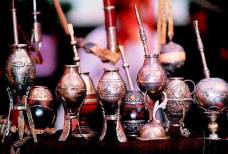
The word mate comes from the Quechua mati that means the cup or gourd used for drinking it. By the year 1740, this meaning was also applied for the hot infusion prepared with the Ilex paraguariensis (Yerba Mate), the Argentineans most favorite and traditional tea.
The Guaran� Indians have long drunk Yerba Mate in the rainforests of Paraguay and North-East of Argentina. They used it for healthful purposes such as cleansing and detoxifying the blood, tone the nervous system, retard aging, combat fatigue, stimulate the mind, and reduce stress and insomnia, among others. In the last centuries, the gauchos or farmers incorporated this ritual to their lives.
Nowadays, drinking mate has become a national and social event. It is common to find a group of close friends or a family sharing this infusion in a park or in any other public place. While the gourd passes from one person to the other, this ceremony is a symbol of companionship, friendship and mutual acceptance. Drinking it can also be a form of meditation or reflection but it is always a moment for communion. It certainly requires a nice and sympathetic atmosphere.
There are about 15,000 Yerba Mate farmers in the Argentinean provinces of Missions (80%) and Corrientes (20%). Between 1990 and 1996, the production grew more than 70% even though the consumption grew only 10%