

This is a true story. The futbol war happened. People died. Others prospered, just like always happens with any war. Even a silly war, like this one. Soccer may be just a game in other parts of the world, but in Central America it's an endemic form of madness that perennially returns to infect the entire populace for several months. Locally known as "futbol" - there is nothing else in the form of sports that can begin to approach the levels of passion it evokes in the land. It isn't hard to imagine a soccer game serving to start a war in this region, but the fighting that erupted between Honduras and El Salvador in July 1969, had been building up for a long time before the sporting event that provided the "Futbol War" label.
The underlying issue was - and still is - the matter of living space. Honduras had a population of about three million living in a land area of 43,277 square miles. El Salvador squeezed her four million people into 8,260 square miles. In terms of population density, Honduras had one citizen for each ten acres of its land area. El Salvador had eight people for each ten acres of national territory. The inequality of population pressures is intensified by the fact that thousands of acres of unused Honduras land lies just across a narrow river valley from El Salvador. Small wonder then that the Salvadoranians have trouble resisting the temptation to wade the river and set up housekeeping on the other side.
In 1960 it was estimated that some 60,000 Salvador nationals were in Honduras; 90% of them without permits or residency papers. At that time, a treaty was worked out between the two countries, whereby Honduras gave the illegal visitors five years in which to obtain legal status or get back across the river. In the stated five year period, about a thousand Salvadorans took advantage of the offer.
The first game of the two-out-of -three championship series was scheduled to be played in Honduras. The Salvador team came to Tegucigalpa looking for scalps, and the local events going on in the host city didn't help anything. When the visitors arrived, a teachers' strike was in progress. The educators had decided that one of the finest methods for calling public attention to their worthy cause was by sprinkling roofing nails in selected thoroughfares throughout the capitol city; a professional approach if I ever heard one. An epidemic of flat tires resulted, and the Salvador futbolistas were prominent among the victims. They considered the nails in the street as being directed against them, and harsh words were exchanged. They entered the stadium the following day chock-full of bitterness. The game was a bare-knuckle classic even by Central American standards. Honduras managed to get a score into the net during the last minute of play to give them the game 1- zip.
The populace went wild. Fights broke out between the respective loyalists, the stadium was set afire; and all had a good time. It was easy to tell who had personally attended the game: they were wearing splints and bandages for several days thereafter.
The second game was staged in San Salvador. When the Hondurans arrived in the neighboring capitol, the reception was a lot like the one the lions used to give the Christians in the Roman Coliseum: We're glad you're here, and you will find out why in due course. Among other breaches of etiquette, the hotel where the Honduran team was sleeping was put to the torch during the early hours of the night. Everyone got out unharmed, but arson doesn�t warm human relationships.
Then, after the Honduras team had been moved to another hotel and got back to bed, a group of Salvadorans decided to make it up to their much-abused visitors by serenading them. This misguided or Machiavellian bunch of alleged peacemakers sang under the windows of the Honduran soccer team for most of the rest of the night.
The motives of the songsters might have been the purest, but the Honduran contingent didn't think so. After escaping from a burning hotel and being an unwilling audience for several hours of amateur a-capella entertainment, the visiting team took to the field like a bunch of zombies - under police escort, it should be added. Needless to say, Salvador won the game. After-game festivities took the form of a citywide battle royal. Cars were set afire in the streets. Store windows were broken. Local hospitals set new attendance records. Miraculously, the Honduran team, by a combination of brilliant maneuvering and professional protection, slipped back across the border without actually losing a single man.
When the futbolistas got back to Tegucigalpa and began recounting their experiences in the sister republic, righteous indignation burst into flame. Goon-squads of Tegucigalpa soccer fans mounted a rumble against resident Salvadoranians that quickly turned into a very heavy scene. In addition to black eyes and cracked heads, bones were broken and people were killed. Honduras officialdom made no attempt to quell the thing at the outset; and later - when it had become a full-fledged bloodletting, they couldn�t stop it. After a couple of days of terror and violence that virtually paralyzed the entire city, the combatants got tired, went home to sleep, and things settled back to some semblance of normal.
With Salvador and Honduras each having won one game, there were no illusions about what was going to happen when they met in Mexico for the final confrontation. Radio, television and newspapers on both sides of the mutual border screamed for blood. Public passions were at a fever pitch and national pride was at stake. The final meeting promised to be a soccer game the like of which hadn't been seen since the Wellingtons squared off against the Napoleons, at Waterloo.
Everything except natural events and bodily functions came to a virtual standstill as national attention was riveted on the upcoming event. Radio stations and newspapers poured forth a continual stream of background information that was piped into the homes, businesses and cars of the total population via radio and TV. One could easily conclude that Honduras was suffering from a pandemic national earache, until you saw that they were little transistor radios that everyone had pressed tightly to the side of his head.
After a no-holds-barred contest distinguished by every imaginable form of mayhem and violence that the permissive rules of one of the toughest body contact sports around could countenance, El Salvador squeaked through to win it in the terminal seconds. In the stadium and throughout Mexico City, generally, a full-fledged riot ensued. Partisan spectators mauled each other in the stands; people were trampled in the melee; women were raped and a few persons were killed. Hospitals painted and posted "Standing Room Only" signs. It was really quite a party.
Honduras charged the officials with crooked officiating, and charged the Salvador team with cheating. Personal and national vilifications flew thick and fast, both on and off the field; and within a matter of hours the exchange of un-pleasantries were taking place at the highest levels of the respective governments. As sovereign sensitivities surfaced and blossomed, everyone got into the act.
PART B:
This part of an article from the El Salvador New Paper:
Who Won?
The "Soccer War," as it came to be known, left 3,000 dead, 6,000 wounded and caused $50 million in damage. Relations between the countries worsened and Honduras closed its borders to Salvadorans, blocked shipments of Salvadoran goods and stopped buying Salvadoran products. As Salvadoran emigrants returned home, land pressures and unemployment increased.
In the end, the Salvadoran military was the only group that benefited from the war. The "effectiveness" of the armed forces had been demonstrated, and Colonel Sanchez Hernandez rode a wave of nationalistic fervor into the presidency in the 1970 elections. The military-allied PCN received 60 percent of the vote versus 28 percent for the PDCs. Nonetheless, repression, torture and disappearances of dissidents continued.
PART C:
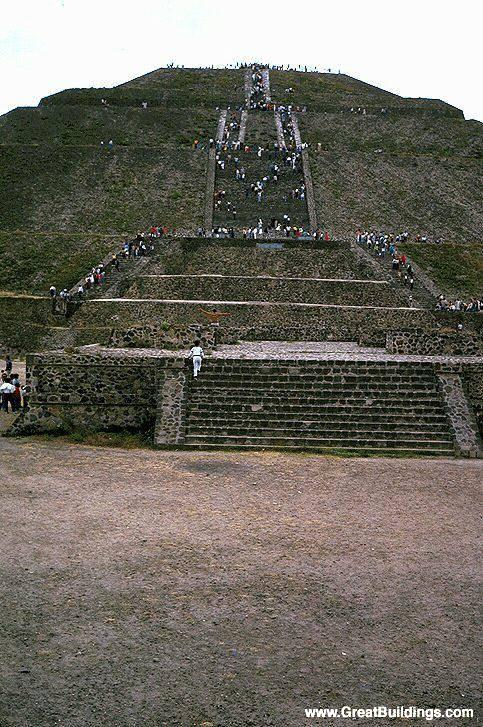
Any appreciation of ancient Meso-America's architectural splendor must begin with Teotihuac�n, the City of the Gods. Its two gigantic pyramid temples, dating from about the time of Christ, are the largest and oldest in the Americas and were models for all the rest. There, too, stand the remains of the Pyramid of the powerful god Quetzalcoatl, the Plumed Serpent. Teotihuac�n was destroyed by fire in the 7th century, but the Toltecs, who settled in central Mexico in the 10th century and established their capital at Tula, subsequently adopted the worship of Quetzalcoatl. Their Aztec conquerors were, in turn, heirs to the cult of the Plumed Serpent.