Motive,
Approach and Behavior
By Elder Johnny Outing Jr.
DO
YOU LOVE ME
A wife asked her husband,
“do you love me?” “Of course I do”,
replied the husband. With tears in her
eyes she responded, “then why don’t you show it?” On the defensive the husband replied, “here’s a hundred dollars,
go and buy yourself a new dress”. The
wife sadly replied, “Honey, it’s not the money that I want, I want you to show
me in your own way that you love me?” Still on the defensive, the husband
shouted, “You know I love you now go and buy the dress and leave me alone.” The
wife sadly walks away still wondering if her husband loves her.
THE FRIENDLY SKIES
An airplane takes off from
the airport with a reputation of producing smooth flights. During a recent flight a passenger exclaims
“I thought this plane only have smooth landings, this is the roughest landing
I’ve ever been on.” Voicing his
displeasure to the pilot, the pilot replied, “Our approach was not as smooth as we would have liked, we will work on
a good approach next time.”
I
DON’T SEE YOUR MOTIVE
The first story typifies one
expecting to know their motives;
however all one sees is your behavior that
can only be conditioned with a good approach. The husband expected his wife to see his motive of love for her but all she saw
was his bad behavior. Consequently, marital discord will set
in. The second story shows how
important the approach to landing an
airplane to demonstrate a good landing(behavior). All of that is necessary to reveal the motive of the airplane of being the
smoothest plane around. For one to
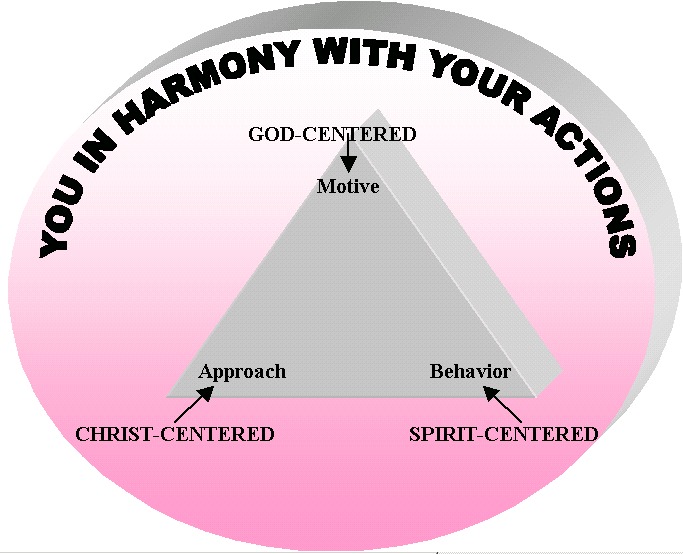
purify his or her actions your motive,
approach and behavior must be in harmony and maximized by the Triune God. In essence we should be God-Centered in our motives, Christ-Centered in our approach, and Spirit-Centered in our behavior. God wants to market the most precious product ever to the world,
salvation. The Christian is given an awesome responsibility to market this
awesome product. To maximize our sell,
we are to maximize our motives, to maximize our motive we are to maximize our
behavior, and to maximize our behavior we must maximize our approach.
WHAT
DO WE SEE?
How often do we take for
granted that people know our motives? We in essence expect them to see our motive, but in reality no one can see
your motives. However, one can see your behavior that is determined by the approach. The Webster’s student dictionary states that motive is, “Any idea, need, feeling, or condition that impels to
action; anything that prompts one to do something (i.e. incentive,
impulse).” Webster also states that
behavior is, “the manner of conducting oneself”. Behavior is everything dealing with our outward
responses(e.g. conversation, outward appearance, conduct). Approach is defined
as “to make advances in order to create a desired result”.
As human beings, we live two
lives, the real and surreal. Real life
is the actual event as it is being transpired.
The surreal life is the fantasy life that we often are living out in our
minds and emotions that is often conflicting with what is really going on
around us. Unfortunately, the surreal
life becomes so real to us that we often mistaken it for reality living out its
false illusions. Consequently, you
mistaken that every one in your world sees your motives but in actuality they see a different picture while you are
living a fantasy that they see and feel your motives. In the Christian
and secular world, we now want to be judged solely on our motives because
unconsciously we want to be in our on surreal world and not be in reality. Reality is too painful to live in so creating
our own surreal world is becoming more popular now. How often do you hear
people say when they need correcting in spiritual matters “God knows my heart
so don’t judge me” or “God is not concern with what I wear to church, he only
cares about my heart”? In essence they really believe you should excuse their behavior
because of their surreal belief that their motive is pure. Christians do not want to be corrected in
their dress and mannerism because they don’t see the importance of their behavior
should be in harmony with their motive. Today’s Church do not see the importance of our dress code in
public worship and how our dress should reflect our salvation. Sensual attire and overly alluring clothing
are the norm for church worshipers now. Are we sending conflicting signals to
unbelievers when we say we are saved but our dress code has a sensual look or
even a superior look? Perhaps our motive is pure and God does know our
heart; however, humans cannot see your heart or motive, they can only see your behavior. It is until one is willing to come out their
surreal world believing that everyone can understand their motives and deal
with the real world, will we see the importance that our behavior should be in
harmony with our motives. It is until
then one will understand the importance of their dress code, wholesome
communication, and conduct to maximize the marketing of Christ to the world.
How do we measure one’s motives? This is quite a difficult task and there is no conclusive
evidence to reflect one’s motives. What we can see his behavior and our approach
will determine the output of our behavior. However, one must begin to learn how do
maximize their approach to any given
situation that will ultimately lead to conducive behavior. First, approach as defined by the Webster
Student dictionary, is “a step or path taken toward accomplishing
something”. Behavior, on the other hand, is defined as “the manner of
conducting oneself”.
Genesis
4:3 And in process of time it came to pass, that Cain brought of the fruit of
the ground an offering unto the LORD.
Genesis
4:4 And Abel, he also brought of the firstlings of his flock and of the fat
thereof. And the LORD had respect unto Abel and to his offering:
Genesis
4:5 But unto Cain and to his offering he had not respect. And Cain was very
wroth, and his countenance fell.
Genesis
4:6 And the LORD said unto Cain, Why
art thou wroth? and why is thy countenance fallen?
Genesis
4:7 If thou doest well, shalt thou not be accepted? and if thou doest not well,
sin lieth at the door.
And
unto thee shall be his desire, and thou
shalt
rule over him.
Genesis 4:8 And Cain talked with Abel his brother: and it came to pass, when they were in the field, that Cain rose up against Abel his brother, and slew him.
Genesis
4:9 And the LORD said unto Cain, Where
is Abel thy brother? And he said, I know not: Am I my brother's keeper?
A GOOD
EXAMPLE OF BAD BEHAVIOR
A biblical example of approach and behavior is the story of Cain and Abel. In this story we find that two brothers gave a sacrifice unto the
Lord. However, the Lord did not accept
Cain’s offering as he did Abel’s.
Why? Because Abel brought his
first-fruits; whereas Cain just brought an offering. You cannot see Cain’s motive,
however his approach of not giving
his first or best revealed his hidden motive
that this offering is not all important.
The old maxim, “a first impression leaves a lasting impression”,
reflects the importance of approach. Your approach
to an event reveals a lot about yourself.
You can determine if the event is of importance or non-importance. In the case of Cain, by not bringing his
first-fruit or best offering showed that the offering was not important to
him. How often do we not bring our best
to the Lord? This only reveals that the
Lord is not that important to us.
After Cain’s approach
on giving was challenged by the Lord, his behavior
turned for the worse. First, he became
angry and secondly, his countenance fell or showed a bit displeasure. His countenance in essence was the approach he chose that resulted in a behavior of anger that was brewing on
the inside. To paraphrase, God told Cain
that his offering would be accepted if it was done well or he had given his
best; however he refused constructive criticism to improve himself and turning
his anger at his brother Abel. We often
get angry at the person that is giving constructive criticism that is design to
point out your strengths and weaknesses and end up turning the anger at the
other person. He should have dealt
with his behavior from the outset to
not give any room for malice and sin.
How many people are in jail or deceased because of their refusal to
master their approach to a
conflicting situation that will lead to temper their behavior from the outset?
Aberrant behavior leads to
anarchy, social and religious.
Unfortunately, the latter is more deceptive than the former. Those that are guilty of religious anarchy
usually camouflage their approach
with spiritual anecdotes and overtones, producing deceptive behavior patterns. It is until we become Christ-Centered in our
approach that you are taking
responsibility of yourself to learn to separate the surreal from the real to
produce good behavior. This will in turn allow you to be
Spirit-Centered in your behavior and
allow the Spirit make our lives transparent to transform us from spiritual
infancy to spiritual adulthood.
What happens if your behavior is pure and yet your motives
were impure?
Luke 22:46-48 And said unto them, Why sleep ye? rise and
pray, lest ye enter into temptation. And while he yet spake, behold a
multitude, and he that was called Judas, one of the twelve, went before them,
and drew near unto Jesus to kiss
him. But Jesus said unto him, Judas, betrayest thou the Son of man with a kiss?
Matthew 26:47-50 And while he yet spake, lo, Judas, one of
the twelve, came, and with him a great multitude with swords and staves, from
the chief priests and elders of the people. Now he that betrayed him gave them
a sign, saying, Whomsoever I shall kiss, that same is he: hold him fast. And
forthwith he came to Jesus, and said, Hail, master; and kissed him. And Jesus
said unto him, Friend, wherefore art thou come? Then came they, and laid hands
on Jesus, and took him.
This is the most deceptive out of the two
situations. In this passage we see that
Judas displayed great behavior but
Jesus noticed his deceptive approach
which revealed his impure motive. Jesus response, “betrayest thou the Son of
man with a kiss?” suggest that you can demonstrate good behavior without having a pure approach. We are living in very deceptive times in
which we need to really see the approach
and not just see the behavior. What was wrong with Judas approach? The answer is Judas approach
was conflicting and exaggerated. The
conflicting part of Judas approach
was he was walking with another group of people that was not in harmony with
Jesus and his teachings. Jesus taught
against the traditions of the chief priest and elders, so why would Judas be in
the company of a group that is against Christ.
The exaggerated part of the approach
was the kiss. Nowhere in the gospel was
there an occasion that Judas nor any of his other disciples greeted him with a
kiss. His behavior was good(the
kiss) but unnecessary or exaggerated for this event. How often we destroy our testimony because we demonstrate good behavior, such as greeting a fellow
Christian with a hug, but we destroy it by exaggerating the situation by adding
exaggerated compliments. We often think
we can impress people that we are spiritual and credible if we exaggerate our approach. For example, if you given the platform to testify in church and
you use all the right spiritual words; however, you destroy the testimony as a
time to tell everyone “I’ve been fasting for 10 days and I’m weak. You started the testimony with humility(good
behavior) but you exaggerated the
rest of it(bad approach). Why do you need to disclose about your fast?
Because you want to impress people that you are really spiritual. Christ knew Judas motives because he is God in the flesh, however, for our sakes
Jesus is giving Christians information on how you can detect impure motives even if the behavior is perfect. The answer is the approach. Why did Judas have to approach Jesus with a kiss and associate himself with scribes and
pharisees at his side? It is not
recorded in scripture that he had done this before.
It doesn’t take a spiritual minded person to detect
impure motives because of bad behavior. However, only the Holy Spirit can really detect impure motives when your behavior is exceptional. We
are often satisfied with our Christian life because we are not displaying
outward aberrant behavior. To be whole in God’s perspective, you must
equally examine your approach. Am I trying to bring attention to
myself? Does my statement fit the
occasion? Are just some questions we
should ask ourselves to maximize a wholesome approach. Let us allow the
Godhead temper every aspect of our lives: God-Centered in our motive, Christ-Centered in our Approach,
and Spirit-Center in our behavior. If we do so we will then be vessels of honor
that the Lord is calling for.
Pure Motive
= Pure Approach + Pure Behavior
Impure Motive
= Impure Approach + Impure Behavior
Impure Motive
= Impure Approach + Pure Behavior