Semantic Change
I don't provide the references for quotes of the Buddha I use here, as I have done that in my book.
When it comes to the Buddha's teaching I think we really have to decided if we are going to believe it is an illogical and imprecise teaching with many meanings to words, which need third party interpreters, or it is not. For a long time I didn't realise that I believed the former. When I decided to change this belief, the Buddha's teaching started to make sense as a very subtle and liberating teaching.
Sati
I have no doubt that an essential part of the Buddha's teaching is "mindfulness" or "awareness" and that, at least the English Theravada Vipassanaa meditation tradition, of which I am most familiar, greatly helps people develop it. I highly recommend such practice. What I am questioning is the theoretical understanding of and use of the translation of "sati" as "mindfulness" or "awareness".
It puzzled me that the English Theravada Vipassanaa meditation tradition speaks a lot of "sati" which it translates as "mindfulness" or "awareness", but according to the current records, the Buddha spoke little of "sati", with only 1 discourse specifically about it [Satipa.t.thaana Sutta with an extended version] and another, which is a particular application of "sati" [Aanaapaanaasati Sutta]. Apart from this he seems to only briefly mention it in the often occurring phrase "sati-sampajanya". I have found no discourse specifically on the important term "sampajanya".
According to the current Paali texts, the Buddha spoke a lot of the 4 ruupa-jhaana, e.g. detailing them in nearly half of the discourses in the Majjhima Nikaaya, but the English Theravada Vipassanaa meditation tradition, does not have a big place for the 4 ruupa-jhaana. It explains jhaana in line with the commentarial work by Bhikkhu Buddhaghosa as part of "samatha" or "calm" practice and that only the first [ruupa] jhaana is needed on the path. This explanation does not match with the definition of "Right Concentration" in the current records as ALL FOUR ruupa jhaana. [DN 22] It also does not take into account that it is the 4 ARUUPA-jhaana that the Buddha indicated are good to develop, but is not necessary for the path.
By applying the study method for the Buddha's teaching, it would seem to me that "jhaana" probably originally meant "mindfulness" or "awareness" and this is why the Buddha spoke so much about it. I think the meaning of the 4 ruupa jhaana teaching eventually got lost [through "semantic change"] amongst the "study monks". Early on two groups formed, the "jhaayins" and the "dhammazelots". I translate the latter as "study monks". The study monks knew the 4 ruupa jhaana teaching was an important teaching and related to concentration, but they had little experience of Right Concentration. Therefore in places where Right Concentration was spoken of, they inserted the jhaana teaching, with the hope to help others understand what the Buddha meant by Right Concentration. Another simpler definition of Right Concentration can be found, that is "any concentration with the previous path factors". I suggest the 4 ruupa jhaana teaching was originally a separate discourse in and of itself.
This is how I see the jhaana matching experience:
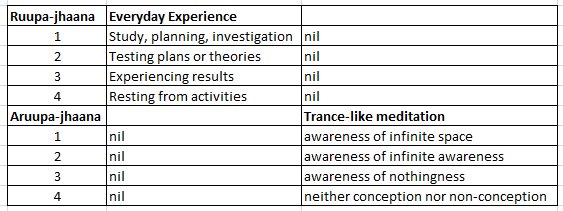
Until I had a theoretic place for study in my practice, I could not put the needed effort in to maintain my practice during study. Maybe this is the reverse for study monks and maybe this is the cause for the early division of monks into meditators and study monks. When our retreats include learning how to develop wholesome activities that should be part of everyday life, like study and dhamma discussion, then we will be able to more easily move our practice out of the retreat setting and we wont have created a psychological barrier, stopping us from pratcising during those times in everyday life that we want, or need, to do those activities.
Dhamma
Dr Primoz Pecenko [now deceased] my former Paali teacher, pointed out that "process" is one of the meanings of "dhamma"
in the Abhidhamma.
"Dhamma" is currently translated as "mental phenomenon" as well as other translations, but if we look at the Buddha's explanation of "ruupa" we can see that that meaning is already included there.
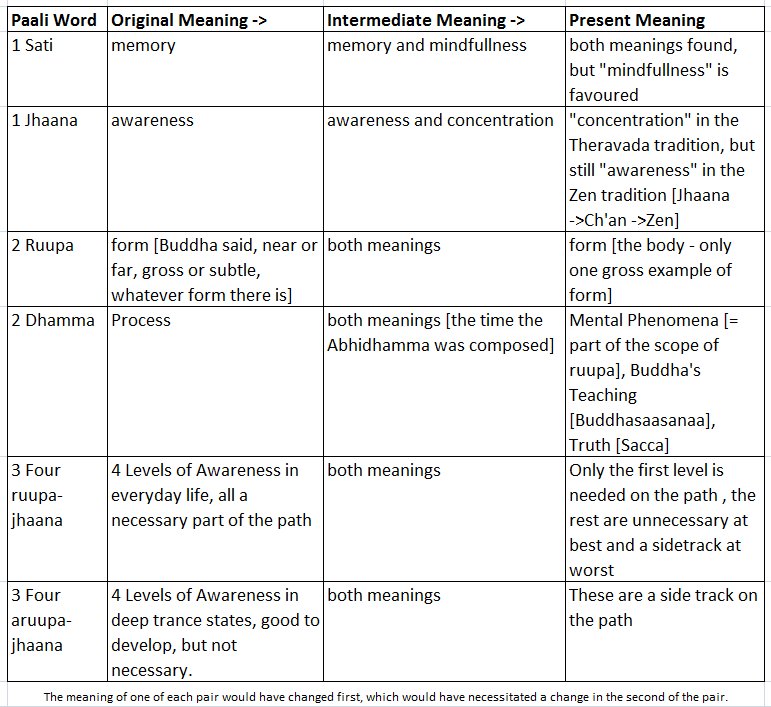
Summary Table
Back to: The Gift of the Buddha - A Happy Life.
