On Slow Learning for tenor, clarinet (B-flat), cello, and piano, set to a text by Scott Cairns, was written as an attempt to create a synthesis of different Western and non-Western compositional techniques in such a way as to highlight the lighthearted and yet keenly perceptive text. The pitch collection in the cello and tenor is drawn from the Indian raga kapi and the whole-tone scale. Rhythmically, the Indian tala tisra triputa, a metrical grouping of 3 + 2 + 2 operating on multiple levels simultaneously, is utilized frequently in the piano and cello parts and occasionally in the tenor. A minimalist-influenced piano ostinato of running 16th notes continues nearly unabatedly throughout the piece. The clarinet pitch-class content is serialized by a 7-note tone row, with all 28 rows of the resulting matrix used only once before any given row is repeated. The rhythmic content is also serialized into 7 cells each of 5 pitches creating an isorhythmic relationship between the rhythmic and pitch rows. The 7 rhythmic cells occur first in their prime form in ascending order, and then descending in inversion, ascending in retrograde, and descending in retrograde-inversion forms; the series then repeats, but with the prime and retrograde series descending and inversion and retrograde-inversion series ascending. The final cell of the last retrograde-inversion series, however, is substituted for a final cadential figure. Unfortunately, cell 5 of the prime series is inadvertently and inexcusably skipped both times the prime series occurs. The composer humbly apologizes for his error.
On Slow Learning was written with the composer and his three housemates in mind, and on 22 February in Houghton, New York it was premièred by these: Christopher Alberts, tenor, Brian Donat, cello, Joshua Mills, clarinet, and Adam Potter, piano, with Robert Summers Potterton III conducting. The recording of this performance may be heard here.
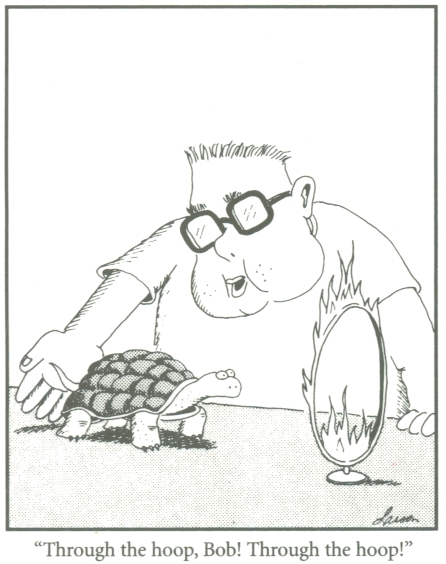
If you have ever owned
a tortoise, you already know
how terribly difficult
paper training can be
for some pets.
Even if you get so far
as to instill in your tortoise
the value of achieving the paper,
there remains one obstacle–
your tortoise's intrinsic sloth.
Even a well-intentioned tortoise
may find himself, in his journeys,
to be painfully far from the mark.
Failing, your tortoise may shy away
for weeks within his shell, utterly
ashamed, or looking up with tiny,
wet eyes might offer an honest shrug.
Forgive him.
– Scott Cairns