Oh, to vex me, contraryes meet in one:
Inconstancy unnaturally hath begott
A constant habit; that when I would not
I change in vowes, and in devotione.
As humorous is my contritione
As my prophane Love, and as soone forgott:
As ridlingly distemper'd, cold and hott,
As praying, as mute; as infinite, as none.
I durst not view heaven yesterday, and to day
In prayers, and flattering speaches I court God:
To morrow I quake with true feare of his rod.
So my devout fitts come and go away
Like a fantastique Ague; save that here
Those are my best dayes, when I shake with feare.
– John Donne (1572-1631)
English metaphysical poet and Anglical priest John Donne was born in London in 1572 to a prosperous Roman Catholic family. He studied at both Oxford and Combridge Universities but took no degree at either because of his refual to take the required Oath of Supremacy recognizing the English King as the head of the church. Donne's conversion to Anglicanism occurred in the 1590s, sometime after his brother succumbed to fever in 1593 while imprissoned for sheltering an Catholic priest. Pressured by James I, he took Anglican orders in 1615, which he had refused eight years earlier, and was later appointed Dean of Saint Paul's in 1621, a post he held until his 1631 death. His mesmerizing sermons, filled with elaborate metaphors and religious symbolism, established him as one of the greatest preachers of his age.
In 1617, not long after he had entered the ministry, his wife Anne died at the age of thirty-three after giving birth to the last of their twelve children, a child who was stillborn, leaving only seven to survive her death. It is this phase of his life to which Donne's Holy Sonnets are attributed. In the last of these nineteen poems, he couples his eloquent command as a poet with his experience of a wavering and inconsistent faith and devotion. This conflict, so common to the Christian journey and yet so often ignored, is what this piece tries to capture.
The piece is generally scored in a very sparse and soloistic manner in an attempt to communicate the high degree of intimacy and subtlety present in the poem. Lying beneath the complex and confliced surface of the music is a sense of a peaceful chorale which shows through in places with varying degrees. It is centered tonally on G (F in the Symphonic Band version), heard most frequently by the chimes in threes, but also draws on dodecaphonic material and what often resembles complex late-Renaissance style voice leading.
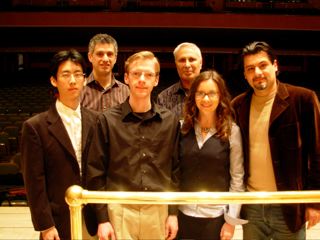
Holy Sonnet XIX was originally written for Symphonic Band and was re-orchestrated for full orchestra in November of 2006. This version was read by the Buffalo Philharmonic Orchestra under the baton of Robert Franz as part of their Young Composers' Forum along with works by Jennifer Bellor, Paolo Cavallone, and fellow Houghton composer Roc Lee. Guest composer John Corigliano was present at the reading to mentor participants, and he described the composition as “Beautiful. Beautiful,” also commenting that the piece possessed “great shape”. Composer Daniel S. Godfrey was also present and commented that the “…ideas have real life to them.” (In the photo, from left to right, are Roc Lee, Robert Franz, Joshua William Mills, John Corigliano, Jennifer Bellor, and Paolo Cavallone.)