 |
|
 |
 |
 |
 |
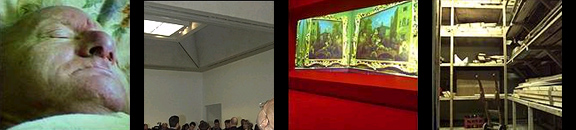
| Richard Billingham ...more photos of fat Liz and drunk Ray, more Jason swatting flies, and the cat - not levitating, but hurled across the room. from the Guardian - ful article online at: http://www.guardian.co.uk/Archive/Article/0,4273,4293526,00.html Probably the best known, certainly the best loved of the artists on this year's short list, Billingham was born in Birmingham in 1970. He studied at the university of Sunderland after being rejected by 16 other colleges. The photographs he took as source material for his paintings gradually supplanted the paintings themselves - a tragi-comic document of his family in their Birmingham tower block, recorded in Fuji-film snaps. Billingham's images, many anthologised in the hardback Ray's a Laugh, are collected by Tate Britain and the Metropolitan Museum in New York. He has also made short videos for Channel 4. William Hill odds: 11-4 from the Observer - full article online at: http://www.guardian.co.uk/Archive/Article/0,4273,4296452,00.html His blown-up records of life with his family at home in their cluttered council flat have a compelling and sometimes terrible candour, and at times a weird grandeur at odds with their everyday subject matter - mum Liz, smoking at a window, alcoholic Ray, laughing drunk at his reflection in a mirror. Billingham invests the dismal and the ordinary with an unexpected dignity. I guess the argument will be about his proximity to his subject (only an insider could do what he does), and the status of his work in relation to the genre of documentary photography. from Adrian Searle, the Guardian - full article online at: http://www.guardian.co.uk/turnerprize2001/story/0,7369,499033,00.html Martin Creed The spotlights come on - suddenly. The hidden fluorescents power up a nanosecond later. It's bright for a bit, then the lights go off in a fast, even fade - an effect achieved through pure electromechanics rather than the artist's tinkering. You think about the semi-darkness for a bit, then the lights come on again. from the Guardian - ful article online at: http://www.guardian.co.uk/Archive/Article/0,4273,4293526,00.html Born in Wakefield in 1968 and brought up in Scotland, Creed studied painting at the Slade. Although he no longer paints, he still wishes to present something on a wall - neon messages, ambiguous texts, minimal works made of Sellotape, Blu-tack or Elastoplast. A trained musician who performs in his own band, Creed has made 'serial music' out of metronomes. His last show, which toured Britain for a year, made him a popular public nomination for the Turner Prize. Commended for his 'characteristic mixture of seriousness and humour', he has the lightest touch on the short list. Odds: 3-1 from the Observer - full article online at: http://www.guardian.co.uk/Archive/Article/0,4273,4296452,00.html Isaac Julien Both films are immensely seductive works, enriched by multiple viewings. However, there are tiresome longueurs in Mazatlan - if I see those leg-kicking, pouting, camera-conscious hitch-hiking saloon girls (choreographed by Javier de Frutos) one more time, I shall scream. from the Guardian - ful article online at: http://www.guardian.co.uk/Archive/Article/0,4273,4293526,00.html Born in Bow in 1960, Julien studied at St Martin's School of Art. His full-length feature films - including Young Soul Rebels and biopics of Langston Hughes and Frantz Fanon - have won several festival awards, including Cannes. He also trained with the London Youth Dance Theatre and now collaborates with choreographers and composers to make video installations, often concerned with racial and sexual stereotypes, shortlisted for their combination of 'theoretical sophistication and visual beauty'. A visiting lecturer at Harvard, his work has been widely shown in contemporary museums. He lives in London and New York. Odds: 9-4 second favourite from the Observer - full article online at: http://www.guardian.co.uk/Archive/Article/0,4273,4296452,00.html Julien has made pop videos as well as politicised works on gay desire and Aids. He began as a working class Eastender, but ended up teaching at Harvard. His most recent films, shown as installations at Manchester Cornerhouse, were a kind of picaresque road movie set under the Texas sun, and a trip through the obscurity of London's Sir John Soane Museum. The best moments of these fractured narratives of desire, eroticism and memory have a real, almost visceral charge, and are captivating. from Adrian Searle, the Guardian - full article online at: http://www.guardian.co.uk/turnerprize2001/story/0,7369,499033,00.html Mike Nelson ...a shifting terrain in which objects, spaces and places are constantly recycled. He recycles authors too - Borges, Stanislaw Lem, HP Lovecraft, William Burroughs - along with a growing collection of detritus, junk, old doors and little piles of thrown-out objects. from the Guardian - ful article online at: http://www.guardian.co.uk/Archive/Article/0,4273,4293526,00.html Born in Loughborough in 1967, he studied at Reading and Chelsea College of Art and Design. He started making complex architectural mazes in the mid-1990s, beginning with the eerie Trading Station Alpha CMa. He has exhibited at the Tramway in Glasgow, the Collective in Edinburgh and, to excited acclaim, at Matt's Gallery last year. His fabricated environments, littered with cinematic, literary and historical references, have been painstakingly constructed at the ICA and the Venice Biennale this year. Nelson is nominated for the 'haunting resonance... of his open-ended narratives'. Odds: 7-4 favourite from the Observer - full article online at: http://www.guardian.co.uk/Archive/Article/0,4273,4296452,00.html Mike Nelson has been a kind of art world secret for some years. His work owes something to the haunting installations of Ilya Kabakov, though they are influenced by stories, by pulp fiction, rumours and movies, rather than life in the USSR. Nelson's installations are fictions made real: an abandoned room clawed to shreds by a frantic being; a sinister, backwoods trapper's camp relocated to the gallery; a maze of interconnecting waiting rooms, go-downs and cab-shacks from the seamier, sweatier corners of the world. from Adrian Searle, the Guardian - full article online at: http://www.guardian.co.uk/turnerprize2001/story/0,7369,499033,00.html |
|
| Billingham |
| Creed |
| Julien |
| Nelson |
| It is like ending up on Big Brother, without having volunteered. - Adrian Searle, the Guardian, May 31, 2001 |
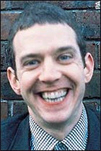
| The Turner Prize Winner 2001 is Martin Creed. What the papers said... The Guardian: Creed's The Lights Going On and Off, an empty room in which the lights do just that, is the most minimal work ever to win the �20,000 prize, so minimal in fact that many of those who have seen it were unaware it was anything more than dodgy wiring. "I can see why some people take the piss out of me," he said. "I quite like all that stuff in a way." Nor is he worried about how easy it is to ape him. "It's true, anyone can do it... It's just I'm better than anyone else at it." Despite the hullabaloo over The Lights Going On and Off, Creed was not the early favourite. Many felt photographer Richard Billingham was overdue the prize. Full article online at: http://www.guardian.co.uk/turnerprize2001/story/0,7369,616274,00.html The Independent: Blink and you'll miss it, the light work that took the Turner prize... In a joint statement, the jury said they "admired [Creed's] audacity in presenting a single work in the exhibition and noted its strength, rigour, wit and sensitivity to the site". Yet for all the detractors' claims that the Turner is a classic example of the emperor's new clothes, the harshest critics of all, the public, are still keenly interested. More than 1,300 people a day have flocked to the exhibition at Tate Britain so far this year, exceeding numbers for Tate Modern's blockbuster "Surrealism" show and putting it ahead of last year's Turner. It runs until 20 January. Full article online at: http://www.independent.co.uk/story.jsp?story=109277 Also from the Independent: The whole point of the Turner prize is to attract attention. So perhaps it's only right that the artist on the shortlist who attracts the most attention should win it. Full article online at: http://www.independent.co.uk/story.jsp?story=109276 The Times: AND the winner is Madonna. If anyone knows the art of shock tactics better than a Turner finalist, it is the self-publicising queen of pop. Presenting the Turner Prize last night, she easily upstaged Martin Creed, the prize recipient, by shouting a crude expletive live on national television. Rachel Campbell-Johnston, The Times art critic, had hoped that Creed would win: �His flickering installation may mean everything or nothing. But at least it gives the viewer something to look at, something more interesting than plotless movies and planks of wood.� Full article online at: http://www.thetimes.co.uk/article/0,,2-2001571415,00.html The Scotsman: Creed�s win again underlines the ability of the judges � led by Tate director Sir Nicholas Serota � to make the award a talking point. The award is regularly derided for focusing on avant garde art, rather than more conventional forms. Critics usually point to the absence of painters and not one was shortlisted among the four nominees this year. Full article online at: http://thescotsman.co.uk/scotland.cfm?id=128321&keyword=turner%20prize The Daily Telegraph: The artist, who recently moved to the island of Alicudi, near Sicily, says his work is about the qualities of "nothing". He has said of The lights going on and off that "it activates the whole of the space it occupies without anything physically being added and I like that because in a way it's a really big work with nothing being there". Full article online at: http://www.portal.telegraph.co.uk/news/main.jhtml?xml=/news/2001/1 |
|
 |
| Martin Creed |