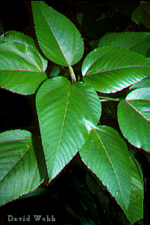
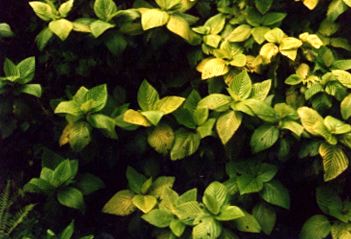
The olona plant grows in Hawaii. The scientific name of the olona fiber plant is Touchardia latifolia. Although it is not common today, this stout-stemmed rain forest shrub of the nettle family can still be found in the gullies of lower elevation forests, near the 2,000 foot level, or in very wet boggy interior valleys near streams.
With 4 to 8 foot tall stems in the wild, the bark of olona slips off easily, revealing the inner bark or bast, which is made up of fine quality fibers that are durable and said to be many times stronger than hemp fiber. When young, the outer bark is green, turning brown as the plant ages. After Captain Cook's arrival, later traders prized and purchases olona cordage for ship's rigging and for whaler's harpoon lines. Word reached Europe of the superior qualities of Hawai`i's olona cordage, such as it does not kink nor stretch, and Swiss climbers began to import it for their use in the mountains of the Alps.
Other uses for olona in ancient Hawai`i were as threads for stitching together cloth, into garments, for stringing and wrapping all manner of lei, to tie off the umbilical cord after a birth, for canoes lines and for every possible purpose that we today might use rope, twine, string or thread. Hawaiians made their fishnets, fish line and canoe rigging out of olona, from a shrub that grows only in Hawai`i.
In Italy there are tons of cities with Olona in the name. Here is a couple that is was able to find.
San Vittore Olona
Fagnano Olona
Olgiate Olona
Solbiate Olona
Vedano Olona
Castiglione Olona
Induno Olona
Gornate Olona
If you know other Olona facts that you would like to put on my site let me know by emailing me at
