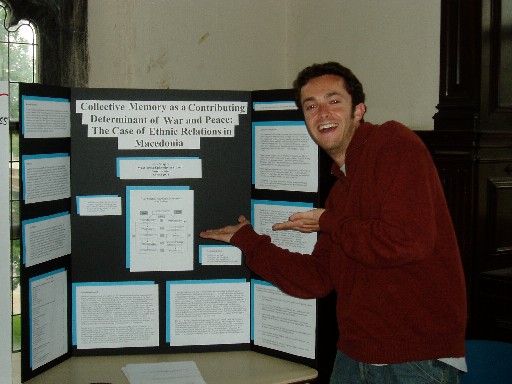
Title: Collective Memory as a Contributing Determinant of War and Peace: The Case of Ethnic Relations in Macedonia.
Abstract: This work is an ethnographic study on ethnic relations in The Former Yugoslavic Republic of Macedonia (F.Y.R.O.M.). The central aim of this work is to explain and show preliminary evidence that suggests collective memory plays a role in the current relations of Macedonian citizens. My thesis is that these memories can either create tension thus leading to violence, or build an atmosphere of tolerance thereby leading to peace. There is a large ethnic Albanian population residing within the borders of Macedonia, where the majority population are ethnic Macedonians. The first part of my hypothesis is that the existence of separate, hostile memories within each group and the way each group views key past events contribute to present ethnic tension. The second part of my hypothesis is that if different, more positive shared memories are cultivated across groups, this could result in improving ethnic relations. Part one of the hypothesis is tested in this research. In the absence of existing positive collective memories shared by ethnic Albanians and Macedonians, it is currently impossible to test part two of the hypothesis. However, I speculate about how such positive memories could be developed, and where they might lead in the Discussion section of this paper.
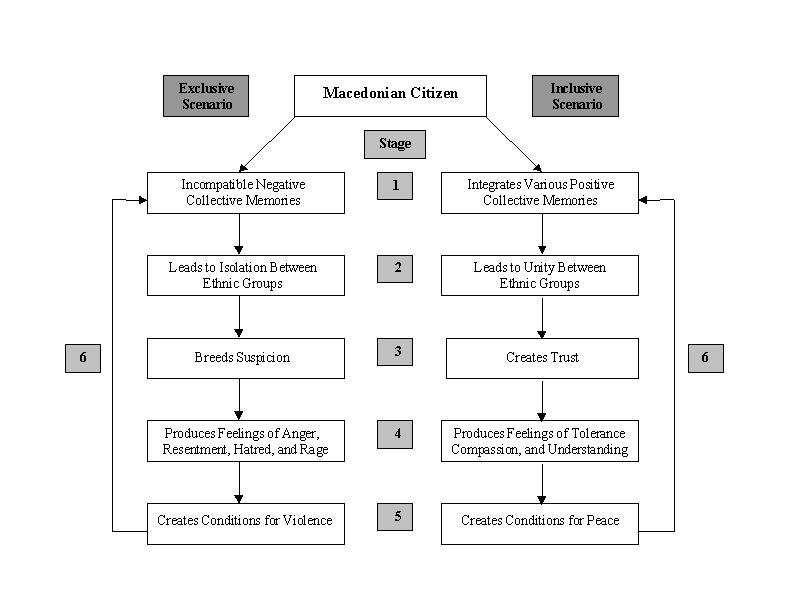
Hypothesis Model: Flow Chart for How Collective Memory Can Be Used
Conclusions: Throughout the course of this study I have tried to bridge many theories and disciplines in analyzing the case of ethnic relations in Macedonia. In so doing, I believe I have only touched the tip of a much larger and complex iceberg. The literature on collective memory is quite extensive and so too is that of conflict resolution. However, the overlap, which appears so critical to me, is nearly non-existent in the literature. The way in which the past is remembered and reconstructed over time will inevitably have a massive impact on the present and future generations.
From the data I collected, I have presented information which provides preliminary support for my original hypothesis: that negative, fearful collective memories lead to mistrust and ill-will, while positive, inclusive collective memories can serve to help reconcile antagonistic people to one another. A decision of conscience must be made and only Macedonian citizens can take the next step. Only Macedonians together are able to decide if they want to live in a peaceful and prosperous Macedonia. Only the Macedonian people can choose to engage in a process of reconciliation and forgiveness that leads to the construction of acceptable, inclusive, and unifying collective memories. Until this happens, there is little hope for lasting solutions to the ethnic tensions which plague Macedonia. The international community can only avert civil war for so long through diplomacy and peace-keeping operations, and inevitably will find it is unable, on its own, without the support of the Macedonian people, to destroy the root causes of suspicion and hate which lead to violence and war.
Senior Honors Thesis
Published by Washington University
Call number LD5791.8.AB2004 S49
May 2004