The Man With The Rainbow Brain; or, A Case of Synesthesia: Hunter S. Thompson 1937 - 2005 R.I.P.
by Joseph Waldman
Monday 21 February 2005, approx. 5:30 - 6:30 AM EST
To everything there is a season, Turn! Turn! Turn! and a time to every
purpose under the heaven:
A time to be born, and a time to die; a time to plant,
and a time to pluck up that which is planted;
A time to kill, and a time to heal; a time to break
down, and a time to build up;
A time to weep, and a time to laugh; a time to mourn,
and a time to dance;
A time to cast away stones, and a time to gather
stones together; a time to embrace, and a time to
refrain from embracing;
A time to get, and a time to lose; a time to keep, and
a time to cast away;
A time to rend, and a time to sew; a time to keep
silence, and a time to speak;
A time to live, and a time to hate; a time of war, and
a time of peace. I swear it's not too late.
Ecclesiastes 3:1-8, Pete Seeger, The Byrds, and me
After 35 years of us waiting, the dumb bastard finally did it. I got the news that Hunter Thompson was dead this morning at about 5:15 as I turned on the TV news after a night spent up reading, writing, swilling tea, and smoking as nervously as a Russian.
He went about as was to be expected, dead of a bullet in the brain at his own hands, which was probably the only way he could have gone. No phamarmaceutical cocktail was ever strong enough to penetrate the bald folds of flesh and massive cranium to get at the center of that swirling mass of gray neurons and strike it down. It would have taken hot lead. As, it turns out, it did.
Hunter was a genius and a madman in so many different ways that it's impossible to figure out just which ones stand at the top. He was the ultimate gutter poet: trash-talking, always frenetic, working nonstop at the speed of sound and with not a fuck's worth of empathy for the sacred conventions of the elite journalists' club. He was a menace to his editors all through his career, and I say God bless him for it. Anyone who takes the Fourth Estate way too seriously and starts bleating about how journalism is the bedrock of American liberty deserves to have his ass handed to him on a platter. The Second Amendment is just as important as the First, as Hunter Thompson knew all too well.
I first became acquainted with him on my final day of high school, the 29th of May 1998. By strange coincidence this was also the day that Barry Goldwater, another personal hero of mine and also a hero to anyone who loves liberty and the Western Way, stepped on a rainbow, and also the day after Phil Hartman was shotgunned to death by his crazy wife out in Los Angeles. (The afternoon of Hartman's death, my friend David Lorch came running up to me in the school library, saying "Guess who's dead?" Political junkie that I was, and knowing that Goldwater was not doing well, I surmised that it was either him or Ronald Reagan. Who ever would have guessed Hartman?)
But back to Hunter. We had a half day of school, then a brunch at the local fancy restaurant for all the graduating seniors, and then we were free. I was most free of all. I was dying to get out of there, to go to college, to get the hell out of my miserable teenage life, to go crazy and meet girls and maybe do drugs and drink a little bit, too, none of which I had managed to do before then.
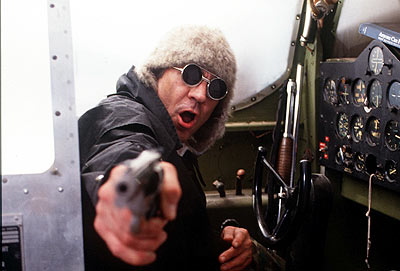
So it was that I schlepped my rustbucket Toyota (soon to die a painful death from radiator failure on the Southfield Freeway a week later) over to the glitzy Star Southfield to take in "Fear and Loathing in Las Vegas," commercials for which I'd been seeing on and off for a couple weeks. I was the only one in the theater that afternoon, which is usually a pretty pathetic way to take in a movie, but somehow this time I didn't care. It looked fun.
And O, was it.
Jesus Christ, what a hoot! It didn't make any sense at all. That was what was so great about it. It took all the psychedelic madness and pretense of the awful Sixties and distilled them down into a good old fashioned American road trip: what "Easy Rider" could have been if it wasn't so slick. And hell, the guy was just as nervy and edgy as I was, and mumbled ten times as much, if such a thing was possible.
I left the theater with my head reeling. "Hot damn!" I thought. "This is what I've been missing all these years! This is what my wonderful hippie uncle Greg was chasing all those years in the Seventies, riding his BMW bike out to Colorado, rock and roll and the American Dream, until he finally ran into a telephone pole in Illinois one hot August night in 1980. This is liberty at its finest! This redeems the baby boomers, almost!"
And I was like that for almost a year. My first year of college, trying desperately to be a pretentious English major, I did what probably every dork like myself does at one point or another: I turned in a review of "Fear and Loathing in Las Vegas" (the book, which I'd meanwhile managed to get my hands on a copy of) -- typed maniacally in about four hours the night before it was due in a fuel of caffeine and adrenaline, full of awful ripoffs of Hunter's own unmistakable and unstealable style -- in place of a review of, I think it was "The Hound of the Baskervilles," that I'd been assigned. Dr. Prindle rightly told me to knock it off, and graciously gave me a second chance, which I gratefully took.
But the unshakeable spirit of Gonzo was always with me. A year later, in the autumn of 1999, I ran for the student legislature on nothing more than a plethora of my own creative poster designs, one of which featured the famous upraised fist from Hunter's 1970 campaign for sheriff of Aspen, with the label "Freak Power Redux!" It almost worked -- I came in third out of three for my dormitory with two seats up for grabs, but the vote tally was something like 42-37-33, and the only reason the other two people won was that one of them was an RA and one of them was in a sorority. So I knew that I really had the vox populi behind me.
That autumn, too, I discovered just what I'd been missing all those years. In the midst of the heartbreak of watching my aunt Anne go off chemotherapy and die, which required me to shuttle back and forth from Columbus to Chicago first to visit her and then for the funeral, I stopped being scared of the things that make life so pleasurable and fine. That is to say, I lost my virginity (to only the second girl I'd ever so much as kissed), I got drunk for the first time, and I discovered that the prohibitionary laws of the United States were really not all they were cracked up to be, and that smoking pot was actually kind of fun.
And for all of this, in a way, I have Hunter to thank.
Things, of course, went on quite a downhill slide not long after that. I think it had something to do with the millennium. I went through a very extended period of betrayal by some very close friends and then sank into a very long depression, lasting through and past my graduation in 2002, which hampered me in all sorts of creative and professional ways. Then, too, there was September 11, which changed all of us, Hunter no less than you or me. In his column for ESPN written that evening, he seems just as shocked and angered as the fiery patriot not too many of his hippie readers would have liked to admit that they were at heart.
Because Hunter was, after all, a very American writer. I'll never forget that scene in the film of "Fear and Loathing," when he and his attorney are running around the Pacific shore just before they head off on their madcap adventure, and Hunter has a huge American flag draped around him like a cape. Which, in many ways, is what a flag should be. It can turn a man into Superman. (Side note: a friend and I used to get very drunk and put flags around our necks as capes -- his was the Nazi swastika, mine was the Soviet hammer-and-sickle -- and run into each other in the halls of Smith Hall East at Ohio Wesleyan University, screaming at the tops of our lungs as we re-enacted World War II. But that's a story for another time.)
And he was always grappling with the depths of Democracy in America, too, just as much as Whitman. "Fear and Loathing: On the Campaign Trail '72" is still a hoot, thirty-three years after it was written, and punctures most of the pretentions of American politics that the stiffness of Richard Nixon and his two equally awful predecessors had managed to foist upon it. "America is the Happy Kingdom," wrote P.J. O'Rourke, another of Hunter's disciples, echoing Hunter's "Kingdom of Fear" (and part of my triumvirate of libertarian literary idols, along with Hunter and Lester Bangs), and its political bases should be just as fun. Name me one other country in the world where the two definitions of "party" -- i.e. "political organization" and "gathering of fun" -- are so intertwined as to be indistinguishable. Liberty means laughter, and Hunter got more than his share of both. And now he has passed the test of the Egyptian scales and become just another star in the American flag.
So, as I sit in this snowy Michigan morning trying to figure out what more there is to say before I prepare to pull myself out of my funk and go relocate to Washington, DC and find a job -- a week after cleaning out my closet and finding, at last, my treasured old paperback copy of "Fear and Loathing in Las Vegas" -- I think it best to leave you with Hunter's own words, some of the most beautiful I have ever read. From chapter eight of the Bible for us Bastards of Young, "'Genius 'Round the World Stands Hand in Hand, and One Shock of Recognition Runs the Whole Circle 'Round'". Everybody get together.
"Strange memories on this nervous night in Las Vegas. Five years later? Six? It seems like a lifetime, or at least a Main Era -- the kind of peak that never comes again. San Francisco in the middle sixties was a very special time and place to be a part of. Maybe it meant something. Maybe not, in the long run . . . but no explanation, no mix of words or music or memories can touch that sense of knowing that you were there and alive in that corner of time and the world. Whatever it meant . . .
"History is hard to know, because of all the hired bullshit, but even without being sure of 'history' it seems entirely reasonable that every now and then the energy of a whole generation comes to a head in a long, fine flash, for reasons that nobody really understands at the time -- and which never explain, in retrospect, what actually happened.
"My central memory of that time seems to hang on one or five or maybe forty nights -- or very early mornings -- when I left the Fillmore half-crazy and, instead of going home, aimed the big 650 Lightning across the Bay Bridge at a hundred miles an hour wearing L.L. Bean shorts and a Butte sheepherder's jacket . . . booming through the Treasure Island tunnel at the lights of Oakland and Berkeley and Richmond, not quite sure which turn-off to take when I got to the other end (always stalling at the toll-gate, too twisted to find neutral while I fumbled for change) . . . but being absolutely certain that no matter which way I went I would come to a place where people were just as high and wild as I was: No doubt at all about that . . .
"There was madness in any direction, at any hour. If not across the Bay, then up the Golden Gate or down 101 to Los Altos or La Honda . . . You could strike sparks anywhere. There was a fantastic universal sense that whatever we were doing was right, that we were winning. . . .
"And that, I think, was the handle -- that sense of inevitable victory over the forces of Old and Evil. Not in any mean or military sense; we didn't need that. Our energy would simply prevail. There was no point in fighting -- on our side or theirs. We had all the momentum; we were riding the crest of a high and beautiful wave. . . .
"So now, less than five years later, you can go up on a steep hill in Las Vegas and look West, and with the right kind of eyes you can almost see the high-water mark -- that place where the wave finally broke and rolled back."
Good-bye, baby, and amen.
� 2005 Joseph Waldman