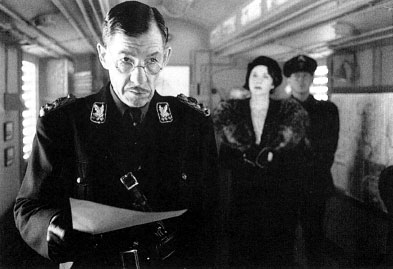
Over the years, there have been numerous attempts by filmmakers and playwrights to provide a "fresh face" for some of Shakespeare's best-loved works. One device that these writers seem to employ with great regularity is to take the entire play and transplant it - original dialogue and all - to a completely different time period. Some times this is a disaster; Baz Luhrmann's horrendous re-telling of Romeo and Juliet is a perfect example, as is Michael Almereyda's version of Hamlet. They are both set in modern times, and the result is universally recognized as being disastrous. (Jack Bender's version of The Tempest, set in the Mississippi bayous during the Civil War, is another instance of a poor temporal decision.) At other times, the transition seems to be transparent, having no real impact on the story as a whole. Branagh's Hamlet is an excellent example of this, as is his Love's Labour's Lost. Then, there is that rare time where the change of period actually adds something to the play; brings something out that was not there before. This version of Richard III, adapted for the screen by Ian McKellen, is such a film. There are a few moments when the setting seems a little jarring. (The "My kingdom for a horse" line comes to mind here. Also the scene where the Queen Mother begs her daughter-in-law to confront the evil Richard, and then flees from England in an airplane.) But there were many more scenes where the setting not only seemed to fit perfectly but to add symbolism to the play. There were some very interesting Nazi symbols that helped the audience better understand exactly how horrible Richard's character actually is. Also, the turmoil connected with that time in world history fits very nicely with the general anarchic feel of the story. Visually, the film was also very interesting. Peter Biziou has been heavily involved with British films in the past, including several Monty Python films and Peter Weir's Truman Show. But this is definitely some of his best work. Excellent uses of light and shadow, and also of fire. However, as with most British films, the real strong point is not in the technical details, but in the cast. Although I didn't care much for the Americans (especially Downey), the British stage influence is really wonderful. Maggie Smith and John Wood are solid, Nigel Hawthorn and Jim Broadbent are excellent, and Kristen Scott Thomas is exceptional. But Ian McKellen is simply amazing. The man is, quite simply, one of the best actors I have ever seen. The difference between his Gandalf and his Richard is huge; it is hard to imagine that one man could do them both so convincingly. There is a scene at the beginning of the film (actually taken from Henry IV, Part II) that is particularly chilling. Then, there is a scene right before the major battle at the end of the film - where Richard grapples with his own conscience - that is itself worth the price of admission. Somehow, after all the horror and villainy, McKellen still manages to make you pity him. Another very interesting aspect to the film is the way that Richard narrates events by looking directly at the camera, sometimes even while the people he is talking about murdering are wandering around next to him. That is really effective, and very, very creepy. All in all, an excellent movie experience, although I really didn't care for the ending. Just a little too strange.
"Why, I can smile and murder while I smile: and cry, content, to that which grieves my heart; and wet my cheeks with artificial tears, and frame my face to all occasions." |
|