
8 of 10
Cinematography by Kazuo Miyagawa
Toshir� Mifune
Machiko Ky�
Masayuki Mori
Takashi Shimura
Minoru Chiaki
Kichijiro Ueda
Fumiko Honma
Daisuke Kat�
|
|
|
|
|
|
|
|
||||||
| Rashomon 8 of 10 |
||||||
| Directed by Akira Kurosawa Cinematography by Kazuo Miyagawa Toshir� Mifune Machiko Ky� Masayuki Mori Takashi Shimura Minoru Chiaki Kichijiro Ueda Fumiko Honma Daisuke Kat� |
||||||
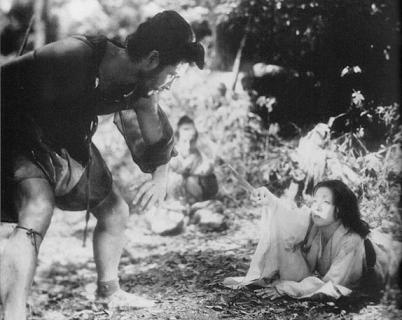
| In my mind, the late Akira Kurosawa is the absolute master of visual imagery; no doubt about it. He is the master of the still shot, and he uses colors like no one else I have ever seen (with the possible exception of Kubrick, whose countless other faults undermine his singular artistic ability.) Just think about Ran. It is simply breathtaking. The contrasts Kurosawa creates there are amazing. (The siege scene comes immediately to mind, as does Lady Kaede's death scene.) Now, imagine that Kurosawa was told that he could not use colors. What would the result be? Such a command would not just handicap most visual directors, it would destroy them. Kurosawa, however, produces black and white films that are just as - if not more - visually striking than the ones he creates with a full palate. And the key, I think, is that he films everything exactly the same way. Black and white is a radically different medium from color, but Kurosawa simply ignores that distinction. If something is beautiful, it will be beautiful whether you see it in color or black and white. His use of light and shadow is as amazing as his use of colors. So, his early films are still certainly worth watching for their visuals. And Rashomon is no exception. There are several amazing shots, including an extended scene where the woodcutter walks through the forest in a long, uninterrupted shot that brings to mind current SteadiCam effects, some 30 years before their time. The scene where a man tells the story of his death through the mouth of a female medium is also spectacular. And the film's opening, with its amazing use of rain, has been an inspiration for myriad gangster movies and serious dramas. But the truly amazing thing about this particular film is its story. Essentially, it is the recording of a crime, but told from 4 different perspectives. And when it is all over, it is very difficult, if not impossible, to understand what has actually happened. Kurosawa seems intent on showing that there is almost no black and white in real life. The result is a complex, thoughtful story, and one that is well worth seeing again. | ||||||