
5 of 10
Cinematography by Pawel Edelman
Adrien Brody
Thomas Kretschmann
Frank Finlay
Maureen Lipman
|
|
|
|
|
|
|
|
||||||
| The Pianist 5 of 10 |
||||||
| Directed by Roman Polanski Cinematography by Pawel Edelman Adrien Brody Thomas Kretschmann Frank Finlay Maureen Lipman |
||||||
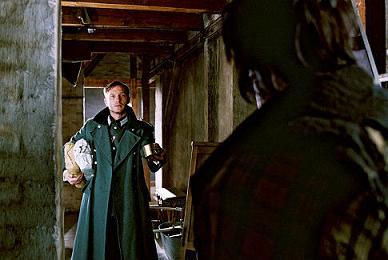
| Stylish, technically brilliant movie shot by a beloved and estranged Hollywood icon, dealing with the most famous historical creation of the last century, and with a critically acclaimed lead performance. Sounds like a real recipe for success, doesn't it? If your notion of success is a "surprise" Oscar win, then The Pianist was indeed a success. But if your notion of success includes any concept of emotional attachment or empathy from an audience, then it was a dismal failure. There is something strangely removed about the whole thing. And I think it starts with Brody. His Wladyslaw Szpilman is almost completely unappealing; he only shows an emotion (other than fear) once in the film, and even his fear seems that of an irrational animal rather than a human. The effect of this fact on the entire story is devastating. It seems to me that the most essential part of a Holocaust film is the audience's awareness of the horror of what is happening. But for that, you need to feel an attachment to the person or the people involved. And that is wholly lacking here. Another serious weakness is the strange way Polanski portrays the violence of the Holocaust. The Nazis are incredibly casual. But that's not necessarily the problem. The problem is the flippant attitude with which Polanski seems to treat it. The atrocities seem to happen almost by accident, and the camera seems to just happen upon it as it goes by. It never really seems to have as much of an effect on the viewer as one would expect. Also, there have been a slew of Holocaust movies made recently. And there was really nothing original told in the film. It seems to be a sterile re-run of previous films. Thomas Kretschmann's sympathetic German officer is something different, however. And I became seriously interested in him, even though he was only onscreen for about ten minutes. (His story is quickly dropped. A little blurb at the end is the only way you would ever know what happens to the only real character in the movie.) Finally, story seemed too short and the film seemed too long. It was visually striking, but the absence of story and characters left you feeling hollow. It was a story without a soul, although I understand that it seems strange to say such a thing about a Holocaust movie. Maybe that shouldn't surprise me, coming from Polanski. Shame on the Academy; this victory was definitely politically motivated. I have one last note: there was far less music in the film than I had been led to believe: only a couple of Chopin pieces and a small segment of a famous Beethoven sonata. And somehow, even that small amount of music was under-used. Polanski said that it was a film "about the power of music, the will to live and the courage to stand against evil." Maybe that's what he wanted it to be about. Sadly, he failed on all three counts. | ||||||