
6 of 10
Cinematography by Chris Menges
Charlize Theron
Frances McDormand
Sean Bean
Woody Harrelson
Richard Jenkins
Sissy Spacek
Jeremy Renner
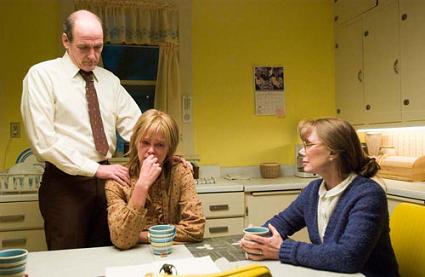
As the film opens, Josey Aimes (Charlize Theron) flees from an abusive relationship, taking her young son and daughter with her. Back in her hometown, she takes up residence with her parents (Sissy Spacek and Richard Jenkins), and begins to search for a means to support her own young family. Her childhood friend Glory (Frances McDormand) suggests she apply for a job at the local mine. (Glory herself is a bit of a legend to the area women: having broken the barrier as the mine�s first female employees, she is the lone female representative on the neighborhood union board.) After some hesitation � and strong resistance from her father, himself a mine employee � Josey decides to submit an application, and is quickly accepted.
She immediately begins to experience harassing, degrading comments from her foreman Arlen Pavich (Xander Berkeley) and nearly every other male mine employee. Bobby Sharp (Jeremy Renner), a childhood flame and Josey�s quasi-supervisor, makes a particular point of trying to break through her defenses. As matters at the mine worsen, Josey�s personal life begins to feel the strain. She grows gradually more isolated from the community, from her largely disapproving parents, and even from her own children. Her friend Glory and her husband Kyle (Sean Bean) try to alleviate the situation by introducing her to a former local hockey hero and lawyer: Bill White (Woody Harrelson). But just as Josey�s life seems to be stabilizing, Glory is diagnosed with Lou Gehrig�s disease.
Glory subsequent withdrawal into her own suffering leaves Josey without an ally. Though her female co-workers are privately disgusted by the behavior they experience every day, they live in constant fear of reprisals. Josey, on the other hand, is made of sterner stuff. She speaks out against the abuse, even meeting with the mine�s owner, Don Pearson, but there is no relief. Pavich and his cohorts convince Pearson that her accusations are baseless, and the mine�s women reap the frightful consequences of Josey�s �betrayal.�
Finally, matters at the mine come to a head. Sharp, emboldened by his fellow workers� unchecked harassment, assaults Josey. Humiliated by her inability to defend herself, and frustrated by the company�s unwillingness to protect her from her own co-workers, she quits the mine. Once clear of its choking grip, she convinces Bill White to help her in bringing suit against the mine. The resulting trial, accompanied by a campaign of character assassination and personal humiliation, proves to be far more damaging than she could ever have imagined. Her family and friends, forced to choose between Josey and their life-long commitment to the mine, struggle for and against her. But she presses on, confident in her belief that this battle is worth fighting. The conclusion of this trial (and the film) forces Josey to confront her past trials and current personal struggles. It also forces the town and the mine to examine its own mores and confront its implicit approval of age-old discriminations.
Stylistically, the film is unexceptional. Its cinematography relies far too heavily on aerial shots of the vast sprawling countryside and the imposing squalor of the mine itself. These shots create a feeling of distance that seems at odds with the film�s message and emotional themes. The acting, on the other hand, suffers from no pedestrianism. It is superb on every level, with the possible exception of Harrelson, who seems marginally uncomfortable in his role as friend and legal advisor. Bean, Jenkins, and McDormand are particularly noteworthy, bringing a depth and subtlety to their characters that is most refreshing.
These performances, exceptional though they are, (or perhaps precisely because they are exceptional), highlight the film�s primary weaknesses. As in her previous film, the enchanting Whale Rider, Niki Caro�s work seems plagued by an excessive need to teach: the film�s agenda is of paramount importance. An immediate result of this often praise-worthy singleness of purpose is the reduction of nearly all characters and events to two-dimensional stereotypes. Part of this is certainly the result of the film�s �court-room drama� feel, a genre that has become nearly impossible to raise above its clich�s. (There is one courtroom flashback scene that does indeed rise above the genre in a spectacularly effective fashion. But its presence only heightens the frustration caused by the other boilerplate sequences.)
Watching the film, one is struck by how safe it is, how correct. The story is certainly worth telling, and is, as the opening titles carefully point out, �inspired by a true story.� But the events and characters it contains are lifeless. They have been seen countless times before; it is nearly impossible for them to invoke a strong emotional reaction. From the �local bully finally revealed as the coward he truly is� to the �brutal, insensitive miners masquerading as men� to the �angst-ridden female co-workers struggling to decide whether to embrace their fear or their friend,� these are characters that have become conventional through sheer mass production. Theron, in a role that is certain to generate substantial Oscar buzz, is painting firmly inside the lines. The portrait is an impressive one, but she is nowhere near the edge of her character. Only Bean and Jenkins clearly rise above their stereotypes. Even McDormand�s role suffers from the agenda-laden message.
This failing does not reduce the film to a mere technical exercise. Indeed, there is much to enjoy here, from the excellent acting, to the meticulous recreation of the film�s time period, to Caro�s sure-handed direction. Still, one cannot help but feel that the film is taking exactly the opposite tact from its main character. Josey was willing to push the boundaries of custom and tradition, to break away from the teachings of generations of her fellow miners. She recognized that for much to be won, much must be risked. It is unfortunate that the film fails to follow her example.
10/24/05