
6 of 10
Cinematography by Raoul Coutard
Anna Karina
Sady Rebbot
Andr� S. Labarthe
Guylaine Schlumberger
Brice Parain
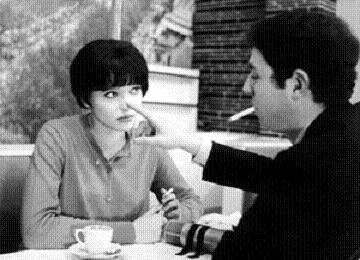
The idea of telling the story through 12 fairly unconnected vignettes appealed to me, as well. It provided a feeling of detachment to the film that was important as Nana moved further and further down the path to destruction. A more traditional story structure would have made her demise much more painful, and possibly less effective for this very reason. I also particularly enjoyed the way Godard drew the comparisons between Nana�s experience at the theater and the final tableaux, even down to the subtitles.
This film was my first Godard, and two things were immediately clear to me as I watched. One of these is a positive, but the other nearly destroyed my ability to enjoy the film. (Luckily, Karina was able to overcome my stubborn irritation.) The first, which elicited a definitely positive reaction, was Godard�s amazing ability to capture small, seemingly insignificant moments and use them as a means to convey real truth. Almost as if in passing, he sheds a keen, insightful light on what we would consider mundane little details. That ability is rare, and he seems to possess it in spades.
Unfortunately, something else he also possesses in spades is a stubborn insistence on filming things against established cinematic conventions: filming an entire conversation from behind the protagonists, so that we never see their faces, for example. Now, its true that it is never good to be slavish about conventions. But it is also true that many conventions have valid reasons for existing. When I watch a film, I watch people�s eyes, and their faces. That is how they convey emotion. The back of the head � even an incredibly expressive one � just can�t do that. Certainly Godard did it for a calculated reason, but mostly it felt like a child rebelling against its parents: �I won�t do what you tell me to�because you told me to.� I just couldn�t get around that fact, alternating between being amazed by his ability to show me something new and insightful and irritated by his stubborn refusal to show it to me in a manner that would appeal.
These two facets of his film-making frustrated me. Maybe he can�t do one without the other; maybe asking him to be more traditional would damage his artistic eye. And maybe it�s a matter of maturity on my part. But at present, I found it to be a touching, insightful film, anchored by a fantastic performance, and nearly ruined by its director.