
1of 10
Cinematography by Roger Deakins
Tenzin Thuthob Tsarong
Gyurme Tethong
Tulku Jamyang Kunga Tenzin
Tenzin Yeshi Paichang
|
|
|
|
|
|
|
|
||||||
| Kundun 1of 10 |
||||||
| Directed by Martin Scorsese Cinematography by Roger Deakins Tenzin Thuthob Tsarong Gyurme Tethong Tulku Jamyang Kunga Tenzin Tenzin Yeshi Paichang |
||||||
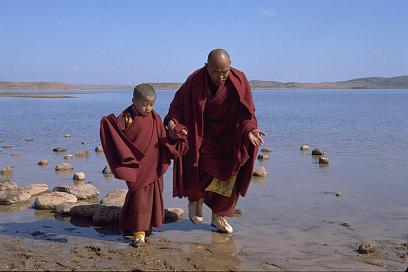
| This was the first film I saw that was directed by the legendary Martin Scorses. And it made me think that maybe it would be the last. It is the biography of the early life of the current Dalai Lama, who is somewhat of a fad amongst the politically liberal, a.k.a. Hollywood. And this film is no exception. Martin Scorsese used real Tibetan refugees in filming this story, apparently because he felt someone who had not been exiled would be unable to accurately portray the emotions involved. This seems pretty gimicky to me, a theme which runs throughout my opinion of the film. It just feels really artificial. The visuals, for example, which were greatly praised by critics everywhere, were really, really gimmicky. "Let's go flying around the four outside corners of this house for no apparent reason. Good job. Now, let's cut back to the story. Oh. And let's film as many things sideways as possible." If Roger Deakins would have just held the camera still, and let the beautiful scenery he was filming speak for itself, he would have been just fine. (In fairness, he does leave some shots alone, and whenever he does, the scenes are breathtakingly beautiful.) But overall, he shows very little restraint, something which is true of Scorsese as well. Scene after scene is used to bludgeon the viewer over the head with information about how unique the Dalai Lama is in his message of tolerance and peace amongst the world leaders of his time. Or we are overwhelmed with scenes that are meant to show how wise and kind he is. Or to show how much he hates violence. Or how evil the rest of the world is not to support him in this message (especially, apparently, America and Harry Truman.) These things may all be true, but the conversation is so one-sided, its impossible not to think that there is probably a lot more to the story than is shown here. It just feels too much like I am being forcefully spoon-fed Scorsese's own personal little political message, and I hate that kind of thing. Something else that I found very distracting was the film's music, also critically acclaimed. It's by Philip Glass, who fancies himself a serious composer at times. And since I've heard his single cord compositional style used in other movies, I kept expecting Truman Burbank to pop up at any moment. Which would have been just fine with me, because it would have at least given me something enjoyable to watch. The "music" seriously detracted from the one part of the movie I really could see myself liking in different circumstances: the last few minutes, where the Dali Lama escapes into Indian from his palace in Tibet. That sequence convinced me that I should probably find some other Scorsese film to watch (maybe one that wasn't so politically motivated) to see there is some real ability there. But I'll really have to make an effort to make myself do that; this entire viewing was a very, very bad experience. | ||||||