
10 of 10
Cinematography by Rudolph Mat�
Maria Falconetti
Eugene Silvain
Andr� Berley
Maurice Schutz
Antonin Artaud
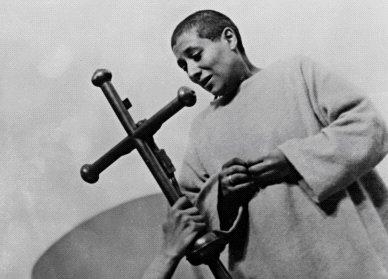
The film�s opening establishes not only its historical context, but its artistic one as well. Dreyer utilizes his actors� unadorned faces wonderfully in numerous close-ups, makes repeated use of fairly extreme camera angles, and establishes a fairly stylized acting approach, setting the stage for everything that is to follow. In fact, this particular scene felt a bit forced to me, as though Dreyer recognized the scene�s pivotal role in determining the look and feel of the film, but was still struggling to found the proper mixture. Maria Falconetti�s facial expressions and reactions feel a bit forced, and the judges come across as a bit too cartoonish for comfort.
In the scene immediately following, however � the scene where the judges plot to deceive Joan into condemning herself � the film truly comes into its own. A counterfeited letter from the French King is delivered to Joan, and she places her confidence completely in the scheming cleric who delivers it to her. The rest of the interrogation, which takes place in her cell, is truly heart-breaking. We watch her realization that the cleric is leading her astray, we see her struggles to extricate herself from the trap he has laid for her, and we sorrow as she realizes that these men seek her conviction at all costs. Dreyer makes wonderful use of Falconetti�s amazingly expressive face here; we know what Joan is thinking and saying long before we see the inter-titles.
It is in this scene also that Dreyer introduces what I felt to be the most effective part of the film: the young chaplain, played by Antonin Artaud. With this character, Dreyer gives us two things: a sympathetic member of the prosecutors, which lends some balance to a largely nasty group. And most importantly, a way for the audience to feel present in the film. We see the film through Artaud�s eyes; he is our mirror image. We experience the same horror and sorrow at Joan�s betrayal and death as he does; we watch in disbelief as her persecutors use that thing she holds most dear � the Blessed Sacrament � as a tool against her resolve; we watch conflicted as she finally signs the confession, only to recant it a moment later. And we are filled with the same feelings of hopelessness and remorse as we see her final moments.
Without Artaud, the film would be an historical retelling of certain real events. It would be powerful, because the events themselves are powerful. But with him, it becomes something more: a sort of spiritual journey. The amazing power of Joan�s actual death scene, for example, shows this wonderfully well. As I watched Joan actually succumb to the flames, I was unsure how exactly to respond. There�s a sorrow and a joy felt simultaneously; an awkward emotional moment. And then I saw Artaud, his expression a perfect reflection of what I was feeling, drawing me into the film itself, and making me a part of it. It is this ability of Dreyer�s film � the ability to transcend the medium itself � which I will most remember.
I would be remiss not to mention two final thoughts. Firstly, the amazing clarity and pristine quality of the print itself, found in a mental hospital in Oslo, and painstakingly restored frame by frame. The Criterion disc shows several comparisons between the old prints and the restored one; the changes are amazing. And last, but far from least, the amazing music of Richard Einhorn. His score � Voice of Light � was inspired by Dreyer�s film, and now lends its voice to the work in one of the finest examples of the combined power of visuals and sound. A truly inspiring experience.