
7 of 10
Cinematography by Freddie Francis
Anthony Hopkins
John Hurt
Anne Bancroft
John Gielgud
Wendy Hiller
Freddie Jones
"I am not an animal! I am a human being! I am a man!"
|
|
|
|
|
|
|
|
||||||
| The Elephant Man 7 of 10 |
||||||
| Directed by David Lynch Cinematography by Freddie Francis Anthony Hopkins John Hurt Anne Bancroft John Gielgud Wendy Hiller Freddie Jones |
||||||
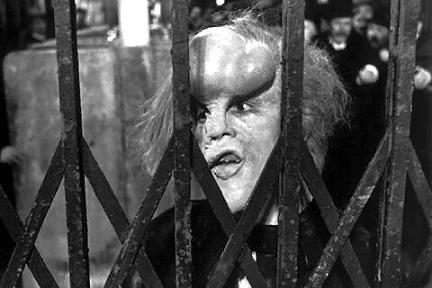
| David Lynch is a very strange director. I have seen a couple different films by him, and they are all radically different. Mulholland Drive - which I think I regret seeing - was very, very strange, hopelessly confusing, and had more junk than pretty much any other movie I've seen. But at the heart of all that was a really brilliant idea. Next, I saw The Straight Story: very clean, straightforward, and moving; without a hint of weirdness. And then, I saw this film. Based on the real-life story of John Merrick, a man catastrophically deformed by Proteous Syndrome, there is an incredible amount of power and sorrow on display throughout the movie. Dr. Frederick Treves, played brilliantly by Anthony Hopkins, discovers Merrick in a freak show at a London fair. He rescues the poor man from the enslavement of a brutal sideshow owner, and spends several weeks trying to discover if there is a human mind behind the deformity, or if Merrick is just an animal. In a brilliant scene - one that makes wonderful use of the 23rd Psalm - he discovers that not only is Merrick a man, he is a sensitive, intelligent, and prayerful one. Nor is he bitter about his past life; far from it. Rather, he is childishly innocent, concerned only about others. But the world is not as eager to accept him as he is to accept the world. And Lynch definitely focuses on that aspect of things. There are some beautiful moments, but there many more ugly ones. And then there is the ending. Lynch, who takes a snide shot at previous movie/Broadway attempts to portray this story, does two things I really, really disagreed with. First off, he changes events in a really drastic way at the very end, making Merrick's character much more questionable. Cinematically, it is much more effective; but it's simply not true, and does his memory a real disservice. And then, Lynch just can't avoid the dream sequence at the very end, which totally destroys the connection he had created with the audience. It's a bad idea. But the most frustrating thing about it is that it is very close to a great film. And Lynch's personal neuroses totally destroy it. Visually, it is a wonderful film; all in black and white. And Lynch really uses that medium to full effect. There is an amazingly sinister feel to everything, even from the very beginning. The cast is also very strong, with the exception of Anne Bancroft, whose character seemed badly out of place. Freddie Jones, the sideshow owner, gives a finely nuanced performance. John Gielgud is excellent, as always. In fact it is John Hurt's Merrick, a performance that won him an Oscar nomination, which seems the most mundane. It is a troubling, insightful film and one that that fails mostly because of its director's lack of self-control. "I am not an animal! I am a human being! I am a man!" |
||||||