
10 of 10
Cinematography by Bill Butler
Sound Editing by Walter Murch
Gene Hackman
John Cazale
Allen Garfield
Cindy Williams
Harrison Ford
Robert Duvall
"I'm not afraid of death. But I am afraid of murder."
|
|
|
|
|
|
|
|
||||||
| The Conversation 10 of 10 |
||||||
| Directed by Francis Ford Coppola Cinematography by Bill Butler Sound Editing by Walter Murch Gene Hackman John Cazale Allen Garfield Cindy Williams Harrison Ford Robert Duvall |
||||||
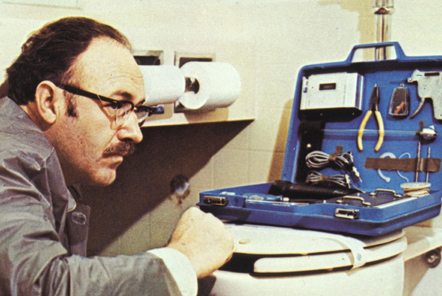
| This is a great twist movie. The event that forces the audience to reconsider everything they have thought about the beginning of the film is wonderfully done. The film�s construction is an obvious homage to Michelangelo Antonioni Blow Up, although there is a profound difference between photography (which is essentially visual, just like film) and sound recording. (It is also the basis of De Palma�s wretched idea, Blow Out.) However, the sudden twist is not what makes this such an extraordinary film. Its real power comes from its amazing characterization of a single man; and from portrayal of his complete destruction when he is finally forced to come to grips with what he has been doing his whole life. As a character study, it is unrivaled in anything I have seen yet. Hackman is flat-out brilliant, and more restrained than I have ever seen him before. No scene chewing here, just scene stealing. Of course, it�s hard to steal a scene when you don�t really get to say anything. But you are forced to really act. And that points to another amazing thing about this film: So much of if is portrayed with sound alone; there is almost no talking during the climax of the film, or it finale. This gives the film a tense, nearly unique mood that is helped along immeasurably by the ground-breaking sound work of Walter Murch, (and by some amazing music from David Shire). I must say that I consider the script here to be far better than The Godfather; Coppola�s finest work, without a doubt. Maybe it�s because it�s a subtle film. His other films are anything but subtle. The movie has a very Neo-realist style to it, without much apparent attention to the visuals. The section where Hackman puts together a recording of the conversation that will become the centerpiece of the film is spectacularly effective, but very much in the Neo-realist mode. The film also makes great use of flashbacks. The cast is wonderful; watch out for Harrison and Duval. But Walter Murch really makes this film work; pure genius. Speaking of genius, the final shots of the film are filled with it, although they could be very unsatisfying to some looking for things to be neatly tied up. The ending does perfectly summarize several important aspects of Caul�s character: his marginal religious beliefs, his inability to adapt to change, and his overwhelming aloneness. By the time its all said and done, it feels like you have witnessed the destruction of an entire life brought about in just the six days depicted in the film. One of the finest films ever made, and a definite must see.
"I'm not afraid of death. But I am afraid of murder." |
||||||