
7 of 10
Cinematography by Robby M�ller
Emily Watson
Stellan Skarsg�rd
Katrin Cartlidge
Jean-Marc Barr
Adrian Rawlins
Jonathan Hackett
These words are spoken by young Bess McNeill, the principle character in Danish director Lars Von Trier�s disturbing, haunting visual parable, Breaking the Waves. This statement is the emotional and theological crux of the entire film, a film that deals with faith, suffering, and redemption in a way that is both brutally harsh and brutally honest. Von Trier�s characters are perfect examples of this claim: they are indeed all good at something. And it is Bess� discovery of her own particular gift that is the film�s most searing insight.
Bess, a simple-minded Scottish lass, lives an extraordinarily isolated life. A member of the region�s stern, fundamentalist community, she is cut off completely from the outside world. Her life, filled with hints of past suffering, is dominated by her church, and her God. Her church, governed by an iron-fisted commitment to inflexible laws and impossible ideals, is a towering, impersonal force in her life. But her God is another matter entirely. Bess visits the local church daily to converse with Him; her faith is obvious and inspirational.
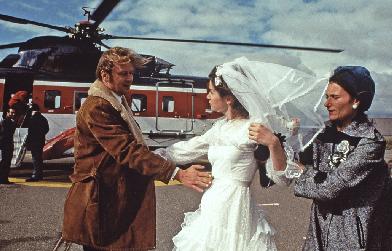
Jan Nyman, an �outsider� from the coastal oil refineries, enters into this simple equation. Bess falls deeply in love, and petitions the community elders to allow her to marry Jan � a request they reluctantly grant. Her joy is short-lived. Following their brief honeymoon, Jan returns to the refinery, leaving Bess to struggle with the unexpected pangs of separation. Devastated and lonely, she beseeches God to bring Jan back to her side. And though logic and reality are set clearly against her, her childish faith refuses to concede any such obstacles to her prayers.
Jan does indeed return, seemingly in answer to Bess� prayers, but the situation is far from a joyous one. Involved in a tragic accident on the rig, he has been paralyzed from the neck down. Bess, guilt-ridden by her possible responsibility for his paralysis, must also deal with the new, utter lack of physical intimacy in her marriage. An added test comes from Jan himself, whose mental abilities have been impaired by the accident. Equally devastated by his inability to make love, he instructs Bess to find another lover � a suggestion she immediately and vehemently rejects. But he finally confronts her with an ultimatum: she must find a man, have sex with him, and return to describe her actions. If she does not, Jan is convinced that he will die.
Bess, shocked and horrified by Jan�s proposal, struggles to align his request with her faith and customs. Gradually convinced that her love and obedience truly are essential to his continued existance, she begins a disturbing descent into sexual perversion and violence. Her family and community members react at first with horror, and then rejection. But Bess, convinced that she is in the right, presses further down the path to destruction. Violence and love, suffering and redemption all come to the fore as the film rushes towards its tragic, moving conclusion.
Emily Watson�s performance is the undeniable backbone of the film. Bess� character strikes an absurd balance between innocence and insanity, between distress and devotion. It is a character that could well have become a caricature, but Watson somehow achieves the necessary balance. The film�s ability to deal with complex issues and themes would be impossible without her performance. The supporting cast is similarly superb, particularly Adrian Rawlins (the young local doctor) and Katrin Cartlidge (Bess� sister-in-law and another outsider).
The film�s visual style, clearly influenced by Von Trier�s �Dogme period,� carries with it many of the strengths and weaknesses one might expect from such principles. (Interestingly enough, Von Trier allows himself to deviate widely from the Dogme manifesto in several crucial areas: non-motivated music, digital manipulation of images, etc.) To the more traditional filmgoer, the mismatched shots, jump cuts, and handheld camera work will probably be more than a bit distracting. But the film�s subject matter is enhanced by this fractured, unrefined style. There is a rawness and vibrancy in the film that cannot be denied.
In a tribute to the story�s power, any discussions of its visual and dramatic merits fall quickly by the wayside. The theological and emotional issues raised by the film take an immediate and urgent precedence over all these matters. They reveal their architect as much more than simply a creator of �moving pictures.� At heart, Lars Von Trier is a thinker, and in this film he deals with some of the most complex � yet seminal � ideas known to man.
Like his countryman and fellow Copenhagen native S�ren Kierkegaard, Von Trier is fascinated by the role of faith in modern society. Though he and Kierkegaard work in very different mediums, both are particularly focused on what they see to be the unfathomable nature of faith. And both make use of biblical archetypes to probe this notion. Kierkegaard�s justly famous examination of Abraham is a more literal example, but Von Trier�s Bess � part Mary Magdalene, part Prodigal Son, part Christ Himself � is just as clearly meant to be a symbol. And though the film presents many wildly differing points of view, its conclusion is deeply rooted in that which follows immediately on faith�s heels: hope.
The film�s unadorned style, its mature subject matter, and its troubling depiction of violence towards women � both physical and psychological � will certainly be distasteful to many viewers. But beneath the film�s disconcerting surface is a fascinating study on the consequences of a devout, unwavering and inexplicable belief � though perhaps it would be more accurate to describe it as a starting point. Clearly, Von Trier seeks to provoke a serious self-examination in the viewer. Just as clearly, he sees this story�s use of grotesque and violent images as the most effective way to elicit the desired response. The actual viewing experience is undeniably disturbing, but Breaking the Wave is a film that will certainly move you, whether you agree with its conclusions or not. And Von Trier would doubtless be pleased by such a result.
10/24/05