 |
 |
|
|
| The Famous Six Wives of Henry VIII From A Catholic Perspective |
 |
 |
|
| King Henry VIII is probably most famous for two things: breaking England away from the Catholic Church and for having six wives. The two issues are intricately linked and the lives of the six women King Henry married also reveal a great deal about this man who founded the Church of England. What follows is this Catholic's look at the women who were Queen of England alongside Henry VIII. |
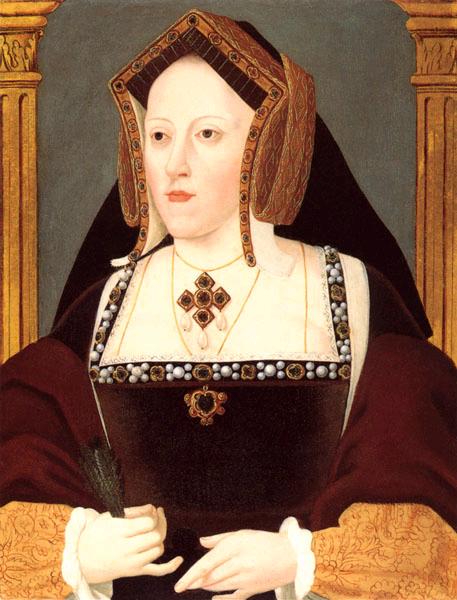
| Catherine of Aragon, Henry's first wife, was originally betrothed to Henry's older brother Prince Arthur. However, when Arthur died only a few months after the two teenagers were married, Henry sought and obtained a dispensation from the Pope to marry Catherine. The couple lived as man and wife for about 15 years during which time only one daughter, Mary, survived childhood. Queen Catherine was a very devoted wife and was adored by the people. She started the lace industry at Walsingham and frequently went on pilgrimages, being a very devout woman. While Henry was fighting in France she ruled England capably in his place as Regent, repelling a Scottish invasion. Henry, though, did not treat her well and was not faithful to her. When he fell in lust with Ann Boleyn he broke with Rome and founded the Church of England to divorce Queen Catherine. She was humiliated, saw her only child declared a bastard and was kept under virtual house arrest. However, she refused to see her nephew, the Emperor Charles V, invade England on her behalf and still forgave her husband, worrying about his soul at her death. |
|
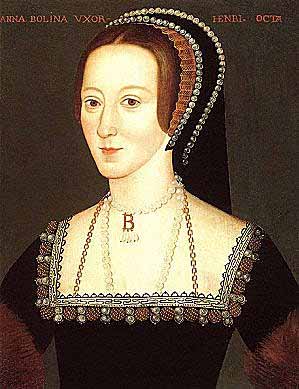 |
| Anne Boleyn, was despised as much as Queen Catherine was loved. Henry had already had an affair with her sister before setting his sights on Anne and it was she who used her influence over the King to totally revolutionize life in England. At her urging Cardinal Wolsey was removed from office and Henry began to embrace Protestantism. She demanded that he make her queen instead of mistress and flaunted herself at Queen Catherine as one of her ladies in waiting while urging the King to divorce her. Everyone believed that the King had been bewitched by Anne, many attributing her hold to bedroom antics learned in France, where she lived for some time. However, Anne's power came more from withholding her favors until the King gave her what she wanted: the crown. Ultimately though, she did give in and was already with child when Henry divorced Catherine and married Anne in his newly formed Church of England. But, Anne was a jealous wife, knowing how Henry had treated his previous wife, and when Anne failed to give Henry a son, Henry's patience with her ran out and she was ultimately beheaded on charges of adultery. |
|
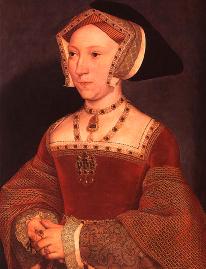 |
| Jane Seymour, was most likely pushed in Henry's direction after Anne's execution by her ambitious family. He had already fallen considerably in lust with Jane as it was less than a day after Boleyn's death that the two were engaged. She certainly had relatives who were radical Protestants, or at least who were keen on using Protestantism to increase their power, but Jane seems to have been somewhat more traditional and Catholic in her leanings. It was Jane who managed to bring Princess Mary, the devoutly Catholic daughter of Henry and Catherine of Aragon, back to court and into the King's good graces. She was also outraged as Henry's betrayal of his promises to Robert Aske and the members of the "Pilgrimage of Grace". Efforts such as these would have been just the thing to set Henry VIII off who wanted a silent and submissive wife who would simply give him a son and look the other way at his indiscretions. But it was Jane Seymour who did give Henry a son, Prince Edward, and so she instantly won first place in the king's heart. However, she died only two weeks later, leaving Henry VIII a widower. As Queen Catherine had died a few years before Henry's marriage to Jane, she was only his second legitimate wife. |
|
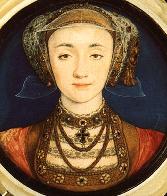 |
| Anne of Cleves, was Henry's next wife, though after the loss of Jane the King went a few years before thinking of marrying again. However, the King's unscrupulous minister, Thomas Cromwell, was pushing for him to remarry and most importantly, to marry a Protestant. The Catholics, of course, would have liked a Catholic match, thinking that since it was a woman who drove Henry VIII into Protestantism, it might take a good Catholic woman to bring him back into the arms of Rome. However, after his treatment of Catherine of Aragon and the execution of Anne Boleyn, few of the princesses of Europe would consider marrying Henry, who by now was becoming old and grossly overweight. But, Cromwell prevailed upon the king to marry the German Princess Anne of Cleves, who was a Protestant. Holbein was sent to paint her portrait, which the king liked and he signed the marriage treaty. However, when Anne came to England the King was disgusted by her appearance, calling her the "Flanders Mare". He refused to consumate the marriage but had a hard time getting out of his agreement. Finally it was decided that the two would divorce with Anne being treated thereafter as the King's sister, with a generous pension. She was well liked and outlived all the other wives. Cromwell, however, was executed for the mortal sin of giving the King a bride he found unattractive. |
|
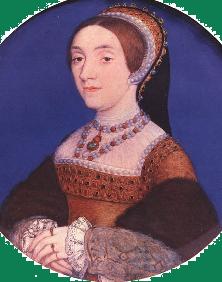 |
| Kathryn Howard, it was hoped, might have been the salvation of the Catholic Church in England in Henry's time, but was not to prove up to such a high calling. She was the niece of the Duke of Norfolk and a cousin of the King's former mistress Anne Boleyn. Kathryn was a beautiful and lively girl of only 19 when Henry VIII first noticed her and when, as seems most likely, Norfolk began pushing her forward as a way to get the Catholics of England back in power again. Henry was 49, more than showing his age, walked with a limp and was extremely overweight, and as is not surprising, he was totally enthralled by the lovely teenage Kathryn. It is probably safe to say that Kathryn never loved the King, but she could not have been unmoved by the way he lavished her with praise and fine gifts. He was also a man who never took no for an answer and in 1540 the two were married, though it seemed Henry was unable to consumate the marriage. It also did not take long for Kathryn to fall madly in love with one of the young gentlemen at court, Thomas Culpeper. An affair developed, but it is hard to be too harsh with Kathryn considering her age and the elderly, disgusting state the King was in. The Protestants also were determined to prove she was having an affair and had not been a virgin at the time of their marriage. Henry was infuriated when presented with the evidence against her had Kathryn beheaded and her uncle imprisoned. |
|
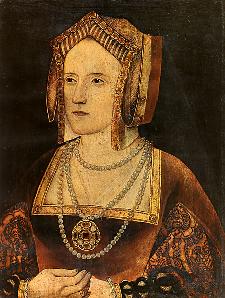 |
| Katherine Parr was the last of Henry's wives. It was the power-hungry Seymour family which was most likely behind the match, and possibly in bringing down Kathryn Howard. In the past, it had always been the very young and attractive who had caught the King's eye, but by this time Henry VIII was simply looking for someone to be his nurse and companion in the twilight of his life. Parr was already a widow twice over when she came to the King's attention, but she was also in love with Thomas Seymour. However, knowing that when it came to women Henry always got what he wanted, and hoping to gain another foothold on power for the Seymour clan, the two decided against marrying probably knowing full well that they would not have to wait long for the King to die. So, Katherine married Henry VIII who enjoyed having someone to look after him and to engage in religious discussions with him, which alarmed many as Katherine was a zealous Protestant. Her one good contribution was to mend some of the fences in the Tudor family, bringing Henry back together with his two daughters, both of whom he had declared bastards at some point in their lives. She cared for the King until his death in 1547, after which she promptly married Thomas Seymour as she had originally wanted. After Henry's death Edward Seymour ruled on behalf of his nephew King Edward VI and with Thomas Seymour married to the Dowager Queen, it was a time of triumph for the Protestant clan, but not one that would last for very long. |
|
| Looking back on the six wives of Henry VIII we see a diverse group of women, some who deserve our sympathy and others which do not. In Queen Catherine of Aragon we a woman who was far too good for the man she married. She was a loyal, faithful wife and pious and capable Queen for 15 years, only to be discarded by a husband who let a temptress turn his head. It would be impossible not to be moved by the sight of the Queen at her trial over the divorce, on her knees before the King, asking what she had done to displease him in all their years of marriage? She was the classic picture of the wronged woman, and yet so saintly that she was more concerned with her cheating husband's soul than her own suffering. It is easy to see why she was so beloved by the English people. Anne Boleyn, on the contrary, can generate very little sympathy or admiration. Though not considered a fantastic beauty, many people commented on her abilities as a flirt and her ability to enthrall men. She was the classic picture of a home-wrecker, a younger face to tempt the husband away from his devoted wife. The only flaw in that being the fact that Henry VIII was easily tempted and had not been faithful to his wife even before Anne turned her charms on him. It is no wonder so many people called her "the goggle-eyed whore" for destroying the marriage of their beloved Queen Catherine. It was also Anne who put the idea in Henry's head that Protestantism would be the ideal way to increase his power, satisfy his lust and put away the Queen all in a single act of defiance. She was probably not guilty of all Henry had charged her with, but it is hard to feel sorry for her for losing her husband to another woman when she herself had once been that "other woman" and she should have remembered that old warning, "if they'll cheat with you, then they will cheat on you". She not only wrecked a marriage, but the religion of a country and started the ball rolling for England to become the most significant Protestant power in Europe. Jane Seymour is a much more sympathetic figure, though when compared to the rest of her scheming, power-hungry family many people would look good. She was good for restoring family peace and was well liked by the Catholics for her conservative nature and ending the rather worldly and "continental" atmosphere at court created by Anne Boleyn. She was a devout Catholic and hoped Henry would change his ways on the subject of papal supremacy. She hoped that the rehabilitation of Mary at court would bring back traditional Catholicism, which did not happen. In 1536 the "Pilgrimage of Grace" began to "restore the monasteries and burn the heretics" and Queen Jane ran the terrible risk of openly challenging the King's policies and suggesting that the rebellion was God's punishments on him for his rejection of his loyalty to Rome. However, Henry VIII reminded her of Anne Boleyn's fate and warned her to stay out of politics, which she did, though the King was duplicitous enough to use the popular name of Queen Jane to placate and ultimately betray the Catholics. She most likely would have fell out of favor for her belief had she not given Henry his only son, but it is perhaps just as well that she died when she did as the radical Protestant schemes of her family after her death would undoubtedly have horrified her. The next, Anne of Cleves, was a tragic figure. Thomas Cromwell had engineered the marriage simply because Anne was a German Protestant, and because the upstanding Catholic women of Europe would have nothing to do with the man who had divorced one wife and beheaded another. Henry VIII had no feelings for her and agreed to the marriage simply because Cromwell and his faction had convinced the King that the fraulein was stunningly beautiful. When the two met, Henry did not agree, and he quickly dismissed the marriage which he had agreed to only out of lust. In fact, the marriage was never consumated, which Henry naturally blamed on Anne. He was already lusting after Kathryn Howard and left Anne alone. As far as the Church is concerned she was of very little consequence. Kathryn Howard is another story, as in her elevation to queenly status there was a devised opportunity for the Catholics to recover what had been lost. It all came to nothing when Kathryn was accused of adultery by the Protestants at court, charges which, though long believed, there is actually not as much actual evidence of as one might think. In any event, Kathryn was simply a victim, successively of the King's lust, arrogance and wrath. Catherine Parr was a more significant wife than one might think for the relations between England and the Catholic Church. Henry VIII had at last had all of his vain lust driven from him and with her he simply wanted a nurse and companion. The good thing was that Catherine brought the Tudor family back together; the King, Mary, Elizabeth and Edward. The problem was, Catherine Parr was very much a Protestant and she was all the time actually in love with Sir Thomas Seymour, one of the ambitious and scheming brothers of the lovely Jane Seymour. In fact, Thomas had agreed to the marriage of his beloved with the King simply because he knew of the great power it would bring to their family and when Henry VIII died it was the radical Protestant Seymours who were guardians of the young King Edward VI as well as the wife of the last Queen consort. It was Catherine Parr who helped along the last of the road to the reign of Edward VI when England stopped being schismatic Catholics and became radically Protestant. |
|
|