 |
|
|
|
|
|
|
|
| The Great Northern Rising |
|
|
|
 |
|
|
|
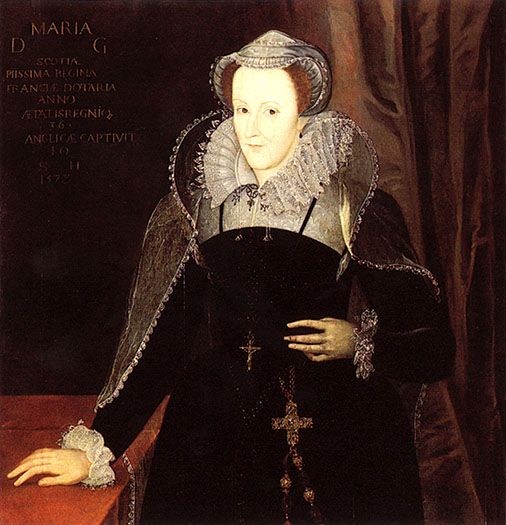
Mary Queen of Scots as well as the hoped for Queen of England by many English Catholics. |
|
|
|
|
|
The Great Northern Rising was the last major effort of the English Roman Catholics to restore the old religion in England as well as being an effort to see Queen Elizabeth I replaced by the Catholic Mary Queen of Scots. Ever since King Henry VIII had broken with Rome, declared himself Supreme Head of his own Church of England and abolished the monasteries the people of northern England had been the most opposed to his draconian measures. It was the faithful Catholics of northern England who marched with Robert Aske on the Pilgrimage of Grace to try to force King Henry to undo the damage he had set in motion and it was these people Henry hoped to appease by making Queen Jane Seymour especially responsible for (Queen Jane was quite devout and had helped to reconcile Henry with his Catholic daughter Mary). When Queen Elizabeth I ascended the throne of England and brought back the persecutions of Catholics it was also northern England that stood the most zealously opposed to her. |
|
|
|
The focus of the Northern Rising was the captivating and tragic Mary Queen of Scots. She was widely considered the legitimate Queen of England by much of the Catholic population, not only because she was Catholic as well but because Catholics did not recognize Elizabeth I as legitimate. Henry VIII had broken with Rome because of the refusal of the Pope to annul his marriage to Catherine of Aragon so that he could marry Ann Boleyn by whom he had fathered Elizabeth. Even by Protestant standards she was illegitimate as she had been conceived prior to the Anglican marriage of the King to Ann after he had given himself a divorce from Catherine. Further, it was suggested that Elizabeth may have been the product of an incestuous relationship as Henry VIII had had an affair with the mother of Ann Boleyn who feared Ann may have been his own daughter (before his affair with Ann, Henry had also had an affair with her older sister so he seemed to believe in keeping things all in the family). When Henry tired of Ann and eventually had her beheaded for adultery he had even obtained an act of Parliament declaring Elizabeth illegitimate himself, though this was later revoked. |
|
|
Mary Queen of Scots had laid claim to the throne of England early on and for a time there was a real fear that her French connections (by her mother and late husband) that England might face a combined Scottish and French invasion. However, Mary had her own problems with Protestants in Scotland despite her efforts to show religious tolerance. She was eventually forced to flee to England from her own Scottish subjects and was quickly placed under house arrest by her cousin Queen Elizabeth I. A plot soon arose to overthrow Elizabeth, rescue Mary of Scots and place her on the throne in a restored Catholic England. Of course, Queen Mary was careful to keep her distance from these plots as she was certainly in no position to risk the wrath of Elizabeth I. However, she was also naturally eager to effect her escape as anyone in her situation would be. |
|
|
While she was imprisoned in Northamptonshire the Northern Rising began to take shape under the leadership of Thomas Percy, Seventh Earl of Northumberland and Charles Neville, Sixth Earl of Westmorland. The original aims of the rebellion were somewhat more modest than what they came to be. Their stated goal was to restore the Catholic Church which Elizabeth had suppressed as soon as she took the throne, to bring about the removal of the Evil Counselors who were giving the Queen bad advice, restore to favor the Duke of Norfolk and other nobles whom the Queen treated as enemies and to liberate Mary Queen of Scots from her house arrest. There was no word about deposing Queen Elizabeth I and it seemed to have a similar ring to the previous Pilgrimage of Grace which had not aimed to overthrow Henry VIII but merely to force him to revoke his oppressive laws against the Church. |
|
|
Northumberland and Westmorland took a select few into their confidence such as George and Christopher Neville (uncles of Westmorland), Leonard and Edward Dacre, Egremont Ratcliffe (brother of the Earl of Sussex), the Nortons, Markenfields, Tempests, Swinburnes and other loyal English Catholics of prominent position. They professed their allegiance to Queen Elizabeth I and stressed that they merely wished to redress legitimate grievances, stop the persecution of Catholics and see the ancient faith of England restored to her and see the dismissal of those policy makers around the Queen whom they blamed for these oppressive measures. Their official manifesto, so to speak, ended with a hearty cry of God Save the Queen! Given the extent to which Elizabethan propagandists associated Catholicism with foreign tyranny it is important to note that the Earls stated that they desired the English to reform England before some foreign power did it for them. |
|
|
However, Queen Elizabeth, ever suspicious of threats to her power, was not about to trust the professed loyalty of these Catholic nobles. She ordered Mary Queen of Scots moved to Coventry and summoned the two earls to Court; a summons they ignored knowing that it would mean certain death. As a result, the rising was prompted in 1569 before all the planning could be completed. Elizabeth came by much of this information through the betrayal of Leonard Dacre. When the youth who was heir to the estate of Dacre died after a fall from his horse his uncle, Leonard Dacre, was unwilling that the estate should fall to his nieces and assumed ownership of them himself. He pushed for the two earls to rebel and then informed on them to Queen Elizabeth when they began planning to do so, even accepting from the Queen responsibility to aid in crushing the rebellion. |
|
|
Taking the property of his nieces he made military preparations at Naworth Castle and assembled about 3000 troops. With this position secure, Lord Henry Scrope advanced out of Carlisle to cut the earls off from Scotland, leaving Bishop John Best in charge in his absence. However, he quickly returned when he heard talk of a plot to capture Carlisle and kill the bishop. News of the attempted arrest of the earls prompted to the Earl of Northumberland to leave Topcliffe with Richard Norton to join the Earl of Westmorland at Brancepeth. Although Northumberland thought that the time was not right for an uprising the zeal of Norton and others prevailed upon them to gather their forces and take to the field, first occupying Durham with a troop of Catholic cavalry. Northumberland, Westmorland and their soldiers entered the Cathedral with Richard Norton carrying the old flag of the Pilgrimage of Grace which featured Christ crucified. They knocked over the communion table and tore up the English Bible and prayer book, setting up instead two altars with the help of the locals. |
|
|
On November 30, 1569 mass was sung again in the Cathedral according to the old Roman rite of the Catholic Church for the first time since Elizabeth and re-imposed Protestantism. After a brief stay in the area the earls marched south, restoring the Catholic rites in Staindrop, Darlington, Richmond, Ripon and Bramham Moor by which time their little force numbered 4,000 infantry and 1,700 cavalry. Commanding the royal forces in York was the Earl of Sussex who was loyal to the Queen but who was also somewhat suspect because his half brother Egremont Ratcliffe was among the rebels. Sussex, however, could do little with the meager forces under his command and it is a testament to the strength of the Catholic tradition in England that he was very concerned that many of his troops would defect to the Catholic cause if given the chance. |
|
|
Sir Ralph Sadler was dispatched to York along with Lord Henry Carey Hunsdon. Sadler wrote to the Queen reassuring her of Sussex and his loyalty to her as well as supporting his position that any military action on his part would be unwise at that time. Most revealing though was his warning that there were not ten gentlemen in northern England who favored the royally mandated Protestant church and who would not prefer the old Catholic religion. This is significant because so much of the history, or more accurately the popular myth, has taken for granted that the enforcement of Protestantism was welcomed with open arms in England and that the Catholic Church was unpopular. Clearly this was not the case as so many instances of resistance and even, as in this case, the words of Protestant officials themselves, reveal. By the end of the year Sadler reported that he estimated the strength of the Catholic forces to have grown to 6,000 infantry and 1,000 cavalry while Sussex had less than half as many and as Sussex stated many of these were of questionable loyalty to Protestantism. |
|
|
The Catholics had, in fact, desired to march on York but were persuaded against it because of word reaching them that the Earl of Essex was assembling a powerful army to reinforce the garrison there. Instead, they moved first to Raby Castle and then on to Barnard Castle which they besieged. Sir George Bowes was defending the fortress and held out for eleven days before surrendering to the Catholics. From there the earls marched on Clifford Moor but were disappointed by the lack of support and the dwindling of their own numbers to 4,000 infantry and 600 cavalry. They had expected more but after so much Protestant persecution many people were fearful of risking everything on such an enterprise unless it seemed certain to succeed. Everyone knew from the actions of Henry VIII and the Pilgrimage of Grace that should they fail they could expect no mercy at all. The Earl of Westmorland began to doubt their chances of success and this caused many to abandon the expedition as well. |
|
|
Northumberland, on the other hand, remained somewhat hopeful and dominated the countryside until December 13 when the recently reinforced Earl of Essex marched out of York with 7,000 men and these being only the vanguard of a force of 12,000 commanded by the Earl of Warwick coming after them. Sir George Bowes met Sussex and Sadler at Croft Bridge on December 17 and seeing the force arrayed against them the rebels were obliged to retreat to Naworth Castle where they were sheltered by Dacre. However, everyone had begun to smell death in the air and Dacre did not allow the Catholic forces to linger long, fearful of his position once royal power had been restored as it now seemed destined to. The Catholic army was forced to disband and the earls made their way to Liddisdale in Scotland. |
|
|
As was to be expected the Catholic rebels suffered terribly for the loss of their cause. Most were killed by the prowling government forces as they tried to make their home or to some place of exile while those who were captured could expect a similar fate. Simon Digby of Aiskew, John Fulthorpe of Iselbeck, Robert Pennyman of Stokesley and Thomas Bishop of Pocklington, for example, were all taken alive. They were subsequently imprisoned in York Castle and then, by order of Queen Elizabeth, were hung, drawn, quartered, disemboweled and beheaded for treason with their disembodied heads afterwards displayed on the gates of York. |
|
|
The bloodshed was not totally over though as the Queen made a special point of going after Leonard Dacre who assembled 3,000 Cumbrians, many of them women, and fought royal forces under Lord Henry Carey Hunsdon at Gelt's Bridge. They fought heroically, even the women whose ferocity compelled the men to even greater acts of courage. However, it was to no avail and the small rebel army was defeated with Dacre fleeing to Scotland and finally Flanders where he died in 1575. Lord Hunsdon interceded for those he defeated and obtained a pardon for them from the Queen. Most others though, were not so fortunate. The Regent Murray imprisoned the Earl of Northumberland at Lochleven and turned him over to Queen Elizabeth in 1572 when he was taken to York and gruesomely executed. His wife was lucky enough to escape to Flanders as was the Earl of Westmorland who later died nearly impoverished in Spain living off a pension from King Philip II. |
|
|
|
Essex and Bowes had crowds of people executed. At Durham, 66 Catholics were put to death, men and women, many more at York and others were taken to London for execution. The anger of the Queen was felt further when Pope St Pius V issued a bull excommunicating her for heresy and absolved her subjects of their allegiance to her. In all, around 800 Catholics were put to death in the wake of the Northern Rising with 57 nobles being taken and their lands absorbed by the Crown. Laws against Catholicism became even more harsh than ever with being a priest, harboring a priest or hearing mass being punishable by death. At York, for one example only, 28 priests were hung, disemboweled and beheaded by administering the sacraments and 11 laymen and one women were brutally executed for giving them shelter. Mary Queen of Scots, though she was not directly involved in the plot at all, was eventually put on trial based on forged documents, was condemned and executed. This gave a moral justification for King Philip II to launch the Spanish Armada and his famous but doomed effort to invade England to restore the Church. |
|