 |
|
|
|
|
|
|
|
|
|
|
|
|
|
|
|
|
|
|
|
|
|
Queen Kathryn Howard |
|
|
|
The Rose Without A Thorn |
|
|
|
 |
|
|
 |
|
|
|
|
 |
|
|
|
|
|
|
|
|
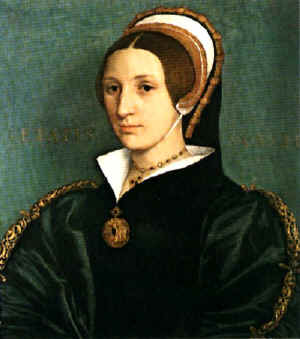
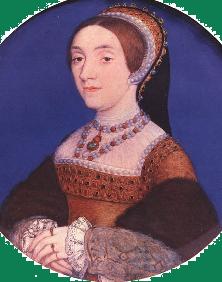
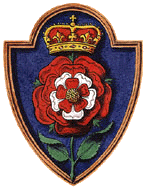
| In any review of the six wives of King Henry VIII, most attention seems to always focus on his early wives, especially the first two; the pious and loyal Queen Catherine of Aragon and her successor the ambitious and flirtatious Ann Boleyn. Much less attention is given to the later wives, some of whom historians actually know rather little about at the end of the day. One such wife was Queen Kathryn Howard, whom King Henry VIII called, "A rose without a thorn". With the possible exception of Queen Jane Seymour, probably no other woman caused Henry VIII so much grief as Kathryn Howard. Since relatively few concrete facts are known about her and her marriage to King Henry, there has been throughout history conflicting views about what kind of woman she was. Some have regarded her as a selfish, wicked temptress while others assert that she was a victim of court intrigue, a lustful and jealous king and a family conspiracy; she was perhaps not perfect, but totally undeserving of her ultimate fate. |
|
| Kathryn Howard was possibly born in 1521 although no one is quite sure. Her father was Lord Edmund Howard. She was the granddaughter of the 2nd Duke of Norfolk, niece of the 3rd Duke of Norfolk and a first cousin to the beheaded former queen Anne Boleyn. Her father, however, was from that group of men present in every kingdom, that is those with nothing but their prestigious name and his debts kept him constantly in need of help. Through the influence of Anne Boleyn he was employed by the king in Calais in 1531 at which time Kathryn was sent to live with the Dowager Duchess of Norfolk, Agnes Tilney, her step-grandmother. It was expected that Kathryn would be brought up in the proper fashion for young ladies, studying, doing needlework and praying. There were many young men and women in the household, but each were kept in separate dormitories. However, the Duchess preferred to be at court and did not keep a very close eye on her attendants and rumors soon spread about romances between the young ladies and gentlemen and a some of the young men being allowed to "find" the keys to the girls rooms. |
|
|
| The Duchess was ignorant of this, but when Kathryn was only eleven or twelve she began to be romanced by Henry Mannox, her music teacher, but though they reportedly explored each other fairly completely, the their relationship was never actually sexual. Young and attractive, she could have any man she wanted and quickly realized this. Soon, she dropped Mannox for the younger and more handsome Francis Dereham which whom, according to her roommates, she did have a full blown affair. The Duchess once caught them kissing and gave them both a lecture for it but the relationship only ended when the Duke of Norfolk secured her a position as a lady-in-waiting to King Henry's neglected German bride Anne of Cleves. It did not take long for the young and stunning Kathryn to catch the eye of Henry VIII. She herself was on cloud nine living at court with all of the fabulous dresses, dances, parties and many handsome men to flatter and fawn all over her. Henry VIII was soon showering her with attention and lavish gifts, which she accepted though she was actually in love with attention rather than the King. |
|
| The Duke of Norfolk and his compatriots saw in the King's fascination a chance to restore the power of their family, and perhaps of the Catholic Church as well. Kathryn was coached on what to say and how to act to appear even more as the ideal woman for King Henry. After the disaster that was his marriage to Anne of Cleves, Henry VIII was quick to propose to the beautiful, young Kathryn. In July of 1540 Henry had his marriage to Anne annulled and on July 28 he married Kathryn Howard, though some believed that the 50-year-old, overweight monarch was unable to consummate the union. Henry VIII was happy though. As far as he knew, Kathryn was perfect, a gorgeous young virgin who totaled loved him in spite of his age and appearance. Kathryn was likely not so enthralled with married life. However, Henry continued to spoil Kathryn with the most extravagant gifts of luxuries of every kind. Queen Kathryn seemed the only good thing in the life of Henry, but the young girl was in an elaborately gilded cage. She wanted to socialize and dance but Henry was unable to at his age and so would often simply watch at parties while his teenage bride danced with the other strapping young men at court. For a young girl unaccustomed to denying herself anything, temptation was everywhere. |
|
|
| So it was that at the same time Kathryn was hungry for male companionship and to show off on the social scene, Henry VIII was increasingly depressed and reclusive. The couple did make a tour of northern England where the King was able to show off his vivacious young Queen, and Kathryn was well received there, but the two had scarcely anything in common and as much as Henry was infatuated with his bride in the full bloom of feminine teenage youth and beauty, she was disgusted by the sight of her aging, sickly and obese husband. In modern terms Kathryn was the prom Queen and Henry was the former captain of the football team who had become a cranky old man with a beer belly. It is then not beyond comprehension that Queen Kathryn soon infatuated with the handsome, young Thomas Culpeper. |
|
| This was a particularly dangerous relationship as Culpeper was probably the one courtier closest to the King and the one he trusted the most. Henry VIII saw in the strapping young man everything that he used to be. Surrounding himself with younger men and having married his ideal "trophy wife" Henry VIII seemed every bit like a man going through a postponed midlife crisis. Now there was to be an illicit romance between the courtier he trusted most and the wife he believed to be as chaste and loyal as she was beautiful, the "rose without a thorn". Henry VIII was about to learn that even the loveliest roses have thorns, and sometimes the biggest ones. Queen Kathryn, however, was nothing like her ambitious cousin Ann Boleyn. She had not actively sought out attention from the King, nor had she been his mistress or aspired to become his wife. Instead, she was plucked from her fun-loving life at court and thrust into a marriage with a man who spoiled her with every luxury imaginable, but for whom she never had any real feelings and to whom she was not the least bit attracted to or satisfied with. |
|
|
| Queen Kathryn began to see more of Thomas Culpeper, in meetings arranged by Lady Jane Rochford, one of her ladies-in-waiting. Not much is definitively known of their relationship. Like much of Queen Kathryn and her past and character most of the information that exists comes from rumors, second hand accounts and oftentimes from the accusations of people at court who were the enemies of her family and thus stood to gain considerably by ruining the reputation of Queen Kathryn. Most have assumed that the two had a full blown affair, but there is actually no concrete evidence that their relationship ever became sexual though that is what is most often reported. Unfortunately, Kathryn was unaware or unbothered by the fact that the Queen is a public figure, and particularly in the Tudor court, it was impossible to keep a secret and soon more and more people were whispering about her and Culpeper. Kathryn surrounded herself by many of these people she hoped to keep silent and in an example of extremely bad judgment even gave positions to Henry Mannox and Francis Dereham who had been infatuated with her in the past. |
|
|
| The primary enemies of Queen Kathryn, or rather the faction at court of the Duke of Norfolk which rose to prominence with her marriage to Henry, was the ultra-Protestant Seymour clan. In Kathryn they saw the ruin of all the ambitious schemes for power they had been carrying out throughout the King's reign and they were eager for any bit of gossip that would ruin the reputation of the Queen and turn Henry against her. When an old friend of Kathryn's said that the Queen had once been involved with Francis Dereham, now her private secretary, before her marriage the Protestant faction was quick to jump on it. Yet, making use of this gossip was not as easy as they thought. They had failed to take into account exactly how much the King had idolized Kathryn as the perfect woman, and the extent to which he allowed her to provide him with reassurance in his own mind that despite his age, appearance and temperament that he still "had it". When Henry VIII was first told of this rumor in 1541 by Archbishop Thomas Cranmer, a known Protestant, that Queen Kathryn was not pure as the driven snow as he believed she was when they married, the King was furious and dismissed the report as a slanderous lie. However, as more stories were collected, doubt crept into the King's mind. |
|
|
| With his fury slowly growing, Henry had Queen Kathryn placed under what amounted to house arrest with Lady Rochford to wait on her and interrogations began. Yet, even if the Queen had actually had an affair with Dereham before her marriage to the King, that was a sin but not a crime. Kathryn was threatened with the possibility of divorce and banishment until she finally admitted that she did have an inappropriate relationship before her marriage, though it had not progressed entirely to fornication. It seemed as though the young Queen might weather the storm, but then someone came forward with a love letter from Kathryn to Thomas Culpeper. King Henry VIII blew into a rage perhaps even more pained than that which had cost Ann Boleyn her head. Not only had his perfect, ideal wife lost her virtue before marrying him, but now there was at least some evidence that she had committed adultery with his favorite courtier. Whether she actually had or not cannot be said with certainty, but for someone in her position, with her enemies and with the King believing it, evidence didn't really matter. Her fate was sealed. |
|
| Kathryn Howard was stripped of her queenly title, charged with adultery and treason against the king and locked up in an abbey in Middlesex at the end of 1541 while the legal process, such as it was, played out. On December 8, 1541 Thomas Culpeper and Francis Dereham were executed at Tyburn for high treason. They were hung, stretched, disemboweled, quartered and beheaded. A month earlier Henry VIII went to Parliament and presented the idea that it was treason, not just for the wife of the King to commit adultery as was already the law, but also for any woman who was not a virgin to marry the King. With the Parliament thus prepared, in January of 1542 Parliament considered the charges against Kathryn Howard. She was moved to the Tower of London on February 10, 1542 and two days later the bill of attainder Henry had proposed was passed. Kathryn was judged guilty of high treason and sentenced to death by beheading. The sentence was to be carried out the following day on February 13, 1542. |
|
| For someone who had not shown a considerable amount of thought in her actions, Kathryn Howard was surprisingly dignified in the matter of her death. The night before her execution she had the block brought to her room and repeatedly rehearsed how she would position herself on it so the execution would go as smoothly as possible. On the morning of her death she was calm and composed, but after all she was a girl who had been on top of the world one minute and was now facing death and she was obviously terrified, though she did a good job of hiding it and maintaining her composure. In her final statement she asked that her family not be punished because of her own sins and asked the public to pray for the mercy of God on her soul. As she had practiced the night before, the lowered her neck across the block and the executioner took off her head with a single blow. |
|
|
| Following the execution Kathryn was buried close to her cousin Ann Boleyn in the Chapel of St Peter ad Vincula at the Tower. Despite her final wish though, the Howard family did not escape the King's wrath. He would have had the Duke of Norfolk himself executed for his part in the marriage, but fortunately for the Duke Henry VIII died before he could sign the death warrant. The Seymours continued their rise to power, but it did not last forever and was never trouble free. |
|
| Of all of the six wives of Henry VIII, Kathryn Howard is perhaps the most mysterious. Many have dismissed her as a spoiled, immature woman of loose morals who played the King to receive his lavish attention but who thought she could do anything and everything to satisfy her desires and cuckolded him in the most wicked fashion. That may be possible, but there is no real proof of it. It could just as easily and more truthfully be said that she was a frivolous girl who was pushed along my more powerful forces, slandered and preyed upon by ambitious courtiers and had some indiscretions, perhaps even somewhat innocent ones, used to destroy her and her family. Whether she actually betrayed the King as horribly as is often believed we cannot say, but Henry VIII was no innocent victim himself, even if all of the lurid rumors were true. He had forced himself on a young girl who he should have known was totally unsuitable and could never have been what he wanted her to be. Locked in an arranged marriage with a man she did not love, surrounded by temptation as well as enemies who would stop at nothing to ruin her reputation and see her downfall, Kathryn Howard was effectively in a no-win situation from the first day Henry saw her. |
|
|
|
 |
|
 |
|
 |
|
|
|
|
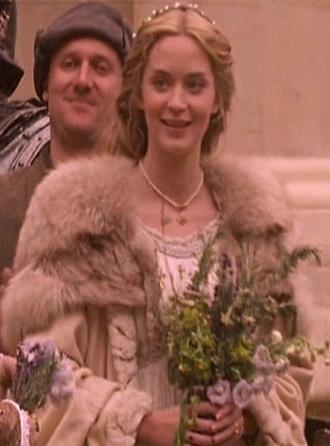
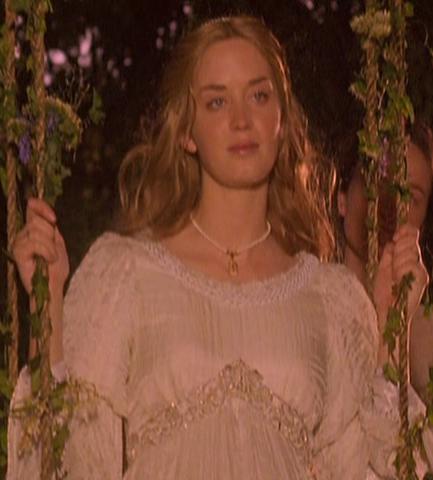
Emily Blunt as Kathryn Howard in the 2003 HBO-ITV movie Henry VIII |
|