 |
|
|
|
|
|
|
|
|
|
|
|
|
|
|
Queen Jane Seymour |
|
|
The Best But One |
|
|
|
 |
|
|
 |
|
|
|
|
|
|
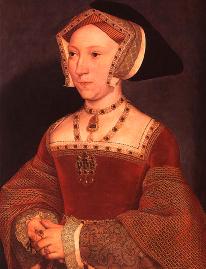
| Queen Jane Seymour could well be regarded as the most successful of all the wives of Henry VIII. She was popular with the people and gave Henry his only male heir which instantly made her his favorite as can be seen by his request to buried next to her. She seemed the ideal wife and queen, but she brought with her a family that was to have quite an impact on English life long after Jane had left the scene. For the Catholics of England she is remembered as a faithful daughter of the Church who tried to reconcile Henry with his Catholic daughter and with Rome, an effort in which she was only half successful but which she undertook with considerable risk to herself. She was a small and quiet woman, but a woman with a devoted and courageous heart within her tiny frame. |
|
|
| Jane was born around 1505 in Wiltshire to Sir John Seymour and Margery Wentworth. The Seymours were a well known family with Norman roots. When she was old enough she secured a position as a lady-in-waiting to Queen Catherine of Aragon. She was very impressed by Queen Catherine and adored her for her kindness and piety. Described as fair, pale, modest, even-tempered and of rather petite build she had the physical appearance Henry liked most and the gentle and reserved nature considered most desirable in a woman of Tudor times. Jane was horribly saddened by the downfall of Queen Catherine and though she also became a maid of honor to Anne Boleyn when Henry VIII married her, she could never feel the same love and admiration for this woman who was more home wrecker than queen. When the time came, Jane had no sympathy for Anne when Henry fell in love with her and Anne had the tables turned on her, getting a taste of her own medicine. |
|
| Jane first caught the eye of the King in September of 1535 when Henry VIII came to Wiltshire and stayed with the Seymours. By early the following year the King was obviously smitten with her, but Jane would not consent to being a mistress and made it clear that she was not the sort to return his advances unless Henry intended to marry her. The King was impressed by her modesty and morals, which was totally different from the flirtations and tantrums of Anne Boleyn. Henry VIII had to play the part of the gentleman courter, even having to put up with his meetings with Jane being chaperoned. Nonetheless, as Queen Anne was being tried for adultery things with Jane proceeded at a fairly quick pace and Jane might have seen herself as the instrument of divine justice for Anne Boleyn. In fact, Anne was not even cold in the ground when Henry VIII and Jane Seymour were engaged the very next day after Anne was executed and were married less than two weeks later on May 30, 1536. |
|
| Jane was the first of Henry's queens who was not crowned, but she quickly adapted to the role of queen consort and by the start of 1537 she was pregnant. Hopes were once again high for a son, especially since Henry's illegitimate son Henry Fitzroy had died only a few months after the royal wedding. Regardless of that though, the differences in style between Jane Seymour and Anne Boleyn could not have been more pronounced. Quite unlike the demanding Anne, Jane took as her motto "Bound to Obey and Serve". All of the frivolity and extravagance of Anne was replaced with a more modest, strict and conservative household by Queen Jane. She was not a socialite and had much more of the quiet, reserved piety of Queen Catherine, the last legitimate queen in Catholic eyes. Queen Jane banned all of the more immodest French fashions Anne had brought in and had all of her ladies dress in traditional, English fashions which were less revealing. Perhaps also remembering how Henry had a tendency to fall for the ladies around the Queen, she made sure that her maids of honor would not draw attention to themselves. |
|
| Queen Jane was also hopeful that she could heal the rift between the King and the Catholic Church and this coincided with the most crucial event in England during her marriage; the Pilgrimage of Grace. This was an uprising of Catholics, mostly from northern England, led by Robert Aske, which intended to force the King to restore the monasteries, dismiss his hated ministers, especially Thomas Cromwell and make England traditionally Catholic again. These people loved Queen Jane, and had more than enough strength to have overthrown Henry VIII had they desired it. However, Henry VIII used treachery to overcome them, and even used the name of Queen Jane in his deceit. He pretended to agree to all of the demands of the Pilgrims and even promised to give Jane a special role as Queen of the Catholic northern part of the country. He had no intention of doing any of this of course and as soon as the trusting Catholics laid down their weapons he crushed them ruthlessly, massacring their leaders and firmly suppressing them. Robert Aske was tortured and executed in a slow and horrific fashion. |
|
| Needless to say, this was the exact opposite of what Queen Jane wanted to happen. She had been working on the King for some time to reconcile with his eldest daughter, Princess Mary, his only surviving child with Queen Catherine. Like her mother, throughout her childhood and adult life Mary was a devout Catholic and had refused to recognize the marriage with Anne Boleyn or the King's title of Supreme Head of the Church. Queen Jane hoped that if she could rehabilitate Mary at court and bring father and daughter together again, this would eventually lead to Henry healing the break with Rome as well and putting everything right again. After all, Anne Boleyn, who had pushed for Henry to reject the Pope, was now dead and disgraced, his marriage to Jane was totally valid and in short all of the reasons Henry had supposedly adopted his radical religious policies were now gone. |
|
| Sadly, this was not to be. Henry had declared Mary illegitimate and had subjected her to horrible humiliations and punishments and when the moment came for reconciliation, the will young Mary finally broke. Henry changed none of his positions and Mary grudgingly recognized the King as Supreme Head of the Church, an act for which she would never forgive herself. Henry had broken with Rome over lust for Anne Boleyn, but now the power of being the supreme temporal and spiritual figure in England had gone to his head and he had no intention of giving it up. Further, he warned Queen Jane to stop meddling in politics and grimly warned her how her predecessor had been beheaded for failing to please him. Queen Jane, ever the faithful wife, accepted this and determined to bear her sufferings in silence with only her sister Elizabeth Seymour and her sister-in-law Anne Stanhope to be her confidants. All in all, 1536 was a year of great promise but ultimate defeat for Jane and by extension for the Catholic cause in England. |
|
|
| Everything soon focused on her pregnancy, which with a husband like Henry, could decide her entire fate. The King did whatever he could to comfort her in her condition so desperate was her for a smooth pregnancy ending in the birth of a son. Jane gained a lot of weight and Henry even had quail brought in from Calais in France and from Flanders to feed her cravings. In September of 1537 Queen Jane took to her chambers to prepare for the upcoming birth. About a month later, on October 12, 1537 the long sought after dream of Henry VIII came true when Queen Jane gave birth to a son, the future King Edward VI of England. Henry was overjoyed and again Jane was the perfect woman in his eyes, the wife who had given him what he wanted most and what none of his others had been able to: a son and heir. |
|
| Yet, the jubilation, sadly, was not to last long. Queen Jane, weakened by the birth, contracted puerperal fever and died a short time after on October 24 in her palace at Hampton Court. Henry VIII mourned her as he had no other. Despite her foray into politics, she had been his ideal woman, the one who had made everything right. He had her buried in Windsor Castle in a magnificent tomb he had built for the two of them there, and where he would one day join her. In fact, Henry was so crushed by her death he gave no thought to remarriage for years later until Thomas Cromwell began pushing the issue on him. Likewise, the role of the Seymour clan did not stop with the death of Queen Jane. Her brothers Thomas and Edward were willing to use her memory, their young nephew and the new Protestant religious views to further their own insatiable thirst for power in the years to come. They were together unworthy to have any association with Queen Jane who must stand alongside Catherine of Aragon as the best of the wives of Henry VIII, who was a modest, devoted wife, far better than her husband deserved, and a devout and loyal Catholic who did her best to restore the Church in England and save the King's soul. She was also a heroic mother who lost her life in the supreme act of giving birth to her son. |
|