 |
|
|
|
|
|
|
|
|
|
|
|
|
|
|
|
|
|
|
|
|
|
|
|
|
|
|
|
|
|
|
|
|
|
|
|
|
|
|
|
|
|
 |
|
The Gunpowder Plot |
|
|
|
|
|
|
|
 |
|
|
|
Remember, Remember the fifth of November |
|
|
|
��������� To this day England still celebrates Guy Fawkes Night every November 5 and most are at least vaguely aware of the facts behind the odd holiday which was once regarded as a sort of British version of Halloween. Most are somewhat aware that in 1605 a Catholic named Guy Fawkes was arrested for attempting to blow up the king in Parliament and that the celebrations ordered for his subsequent execution became a traditional English holiday. However, most people seem to have lost touch with what really happened, who Guy Fawkes was, why people were driven to such extreme actions and the very real questions which arose even at the time as to whether or not what we think about on November 5 ever really happened at all the way we think it did. Here, I will do my best to address the background of the plot, the early Stuart reign, the man Guy Fawkes and why we should remember the fifth of November and perhaps question the traditional story. |
|
|
��������� First of all, we know from years of education that the Gunpowder Plot was a Catholic plot and that there was an antagonism between the English government and the Roman Catholic Church which even today, while gone in fact, remains in principle. To understand this we must go back to the Tudors and King Henry VIII. It was in the time of Henry VIII that official government persecution of Catholics started. Of course most people are aware that Henry VIII broke from Rome when the Pope refused to grant him a divorce from his wife, Queen Catherine, and that he subsequently had himself declared the supreme religious authority of his new Protestant Church of England and made it high treason for anyone to deny his new church and authority. To continue to recognize the Pope as the supreme spiritual ruler on earth was high treason. However, after this, starting in 1536, Henry VIII also started to seize the monasteries of England to take their wealth for himself. |
|
|
|
��������� This was an extremely significant event as the King had effectively declared war on the Catholic Church in England, which had been the only religion of the country for as far back as anyone could remember. That same year the faithful people of England rose up, mostly in the staunchly Catholic northern England, under the leadership of a famous patriot named Robert Aske. In what was called the Pilgrimage of Grace these Catholic rebels marched south with the intention of forcing the King to dismiss his wicked officials and stop his corrupt policies which attacked the Church and hurt the poor by taking the monasteries which had been the sole source of social welfare for the people in that time. The result of this rebellion is one of the most notorious episodes in the already notorious life of Henry VIII. Clearly outmatched by the massive rebel forces, Henry offered to meet with Aske peacefully and promised to give in to all of his demands if Robert would disperse his forces. Believing the King to be sincere, Aske did so, but Henry then went back on his word, cracked down even more harshly on the Catholics, had many of them massacred and had Aske himself executed in the most brutal fashion. |
|
|
|
��������� This was the beginning of the enmity between the English monarchy and the Catholic Church and considering this as a background it is no wonder so many English Catholics came to view their own government as an enemy rather than a servant of the public good. Things grew even worse in the future. Henry VIII, who had once been praised by the Pope for his Catholic devotion, was never more than a selfish and spoiled king. He was predominately a schismatic rather than a heretic, but his children were another story. His only son, King Edward VI, was raised by radical Protestants and so became a zealous anti-Catholic Protestant himself. There was a short return to normalcy during the reign of Queen Mary I, who was a devout Catholic, but she ruled for less than five years after which came the reign of the Protestant Queen Elizabeth I. |
|
|
|
��������� The Elizabethan Persecution, as it came to be called, has gone down in history as one of the worst periods of Catholic oppression since the time of Diocletian and up until the Spanish Civil War. To refuse to acknowledge the Queen as the supreme governor of the church became a criminal offense, to fail to attend Protestant church services was a criminal offense, to be a Catholic or to give shelter to a Catholic priest was a criminal offense and as an added bonus to the government, those refusing to embrace Protestantism would have their lands and wealth seized by the Crown. The persecution of Catholics became worse after Elizabeth was excommunicated by Pope St Pius V and after the Desmond Rebellion in Ireland which was backed by Pope Gregory XIII. In fact, the oppression and butchery against Irish Catholics was so great it led to the Nine Years War from which the Queen did emerge successful but which also saw the most devastating defeat of her reign. Many Catholics were forced to go into exile, English Catholic priests had to study abroad and had to be smuggled back into the country to minister to their people secretly for fear of state oppression. It was, in short, a bad time to be a Catholic and persecution of the Church was a matter of state policy. |
|
|
|
��������� It is no wonder then that many Catholics felt driven to desperate measures to oppose the Protestant government. However, many of the plots against the Queen which were publicized were plots invented by the Elizabethan government in order to unite the people against the Catholic Church, and thus traditional enemies like France and Spain, or to benefit particular courtiers around the Queen. Since Elizabeth I was illegitimate, many Catholics looked to Mary Queen of Scots, who was Catholic, as their hoped for liberator. In fact, the Rising of the North had taken place with the aim of replacing Elizabeth with Mary Queen of Scots. However, Elizabeth supported the Protestants in Scotland against Queen Mary and after Mary was forced to flee to England for her safety, Elizabeth I had her executed. Thus, by the end of her reign, Catholics were in a desperate position. They could find little hope in the world around them and the government of their own country had declared them enemies and traitors simply for continuing to adhere to what had been the religion of England since Roman times. When Elizabeth I was on her deathbed, she named the son of Mary Queen of Scots, King James VI, to be her heir and successor. James, although the son of a staunch Catholic, had been raised by Calvinists and was very much a Protestant, nevertheless, a great many hopes were pinned on him and his reign. |
|
|
 |
|
|
|
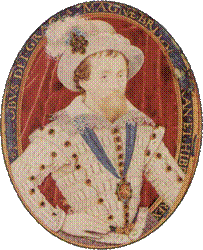
King James VI & I |
|
|
��������� King James I, as he became in England, was the first monarch of the Scottish House of Stuart to reign over England and had courted the position for a long time. James tried to be all things to all people to secure a strong base of support for himself in England. This meant flattering Queen Elizabeth as far as he was able, even naming one of his daughters after her, and assuring the Protestants that he was a devout Protestant and would be a champion of the Church of England. However, he also did not neglect the Catholics and encouraged them to get their hopes up about his succession with vague promises of tolerance and reminders that he was the son of Mary Queen of Scots whom many regarded as a Catholic martyr. In fact, James had dealt softly with a Catholic rebellion in Scotland in 1588 specifically for fear that harsh retaliation would damage his image among the Catholics of England. |
|
|
|
��������� At first, King James seemed to keep his word. At the outset of his reign he stopped enforcing the laws against Catholics, though they officially remained on the books. However, James I was surprised at how many Catholics came out of hiding after this new policy of tolerance started. For many years the vast majority of common English people, especially in rural areas, had remained Catholic at heart; much more so than the Protestant firebrands would have had the world believe. At heart, James was a Protestant inasmuch as he went with whatever group favored his own power and interests. Since the base of his power in England was the Anglican Church he had become a staunch Anglican and he was rather horrified at how many Catholics remained in the country and soon put aside his earlier tolerant leanings. Catholics continued to be oppressed, by the people if not the government, with harassment and assaults of every kind and a Catholic victimized by Protestants could expect very little justice at the hands of the authorities. |
|
|
|
��������� Moreover, James himself soon became known as a monarch Catholics could hardly embrace whole heartedly. There is really no other word to describe him but disgusting. He loathed to wash himself and was constantly filthy, he loved telling obscene jokes and stories, covered himself in the gore of animals he killed while hunting and was widely accepted to be a homosexual, often kissing and fondling his male favorites in public view. To many Catholics it seemed that they had been deceived and saw in James I, not a son in the mold of Mary Queen of Scots, but rather a deceitful, perverse and degenerate man. Furthermore, they expected little in the way of political recovery as James soon became known for his assertion of the Divine Right of Kings and in fact went even further and was fond of asserting that as king he was like a god on earth and that everything he did was divinely ordained. He soon adopted the attitude that to disobey him as king was to disobey God. Obviously, this was not the sort of attitude which would sit well with devout Catholics. They had seen horrors under Elizabeth I, had got their hopes up with James only to have them dashed and were now afraid that their situation would become worse than ever. This was the background to the Gunpowder Plot. |
|
|
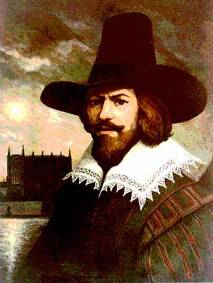
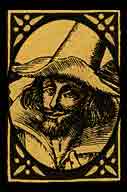
��������� The man most associated with this plot, though not the mastermind as we shall soon see, was Guy Fawkes, by virtue of his holiday probably the most infamous Catholic in English history. But who was Guy Fawkes? He was certainly not the simplistic, two dimensional villain he is often portrayed as, but rather was a very real and complex man with a lifetime of reasons to make him opposed to the government. He was from Yorkshire and the son of a fairly well established Protestant family. Yet, he soon found his conscience to be in a position opposed by his own government. He converted to Catholicism, a criminal offense at the time, and was obliged, like many, to go abroad. He went to the Netherlands and joined the Spanish army in 1593. While serving His Catholic Majesty, the King of Spain, Guy Fawkes gained a reputation for uncommon bravery and courage. He was, of course, also all too familiar with the oppression Catholics were forced to endure in England because of their faith and the general history we have already covered. He was a zealous Catholic and with his high reputation as a soldier it is no wonder his name came to the attention of other Catholics in England who were resolved to take matters into their own hands to set right a government they viewed as having gone terribly wrong. |
|
|
|
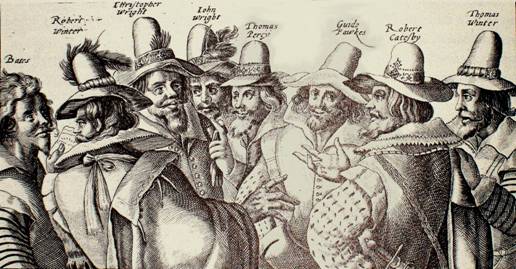
��������� The idea was formulated for a coup which would topple the Protestant government of King James and see freedom for Catholics restored though it was not Guy Fawkes who came up with this plan but rather an English Catholic named Robert Catesby. He knew from firsthand experience the oppression and persecution Catholics had known in England since the Protestant seizure of power and the coup, which became known as the Gunpowder Plot, was of his making. Catesby contacted Guy Fawkes because of his fame as a soldier and as a Catholic and thought that he would be extremely useful in his plan to rid England of absolute Protestant rule. Many mistakenly believe that the men behind the Gunpowder Plot had no plan other than destruction, a belief in fact which has been seized on by some modern day anarchists who sometimes adopt the image of Guy Fawkes as that of a champion of anarchy. However, if accounts are to be believed, the Catholic plotters had a very real and definite plan about what was to happen in England if their plan was successful. The plan was simple and yet radically extreme. |
|
|
|
 |
|
|
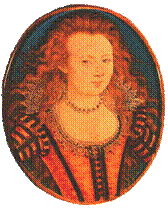
The would be Catholic Queen |
|
|
��������� They would pack the underside of the parliament building where the House of Lords was meeting with gunpowder. When King James I came to open Parliament everyone who was anyone in Stuart England would be in one place at one time. The King would be there, the Prince of Wales, the nobility of England and all the gentlemen of the shires would be gathered in that one cramped room. Then, it was decided; Guy Fawkes, who had been recruited specifically because of his military experience and knowledge of explosives, would set off the gunpowder under the building and blow them all sky high. Catesby would then lead a Catholic coup which would seize power and place the young Princess Elizabeth on the throne as Queen of England who could then be brought up in the Catholic faith and restore the traditional rights and freedoms for the Church and the people as existed in old England before the Protestants took control of the country. Many have dismissed this plan as wishful thinking and asserted that after so many years of Protestant domination England would never be Catholic again and that any coup would fail and only make things worse for the Catholics of Britain. That may be true, no one can see the future, but it is worth remembering that even after the reign of Elizabeth there were still many Catholics in England as evidenced by the shock James got when he relaxed the laws against them. Furthermore, we can see coded references in Shakespeare that Elizabeth was not as popular as many today think and King James was certainly viewed with disgust by many, both for his homosexual ways and his absolutism. In her subsequent life we also know that the Princess Elizabeth, who went on to be Queen of Bohemia, was a highly competent and beloved woman who could have made an excellent Queen of England. |
|
|
|
 |
|
|
|
The Gunpowder Plotters including (second and third from left) Robert Catesby and Guy Fawkes |
|
|
|
��������� The plan did not exactly go off without a hitch. It took some time to prepare and to find a way to get the powder into the basement of the Parliament building. Eventually, the plotters managed to rent a house from a government official right across from the Parliament. From there they could tunnel into the basement directly underneath the House of Lords where they would be in a perfect position to blow the leadership of England into a million pieces. The other plotters made plans to escape the immediate aftermath of the attack, but Guy Fawkes, the munitions expert, was to stay behind, make sure that the fuse was lit and the explosion certain before making his getaway to Flanders. The gunpowder was obtained and the cellar was packed. Finally, it seemed to those involved, the operation was progressing as planned. However, a critical mistake was made in the name of compassion. A letter was sent out prior to the assembling of Parliament warning Catholics to stay away so as to avoid killing any of their fellow brethren of the Church of Rome. One of these letters would be the undoing of the Gunpowder Plot. |
|
|
|
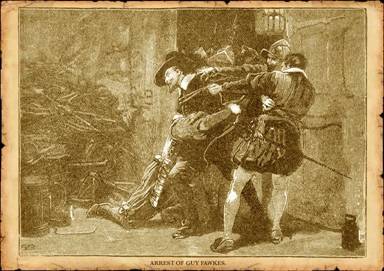
��������� On October 26 one of these letters was delivered to Lord William Parker, the Fourth Baron Monteagle. Catesby was concerned about the word getting out, under somewhat mysterious circumstances, but was convinced that the letter was vague enough to protect them and the plan was still a go. However, unknown to the plotters, Monteagle went to the authorities and shared the letter with them. He himself accompanied the Earl of Suffolk, Lord Chamberlain, with a search party to the Parliament buildings. The gunpowder was discovered, as was Guy Fawkes with slow matches and touchwood on his person to set it off. The plot had been discovered and Guy Fawkes was quickly arrested though he protested that had he been given the opportunity he would have exploded the powder then and there taking out those on hand and himself with them in service of his cause. |
|
|
��������� When November 5 came Fawkes was brought before a meeting of the Privy Council, but refused to divulge any information that would incriminate his comrades and gave a false name for himself. Seeing that the game was up though he did open up somewhat as to his reasons for his involvement. When King James asked him how he could be a part of such an enterprise, Fawkes is said to have replied that a disease so dangerous required a desperate remedy. The King authorized Fawkes to be tortured and eventually he was tormented into revealing his identity and the number of the plotters involved as well as eventually their names and the details of the plot. He is alleged to have said that he prayed every day for the chance to perform some act to advance the Catholic Faith and save his own soul. |
|
|
 |
|
|
The arrest of Guy Fawkes |
|
|
��������� The fate of Guy Fawkes was never in question from the moment of his capture. Along with seven others Fawkes pled not guilty but only because the charges named the Jesuits as the instigators of the plot. On January 31, 1606 Guy Fawkes, Thomas Wintour, Ambrose Rookwood and Robert Keyes were taken to Westminster where they were hanged, drawn and quartered with Guy Fawkes being the last to die. To celebrate his deliverance from this Catholic plot against his life and his government, King James declared November 5 a holiday, now known as Guy Fawkes Day, and was used as an occasion to ridicule and denigrate Catholicism and to burn effigies of Guy Fawkes and the Pope. However, how much of what we supposedly know about Guy Fawkes and the Gunpowder Plot is really true and was it really the Catholic plot everyone accepts it as? There are certainly enough unpleasant facts to make one at least wonder if there was not more to it than that. |
|
|
��������� One of the first odd mysteries is how Catesby and his men obtained the massive quantities of gunpowder in the first place. Gunpowder was a government monopoly and only Crown officials should have been able to obtain it. When stores of gunpowder were found missing from the Tower of London (a government stronghold) Robert Cecil, the Lord Chancellor of England, refused to investigate it. Furthermore it seems a little too convenient that the plotters were able to obtain a house right next door to the Parliament building, ideally suited to their needs, and which was owned by a government official no less! If that does not make one stop and wonder, consider that the government official who rented the house died on no date other than November 5 itself. Quite a coincidence one would have to agree. Various other parts of the government story do not fit the facts. Why were two of the plotters shot immediately before they could be questioned? Why were several conspirators arrested on November 5 when the government claimed that they did not know the identity of the plotters until Guy Fawkes revealed their names under torture on November 8? Finally, was it not convenient that the meeting of Parliament, which had been scheduled for February, was postponed until November when everything was set up for the explosion? |
|
|
��������� For anyone with an open mind there would seem to be too many unanswered questions and convenient coincidences to simply dismiss the issue no matter what opinion one might hold. In fact, all of the evidence mentioned above has caused some to wonder if Robert Cecil did not mastermind the whole plot, using the plotters as his dupes, specifically to enflame King James against the Catholics, revive public paranoia and ensure that the Catholic Church could never reestablish itself. The radical Protestantism of Cecil is given to support this as well as the fact that the weapon of choice was gunpowder since King James was particularly paranoid about that method of death as his own father had been killed in a gunpowder explosion. The truth may never be known, but certainly this is a somewhat plausible theory with enough facts to make an open minded person question who exactly was the real villain behind the Gunpowder Plot and doing that one might find Robert Cecil a far more dastardly figure than poor Guy Fawkes. |
|
|
|
��������� In any event, whatever Cecil did or did not do, the result was a renewed wave of anti-Catholicism in Britain. The fanatical hatred and paranoid fear of the Catholic Church was to last throughout the reign of James I, his son Charles I, the Puritan interregnum, the reign of Charles II and James II when the radical Protestant cause triumphed and saw the Stuart monarchy (which had become Catholic) replaced by the Protestant Prince of Orange and later the Hanoverian dynasty. Even far into the period of the Enlightenment, King George III still could not bring himself to grant civil rights to Catholics under his rule. What would have happened had the plot succeeded we will never know for sure. Would the Catholics have been able to take advantage of the chaos that followed and take power? Would Princess Elizabeth have made a great Catholic Queen of Britain rather than a Protestant Queen of Bohemia? They are interesting questions but ones that cannot be answered. |
|
|
|
��������� What is certain is that the Gunpowder Plot was one of the most pivotal events in English history, even if it was trumped up to be so. The image of Guy Fawkes has been seared into the public memory. To this day, before the Queen opens Parliament, the basement is searched the night before with the guards chanting, "Remember, remember the fifth of November". Guy Fawkes Night is still celebrated, the bonfires are still lit and his effigy is still burned in a bizarre tradition that has lasted even longer than the royal house of the King that started it (until 1959 it was, in fact, illegal not to celebrate Guy Fawkes Night in England). However, it may not always be celebrated in quite the way King James and Cecil intended. There is the impression that many who still remember, remember the fifth of November use that slogan as a grave warning to their own government rather than a warning about the dangers of the Catholic Church. Cecil may have wanted people to remember the fifth of November to stir up anti-Catholicism and support for the state but many people today want the state itself to remember the fifth of November and consider what extremes people can be pushed to in the face of oppression and persecution. |
|
|
|
��������� What then, as a closing thought, are Catholics to make of all the festivities of the fifth of November? That answer varies from person to person. Some Catholics join in with the belief that Guy Fawkes and company were terrorists and traitors and celebrate the day the same as anyone else (though one assumes they would not join the crowds in Northern Ireland burning effigies of the Pope as well as Guy Fawkes). Others believe that the whole thing was a Protestant plot; that Catesby and Fawkes and the rest were dupes in a wicked conspiracy by Robert Cecil and they have no part in Guy Fawkes Night unless it is to try to convince others of what they believe to have really happened. Then there are those Catholics who may or may not believe it was a set up but who nonetheless celebrate Guy Fawkes as a hero, a sort of political martyr who was fighting against oppression and wanted Protestant rule in Britain to go out with a bang. These Catholics are certainly the most fun to spend Guy Fawkes Night with. My favorite tradition in this circle is to have a little party for Guy Fawkes Night (and I know at least one Catholic who did this and she did it well) at which, following the usual grub, gab and drinks as well as a toast to the only man to enter Parliament with honest intentions; a gingerbread house is brought out, made to be a (crude) model of the Parliament building. Gingerbread men (or in the case in question crude marshmallow people) are inserted to represent the King and crew. The little dessert Parliament is then stuffed with firecrackers (M60's in this case) and blown into little pieces. It is all in good fun but needless to say this should not be attempted among Protestants or those who do not think Guy Fawkes was such a swell --Guy. |
|
|
��������� No matter what though, the Gunpowder Plot continues to fascinate people. Both for what it was, what it might have been and for what it could have been had it succeeded. Guy Fawkes has certainly won a place in the history books (and cameos in political posters, pop bands and movies) and it seems that no matter what one believes about Guy and the plot, whether he was a martyr or a mad man, it looks as though throughout the English speaking world we will always remember the fifth of November. |
|
|
 |
|
|
|
REMEMBER, REMEMBER THE FIFTH OF NOVEMBER |
|
|
|
THE GUNPOWDER TREASON AND PLOT |
|
|
|
I CAN THINK OF NO REASON |
|
|
|
WHY GUNPOWDER TREASON |
|
|
|
SHOULD EVER BE FORGOT |
|
|
|
|
|