
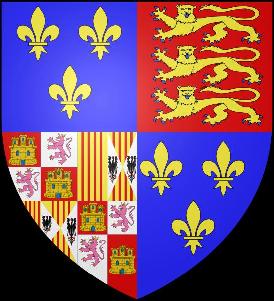
King consort of England
|
|
|
|
|
|
|
|
|
|
|
|
|
|
|
|
|
|
|
|
|
|
||||||||||||||||
| King Philip II of Spain | ||||||||||||||||||
| Champion of Christendom King consort of England |
||||||||||||||||||
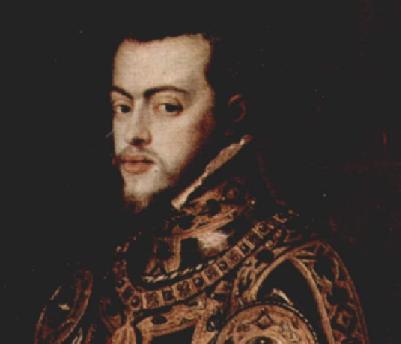
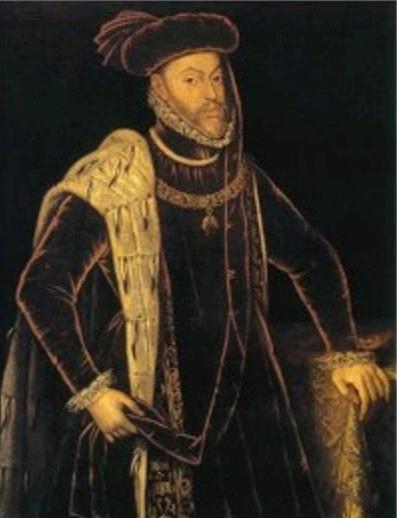
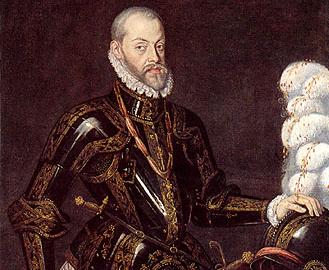
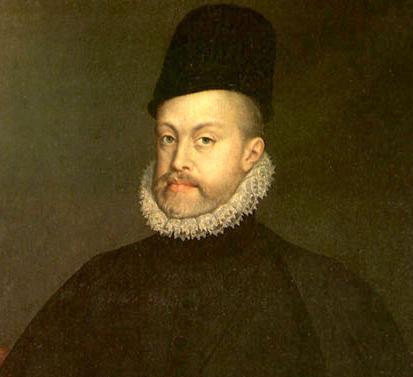
| King Philip II of Spain was the only (legitimate) son and heir of the great Holy Roman Emperor Charles V, also known as King Carlos I of Spain, and he inherited the western domains of his father upon his abdication in 1556. While his brother Ferdinand became Holy Roman Emperor over Austria and Germany, Philip II became King of Spain, Burgundy, the Low Countries and America. Ultimately, his long list of titles included King of Spain, King of Naples and Sicily, King of England, Ireland and France (by marriage), Lord of the Seventeen Provinces (the Netherlands), King of Portugal and the Algarves and King of Chile. The Kingdom of Spain reached its peak of greatness during the reign of Philip II, however, he also had great trials throughout his life, immense responsibilities and a succession of threats to his own domains and to Christendom which he took responsibility for defending. Although not without his faults, Philip II was a staunch Catholic who took his religious responsibilities seriously and did his best to rule as a just and zealous Catholic monarch. | ||||||||||||||||||
| Philip was born in Valladolid on May 21, 1527 and as with most royal figures of this period little time was wasted before putting him to work for the maintenance of the Hapsburg empire. In 1543 he married his cousin, Princess Maria of Portugal. Philip already had strong family ties to the kingdom and throughout his early years while his mother was still alive he spoke Portuguese as his first language. The succession was seemingly secured when Maria gave Philip a son, Don Carlos, in 1545 but sadly she died shortly afterward and Philip was to have a great deal of trouble with his son in the future. He also had to concern himself with the ongoing war with France but his father, Emperor Charles V, soon entered into negotiations for his second marriage. In 1554 Philip wed Queen Mary I of England, probably his most famous match in the English speaking world at least. He was kind and respectful toward Mary but probably never loved her as she did him. Royal marriages were political alliances first and any romance was considered simply an added bonus. He wanted English support against the French and to help shore up the Catholic Church in England which Queen Mary I had restored. | ||||||||||||||||||
| Philip was not popular in England, nor has Queen Mary been treated fairly by most Protestant histories. However, the English people who branded Philip as a foreign tyrant who was cheering the suppression of Protestants and the burning of heretics either did not know or chose to ignore that Philip counseled moderation in dealing with the adherents of the new brand of Christianity. He also prevailed upon Queen Mary not to disinherit her half sister Elizabeth who was suspected (correctly) of being a Protestant. So it is that, in a way, the woman hailed as the greatest English queen in history owes her throne to Philip II who would be her greatest antagonist. That was all in the future though and in 1558 when Queen Mary I died childless Philip actually proposed to Elizabeth in an effort to maintain the Anglo-Spanish alliance his father Charles V had put such hopes in. It was not to be however and with the succession of Queen Elizabeth I there would be a restoration of Protestantism and the start of wars and struggles between England and Spain that would outlast both monarchs. | ||||||||||||||||||
| The following year, in 1559, a peace was negotiated between France and Spain by which Philip was to marry Elisabeth of Valois. Although no sons were forthcoming, she did eventually give Philip two daughters, Isabella Clara Eugenia and Catalina Micaela. However, Philip scarcely had any time for domestic concerns as the threat of war loomed in the Mediterranean. The Ottoman Turks were growing ever more aggressive and were a plague to Spanish shipping. In response, Philip II joined the Holy League in 1560 with the Catholic powers of the Republic of Venice, the Republic of Genoa, the Papal States, the Duchy of Savoy and the Knights of Malta. Only five years later, in 1565, the Muslim Turks besieged the Christian island of Malta, defended by the Knights of Malta under Grand Master La Valette based at St Elmo castle. The knights were vastly outnumbered but fought valiantly to great effect and because of the timely arrival of the Spanish fleet they were able to drive the Turks off. | ||||||||||||||||||
| The common threat of Muslim conquest had once united all Christians from Italy to Norway but now there were Protestants who cheered the Muslim conquerors in the hope that they could crush the Catholic powers between them. The Dutch were rebelling against Spain and were making Holland the epicenter of religious conflict in Europe. In 1566 this manifested itself in the infamous bloodbath known as the Calvinist Fury. Catholics were slaughtered, Churches desecrated and atrocities of every sort were carried out. Philip II was persuaded to take stern measures against the Dutch and he dispatched the Duke of Alba with an army to put down the revolt. The conflict in the Netherlands would go on for some time and religious strife even reached the supposed safety of Spain where Philip supported the Holy Office of the Inquisition in ensuring that heresy did not spread. The King also had personal problems to deal with. His son, Carlos, son of his late first wife Maria of Portugal, was most probably insane. Don Carlos had wanted to command the army sent to Holland and when his father refused to trust him with such a duty he tried to kill the Duke of Alba. He openly spoke of wanting his father dead and plotted to leave Spain and join the Protestant rebels in Germany. This forced Philip to put his son under house arrest and he died in 1568 from self inflicted starvation. That same year his third wife, Queen Isabel (as the Spanish called Elisabeth), died making him a widower for a third time. | ||||||||||||||||||
|
||||||||||||||||||
| Lest anyone think the Spanish Inquisition was all unjustified cruelty, that same year also witnessed a rebellion in Spain by the Moors. Furthermore, the numbers most often quoted of those burned by the Inquisition have been grossly exaggerated and scholars who have studied the period have recognized that the Inquisition was actually one of the most humane and fair court systems in the world at the time and stands up well even by the standards of today. All of this was also going on in a period of continuous Islamic aggression. In 1571 the Turkish forces of Sultan Selim the Grim conquered Cyprus. Pope St Pius V called for a crusade and Philip II was the only major figure in Christendom to answer the call. He contributed a great number of warships under the command of his half brother Don Juan of Austria who defeated the Muslim fleet at the great battle of Lepanto off the coast of Greece. Turkish sea power was broken and southern Europe was saved from amphibious attack. | ||||||||||||||||||
| In 1578 Philip II married again, this time to his niece, Anne of Austria, who bore him four sons over the next four years but, sadly, only the youngest, Philip, survived to adulthood. Still, he remained committed to his duties and in 1580 became King of Portugal following the death of his nephew King Sebastian. However, his attitude toward the Portuguese proves how wrong his enemy propagandists were in portraying him as some sort of tyrant. He did not annex Portugal to Spain but rather served as king separately over that country in accordance with Portuguese laws and customs. For the next six decades Spain and Portugal were in personal union and because of his mother Philip spoke excellent Portuguese, he wore his beard and even dressed according to Portuguese fashion, spent the first two years reigning from Lisbon and did nothing to interfere with the established system of government in Portugal. The inclusion of the rich Portuguese colonies in Brazil and the East Indies also provided a much needed source of income for his cash strapped domains as he continued to battle Turks and Protestants as he felt was his Christian duty. | ||||||||||||||||||
| This was significant as the wars he felt obligated to wage against heathen and heretic continued. Meanwhile, as the Spanish recaptured and again lost their north African foothold in Tunis, the war against Protestant rebels dragged on in the Netherlands and after a second Calvinist Fury Philip II tried to change strategy. He recalled Alba and replaced him with the victorious Don Juan. He pledged to fight under the sign of the cross and gain a victory over the heretics as he had the Muslims. At first, he seemed to and defeated the Dutch, gaining enough momentum that he considered invading England, rescuing Mary Queen of Scots and marrying her to rule Britain. However, he died not long after his initial victories. He was succeeded by the Prince of Parma who dominated the battlefield and soon had the Dutch pushed into a far corner of Holland. Were it not for the intervention of England and Protestant control of the Dutch coast there is little doubt that the fledgling Dutch republic would have been crushed then and there. | ||||||||||||||||||
| Despite harassment from English pirates, Muslim attacks and Dutch insurgents Philip II had triumphed over them all, held Spain as the strongest nation in Europe, secured the Mediterranean from Ottoman attack and had the Protestants cornered. A new problem arose, however, in England. Philip had formerly been King of England while married to Queen Mary I, he knew of the persecution English Catholics were enduring under Elizabeth I and he remembered how he had urged Mary not to remove her sister from the succession which made him feel partly responsible. The final straw came when Elizabeth I ordered the execution of Mary Queen of Scots who was also the rightful Queen of England as Elizabeth I was illegitimate; actually by both Catholic and Protestant standards as she was conceived before Henry VIII married her mother Anne Boleyn in his newly created Protestant church. The regicide of an anointed queen, combined with the pirate attacks, support for the Dutch rebels and the persecution of the Church all added up to a just cause for war against England. In what was called the Enterprise of England, Philip planned to build the largest naval force in history, sail up the Thames River, land a massive army from Flanders, conquer England, overthrow Elizabeth, restore the Catholic Church and make his daughter, the Infanta Isabella, Queen of England. | ||||||||||||||||||
|
||||||||||||||||||
| Philip II tended to be a micromanager but even by his standards he took a special interest in the Armada. He had previously been King of England (and had English royal blood in his own veins through his mother), he sympathized with the persecuted Church there, he felt partly responsible for Elizabeth gaining the throne and was chivalrously outraged at the regicide of Queen Mary. Further, since King James VI of Scotland (a child under Protestant control) had disavowed his mother, Mary had named Philip as heir to her rightful claim to the throne of England. English pirates were also raiding his ships sailing back and forth from America and England supported the Dutch Protestants in rebellion against him. All of this added together to make Philip obsess over the Armada and involve himself in its organization down to the last detail. However, Philip was not a sailor and hard work and determination could not substitute for naval skill. He used converted merchant ships which slowed down the Armada, the large fore and aft castles used at that time also slowed them down and the ships were heavily laden with supplies and soldiers. Furthermore, there were immense logistical problems long before the Armada even sailed, most of which came down to too many men crowded into too small a space and greedy merchants who sold the Spanish navy rotten food. | ||||||||||||||||||
| The plan was for the Armada to hold off the English navy long enough for Parma to take his troops across the Channel and land in England. Once there, everyone was convinced that Spanish victory would be swift and certain both because of the established genius of Parma and the high reputation of the Spanish army as well as the dilapidated state of English defenses and the simmering discontent of the oppressed English Catholics. However, the Armada was plagued with misfortune from the beginning. Admiral Santa Cruz, regarded as the best sailor in Spain, died before the Armada set sail and Philip appointed the Duke of Medina Sidonia to replace him; an able military commander but a man with no naval experience. An early English raid further delayed departure and it was not until late May, 1588 that the Armada sailed. Still, it was an impressive sight with 130 ships carrying tens of thousands of soldiers and sailors. | ||||||||||||||||||
| Storms scattered the fleet and badly damaged a number of ships before they were able to reassemble and meet the English navy for the first time on July 31 off Plymouth when they discovered how outmatched they were by the faster and more nimble English vessels. The English ships darted around the Spanish fleet, using their longer ranged guns to inflict damage without the Spanish being able to effectively retaliate. The Spanish intended to fight in the traditional fashion which was to come in close, grapple and board the enemy ship and let the soldiers seize control of it. However, the English opened a new era in naval warfare as they fought at a distance with their canon and never allowed the Spanish ships to get close to them. On August 2 at Portland Bill another aggravating but inconclusive battle was fought but one which also gave the English the idea of sailing their ships in a moving line rather than abreast and attacking all at once. This new tactic was to revolutionize naval warfare and become standard procedure for hundreds of years to come. | ||||||||||||||||||
| Nothing was going right for the Armada. They were running low on ammunition and supplies and while the English could quickly put in at their nearby ports for more the Spanish could not. Medina Sidonia sent frantic letters to the Prince of Parma urging him to board his troops and get them across the Channel as quickly as possible, but Parma, who did not like the whole plan to begin with, thought it too risky and wanted more time but it was time that Medina Sidonia did not have. The Spanish put in at Calais and on the night of August 7 there were attacked by English fireships. The fireships actually did little damage themselves but their appearance forced the Spanish to cut their anchors to escape and many ships were never recovered. The next day at the battle of Gravelines the climatic battle came and the Armada was devastated by the English ships. The Spanish ammunition was poor and did little damage and their guns were often too big for the converted merchantmen they were mounted on and the strain of their firing weakened them. Fortunately, before the Spanish could be totally destroyed a wind scattered the English ships. | ||||||||||||||||||
| The Spanish fleet was blown into shallow water and the overwhelmed Medina Sidonia ordered his men to pray, which they did, and thanks be to God the wind changed and blew the ships back into deep water. Medina Sidonia had no choice but to retreat and the only possible escape route was north around the coasts of Scotland and Ireland. Provisions were low and the men were cold, wet and hungry but their commander shared their privation, allowing himself no more or better food and drink than what his men had. Some 26 ships were lost on this horrific trek, wrecked on the Irish coast where many of the survivors were killed by English patrols though some were rescued by sympathetic Irish Catholics like the chief of the O'Rourke. Some 6,000 Spaniards had been killed and when Medina Sidonia finally limped back to port it was without half his ships and a third of his men. This episode marked the end of Spanish naval supremacy and the beginning of the ascendancy of the English and later the British Royal Navy as the masters of the waves. | ||||||||||||||||||
| Although then as now many played the blame game for the disaster that befell the Armada but King Philip was not among them. In fact, he ordered a Te Deum to be sung to praise God and in acceptance of the cross he had to bear. He once said that he considered it impious and nearly blasphemous for anyone, whether king or commoner, to presume to know the will of God but rather strove to accept whatever fortune God handed down to him, whether good or bad. He had done his duty, he had done his best but time and chance were against him and he accepted his defeat gracefully in an exemplary Christian fashion. Nor did this setback weaken his resolve and he proved relentless in the pursuit of his duties. And, he was sorely needed for trouble had been brewing again in France for some time as Protestant rebels fought for control of the country. The situation boiled down to Henri Navarre who led the Protestants, Henri of Guise who led the Catholic League and King Henri III who wavered in the middle. | ||||||||||||||||||
| When the Duke of Guise took Paris many expected that he would seize power but instead he sent an assurance of his allegiance to Henri III, however, on Christmas Day 1588 the king had him assassinated with the connivance of the Protestants and even Queen Elizabeth. The king himself was in turn assassinated but not before he named Henri Navarre as his successor. With the help of huge amounts of money from England, Navarre and the Protestants soon turned the tide and gained control of much of the country until the summer of 1590 when only Paris held out. For two months the Catholics in Paris were under siege and 13,000 died of starvation. Once again, where the faith was in peril, Philip II responded and he ordered the Prince of Parma to break off his operations in Holland and march to the relief of Paris. The Spanish troops were successful and Paris was relieved. Henri Navarre found that he could not be king and remain a Protestant so, in 1593, he saw fit to convert to Catholicism. King Philip II had saved the Eldest Daughter of the Church from heresy and although he lost much that was reward enough for him. | ||||||||||||||||||
|
||||||||||||||||||
| By the end of his life, despite being surrounded by enemies, Spain was still a superpower of the day but it was also bankrupt. Mineral wealth imported from America kept Spain afloat but Philip was constantly forced to borrow money to pay his troops and juggle the books to fund military expeditions which he felt compelled to pursue. He was also hampered by the different laws and government bodies of the different regions of Spain of which he was king. This meant that Spain was much more differently governed than most think. There was actually a great degree of local rule, checks and balances and the rule of law rather than royal absolutism. However, it also made things more difficult in working together which could not be avoided without making the country a centralized more autocratic country which went against both Spanish history, tradition and culture as well as the Catholic aversion to arbitrary royal rule. Philip, as a dutiful son of the Church and a freedom loving Spaniard, remained faithful to this system which meant a continuation of local rule but also meant that by 1596 Spain was bankrupt and only kept afloat by foreign loans and gold and silver mined from the New World. | ||||||||||||||||||
| King Philip II died on September 13, 1598 at his monastery palace of El Escorial and was buried, according to his wishes, in a plain and simple wooden coffin. He passed into history in the embrace of the Church having done his best to be a good, Catholic monarch. His historical image depends greatly on which country writes the history. In Spain he is remembered as a great monarch under whose reign the Spanish people achieved their peak of power and prestige and were the most advanced, modern and militarily powerful country in Europe. Catholics too look upon him with admiration for his dedicated defense of the Church and his heartfelt efforts to resist heretical ascendancy in England, France and Holland as well as defending Christendom from the Muslim Turks. In the English speaking and Protestant world, on the other hand, he is ignorantly portrayed as the worst villain possible, mostly because of how close he came to stopping Protestantism in England, restoring the Catholic Church there and, had he done so, the subsequent glorious history of the massive British Empire might have been a Spanish one. | ||||||||||||||||||
| What is true is that he did his duty as best he could, sometimes the odds against him were too great but he did accomplish a great many crucial things for Spain, Christendom and the Holy Church. Because of his courage and dedication heresy was not allowed to take root in Spain and Spanish possessions in the New World and beyond. Thanks to this, Spain was spared the bloody history of Germany with a long series of religious wars. He failed to see England restored to the Catholic Church, just barely, but he was responsible for the survival of the Church in France and the maintenance of a Catholic monarchy there. Although he came very close he was unable to totally suppress the Protestant rebellion in Holland but he did ensure that Belgium remained Catholic. Philip, through the military actions at Lepanto and Malta especially he also saved Europe from the threat of Muslim Turkish invasion. He came maddeningly close to success but could not see the total suppression of Protestantism, however, his courage, loyalty and dedication did ensure that Protestantism was contained. Thanks to the actions of Philip II, and his father Charles V and others, Protestantism would not become permanent until the end of the Thirty Years War. | ||||||||||||||||||
| Finally, it is important to note the personal conduct and character of King Philip II, especially in light of the very unflattering image of him painted by Protestants. Philip was an intelligent and sensitive man. As King of England he had advised Queen Mary not to be too harsh in dealing with heretics and had realized the situation of the country and it is for that reason that he made the mistake of urging her not to disinherit Elizabeth. Philip, as a good son of the Church supported the Inquisition in Spain, but knew that the situation in England was very different. He realized that to do so would be to risk civil war. He kept his country united despite efforts of Aragon to separate itself. He was a devoted family man who loved his daughter Isabella especially deeply and allowed her to assist him in his work. He had his conflicts with the Pope on political matters and his own worldly failings, but at heart he was a deeply religious man who prayed frequently and who accepted both victories and defeats with good grace as the will of God. He was also a humble man and would listen to the cares and concerns of his lowliest subjects and take action to help them in their problems. In comparison to the King of France who was driven by self interest or Queen Elizabeth I who was notoriously vain and arrogant and reacted violently when something did not go her way King Philip stands out all the more as an upright, steadfast and very moral man and humble servant of God. Certainly one of the greatest Spanish kings of all time, His Catholic Majesty Philip II was also one of the great heroes of Catholic history. | ||||||||||||||||||
|
||||||||||||||||||
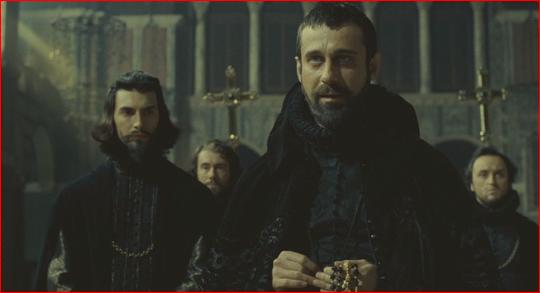
| The popular image of King Philip II, in English speaking countries especially, has been largely colored by the Black Legend. That is; the propaganda version of the Spanish which originated in the time of Elizabeth I of England which portrayed every and all things Spanish and/or Catholic as cruel, wicked, tyrannical and superstitious. Unfortunately, this has persisted even today when modern man likes to think of himself as being very tolerant, fair and free of prejudice and bigotry. For example, in the recent film "Elizabeth: The Golden Age" the portrayal of Philip II is almost cartoonish. He is portrayed as superstitious, scheming, murderous and is always shown draped in black, lurking in the shadows and living in a dark palace where he plots the annihilation of England. The truth about any human being though is seldom so one dimensional. The movie, incidentally, was hated in Spain and all around was a box office flop, which is good, but it shows to what extent the life and times of Philip II, the Armada and the English reaction still lingers with us to this day. | ||||||||||||||||||