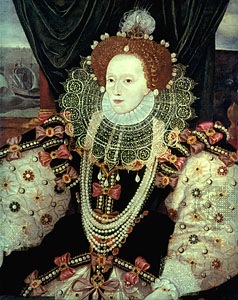
The reign of Queen Elizabeth I is regarded as the "Golden Age" of English history, and indeed it is impossible to overlook the accomplishments of her time. From the literature of Shakespeare, the great wealth gained by the piratical "Sea Dogs" and the defeat of the Spanish Armada which marked the end of Spanish naval supremacy and the start of English domination of the seas. The country was kept secure from foreign control and toleration replaced the heavy-handedness of her older sister Queen Mary, or at least that is what most now believe. In fact, along with all of the undeniable greatness of Elizabeth's reign there was also great cruelties and injustice. There was English support for the Dutch rebels and French Protestant assassins as well as what was arguably the worst persecution of Catholics that was to occur until the Spanish Civil War. Ireland certainly does not remember Elizabeth fondly, nor do the Catholic martyrs of England such as St Edmund Campion who, as he pointed out, was doing nothing more than preaching the same faith as all the great kings of English history like Richard I, Henry V or St Edward the Confessor.
Queen Elizabeth was, it must be said to begin with, illegitimate from any point of view, Catholic or Protestant. Even if one accepts the Protestant point of view that Henry VIII could make himself "Supreme Head of the Church" and lawfully divorce Catherine of Aragon to marry Anne Boleyn, the fact is that Elizabeth was already in the womb when Henry VIII married his former mistress. When compared to her older sister Mary, Elizabeth had a privelaged youth growing up and enjoyed the support of the powerful Protestants of the country and she was quick to recognize them as her key to absolute power. Yet, when she came to the throne in 1558 it was mostly thanks to a man she would make her arch-enemy; King Philip II of Spain. Queen Mary had been very reluctant to leave Elizabeth the throne, and her religion and association with the Protestant elites who had plotted against Queen Mary were at the heart of the matter. A comparison of the sisters is worthwhile. During the reign of their younger brother, King Edward VI, Mary had remained faithful to the Catholic Church in spite of radical Protestant rule and never pretended to be anything but a Catholic; for her, to abandon her faith was simply unthinkable, no matter how much danger it put her in. Elizabeth, on the other hand, had no such devotion and went to Protestant services during her brother's reign and later to the Catholic mass after Mary became Queen and restored the link with Rome. Seeing no religious devotion in her sister, Mary might well have tried to exclude her from the succession had not her husband, King Philip II, persuaded her that it would be in the interest of peace and stability to allow the throne to pass to Elizabeth.
The concerns about Elizabeth and her pretended loyalty to Catholicism were to prove all too legitimate. Among her first acts were to enforce Protestantism on England and Ireland, to once again break with Rome and make herself "Supreme Governor" of the Church of England. Catholics were forced to attend Protestant services, forced to celebrate mass in secret, forbidden to raise their children Catholic and priests were hunted and persecuted. Ireland in particular felt the wrath of the Protestant Queen and efforts to stamp out the faith there were extremely brutal. Certain Catholics whom the Queen deemed to be of value were spared, but the ridiculous persecution of Catholics as traitors is best illustrated by the execution of St Edmund Campion who pointed out that what Elizabeth regarded as treason was nothing more than upholding the same Church that all of the English kings of history before Henry VIII had upheld and fought for.
Furthermore, Elizabeth, as a Protestant, worked to undermine the other monarchs of Europe, making bad situations worse. She launched an unprovoked attack on Scotland, which was repulsed, but aided the Protestant Scots in overthrowing their Catholic Queen, Mary Stuart. She later had Queen Mary, her own cousin, executed after Elizabeth's spy master Sir Francis Walsingham set up laws and false evidence to first imprison and later frame the Scottish queen for plotting against Elizabeth. Under Elizabeth it was treason to simply be named in a plot against the Queen, even if the person named had no knowledge of the plot at all. She also supported the Dutch republican rebels, who were Protestant, against the King of Spain and sent aid to the Hugenots of France who assassinated the leader of the Catholic faction in France, the Duke of Guise. Known as the "Virgin Queen" because of her refusal to marry and share power with anyone, she nevertheless was highly suspected of an adulterous affair with the Earl of Leicester and passed a law that even any illegitimate children she might have would be regarded as lawful heirs and making it treason for anyone to deny them that status.
Although her reign is often regarded as an era of peace and toleration it was nothing of the sort. Her persecution of Catholics and her policy of apostasy prompted Pope St Pius V to excommunicate her and absolve her subjects of their allegiance to her. Further, her aid of the Dutch rebels and English piracy against Spanish shipping caused King Philip II of Spain to send the famous Armada against her with the intention of invading England, fortunately for Elizabeth though, a combination of bad weather and a smaller but more modern fleet saved her from invasion. She also put down with extreme brutality a rebellion in Ireland supported by Pope Gregory XIII. Although the defeat of the Spanish Armada is much remembered, little is ever said of the fact that a follow-up English expedition into Holland was bloodily defeated and that the Spanish even succeeded in a brief raid on the English mainland in Cornwall in 1595. Her forces in France were likewise defeated and an effort to invade the Azores was bloodily repulsed. Her forces also suffered a particularly humiliating defeat at the battle of Yellow Ford in Ireland by a rebel force under the Catholic hero Hugh O'Neill. Far from expanding English power, she barely managed to hold what she had.
During the later years of her reign, the succession was the most worrisome issue. Although she had flirted with half the princes of Europe, she had never married and never named an heir. She was also shown to be an extremely vain woman, delighting in the company of young, handsome male sycophants and wearing extravegant gowns and jewels. In later life she wore vast amounts of makeup and beauty products to try to hide the fact that she was becoming an old woman. She also never tired of self-promotion and along with the Catholic persecution and the suppression of devotion to the Virgin Mary there was a concerted effort to create a public cult around Elizabeth herself as the goddess-like "Virgin Queen". When she finally died in 1603 it is somewhat doubtful whether she ever named a successor at all, quite a selfish dereliction of duty for any monarch, nevertheless shortly after she breathed her last King James VI of Scotland was proclaimed King of England and no other potential claimant contested it. Her death was not a peaceful one. Unlike her sister Mary who had visions of children playing and the comfort of the sacraments Elizabeth was restless, constantly thirsty and driven to insomnia by the horrible nightmares she had. She chased away the Anglican preachers who came to her and was constantly in a state of paranoia fearing assassination. After two weeks of torment she finally collapsed and died shortly thereafter in bed.
It is not surprising that Elizabeth maintains a glorious reputation today since her government enforced a near worship of her in life and wrote all of the histories about her after her death. And, as has been stated, one cannot deny the successes of her reign and her cold political ability to play off one faction against another and emerge as the only survivor. However, for the Catholics of Europe she was an absolute terror, and her actions toward Queen Mary and King Philip helped set a dangerous precedent for liberal rebellions against legitimate monarchy and less than fifty years after her death it was the King of Britain, Charles I, who was overthrown and executed by his own people. Protestant histories may refer to her as "Good Queen Bess" but English Catholics who remember St Margaret Clitherow being crushed to death by stones, St Edmund Campion being hung, drawn and quartered or any of the other 189 Catholics martyred for their faith as well as the horrible persecutions in Ireland would certainly disagree and point to all of these things as the side of Queen Elizabeth I that remains largely unseen. |