 |
|
|
|
|
|
|
|
|
|
|
|
|
|
|
|
|
|
|
|
|
|
 |
|
 |
|
|
|
|
|
|
|
Saint Edmund Campion |
|
|
|
Secret Agent for the Kingdom of Heaven |
|
|
|
 |
|
|
|
|
The fact that Great Britain, and most especially England, is known as a culturally Protestant country is due completely to factors having nothing to do with culture or popular sentiment and everything to do with personal and political convenience and a new religion being imposed from above which employed skillful propagandists. It is certainly not because the English were ripe for throwing away the Catholic Church and it was certainly not because England was lacking saints who stood up for truth, tradition, justice and the old religion. St Thomas More, St John Fisher, St Margaret Clitherow and others are all English martyrs and examples of this but probably none had a life so fascinating and inspirational as the English convert who acted as a secret agent for the Kingdom of Heaven; St Edmund Campion. Whereas the other martyrs mentioned came from solidly Catholic backgrounds and showed their courage by holding fast to the Church when it was persecuted by the government, St Edmund Campion was different. He had not been especially religious, went along with the imposed Protestantism but later came to see the error of his ways, converted to Catholicism and finally endeavored to make up for his past sins by giving his life in the service of God and Holy Mother Church, even to the shedding of his own blood. |
|
|
St Edmund Campion was born in London on January 24, 1540 in the final years of the reign of King Henry VIII. The Church of England had been imposed by this time, but for most of his early years, like many Englishmen, Campion went along to get along and stayed out of trouble; focusing on his studies to make a name for himself and earn a prominent position amongst the educated elites of England. He was a handsome, dashing and extremely intelligent young man who quickly became very popular. The professors of London chose him from among all their students to present a speech of welcome to Queen Mary I. This was during the period when the Catholic Church was restored in England but young Edmund paid little attention to religious matters. His focus was on success in this life and not in arguments over the hereafter and he was hugely successful. He went to school at Oxford and by the time he was only 17 was already a professor! In 1557, the last full year of the reign of Queen Mary I, he became a fellow at St John College. When Queen Mary I died and was succeeded by her half sister Elizabeth I in 1558 Protestantism was re-imposed on the country. A common prayer book was handed down by the government and an oath of supremacy was again required which stated that the Queen was the Supreme Head on earth of the Church. Edmund did not think much of it; in 1564 he took the Oath of Supremacy as the law dictated and as the law dictated he attended Protestant services (which the Catholic recusants refused to do, continuing to go to mass secretly). His focus was on his academic career and that same year he had the honor of giving the Latin oration at the funeral of Sir Thomas White. |
|
|
Edmund Campion was a rising star in the secular and Protestant spheres. He spoke in a debate before Queen Elizabeth I who was quite taken with his charm, intellect and eloquence. He won himself powerful friends at court such as William Cecil, the scheming mastermind behind the Elizabethan throne, and the Earl of Leicester; widely believed to be having an affair with the Queen. In short, he had everything going for him; education, position, notice by the monarch and friends in high places. With church and state now combined in the Protestant Church of England there was even talk of him taking on spiritual duties and becoming the Archbishop of Canterbury. It was also, though, around this time that Campion began having some doubts about the Protestantism he officially espoused. As part of his studies he had read the Church Fathers and had begun to doubt the validity of the Protestant position. From what he studied, more and more, it seemed as though it was the Roman Catholic Church that came before all others and which had history and philosophy on its side. However, he still tried to put these concerns aside. He was a very successful scholar, and important man; and anyone even suspected of having Catholic sympathies could expect a world of torment at the hands of the Protestant state. True doctrine did not seem worth giving up all of the achievements he had worked so hard for. The Bishop of Gloucester even persuaded him to become an Anglican deacon. Again, he went along to get along. |
|
|
However, religion was only to get more complicated for the soul of St Edmund Campion. By 1568 the persecution of Catholics was going at full strength. Campion was touched by the suffering of these people who refused to give up their old religion and bend to the state mandated form of worship. He knew by now that Catholicism was true and it went both against his conscience and his sense of academic reason to punish people for professing truth and refusing to embrace error. He began to be more and more bothered by his previous casual attitude toward religion and felt rather guilty about how he was able to live the good life while people who believed as he believed were being oppressed, tortured and killed because they had taken a stand for those same truths he held to. Even then there were rumors circulating about Campion asking questions and saying things that made him seem sympathetic to the Catholic Church. Determined that this should go on no longer and deciding to risk worldly success for truth, in 1569 Campion openly professed himself to be Catholic. |
|
|
|
This meant the immediate end of his position of proctor at Oxford University and so Campion packed up and set sail for the Emerald Isle where he hoped to get in on the ground floor of the University of Dublin. However, Campion was now a marked man wherever the Protestant British government held sway. He worked as a tutor to Richard Stainhurst, whose father was Speaker in the Irish parliament with whom he was good friends. However, by 1570 the Elizabethan persecution had hit Ireland hard and if anything the Catholics of Ireland suffered even worse than those in England. Campion moved into the Pale to escape the Protestants in Ulster (bloodthirsty even at this early stage) and for several months he slipped about the country in disguise, going by the name Mr. Patrick and writing about Irish history when he was not running from the authorities. He had hoped to be able to live a quiet life as a Catholic layman but this proved impossible. The English government saw all Catholics as enemies of the state and they were considered such without benefit of trial and treated as such. Finally, Campion was forced to go abroad and in 1571 he traveled to Douai in what was then Belgium where a special seminary had been set up for English Catholics in exile since government oppression prevented having one at home. Laws had been passed against anyone becoming a priest, going abroad to study for the priesthood and priests themselves were subject to the death penalty. Sir William Cecil had insisted on this policy in the hope that those ordained during the reign of Queen Mary I would be the last English Catholic priests in existence. |
|
|
At last Edmund Campion was safe and could practice his religion freely. For the first time in the 12 years since becoming Catholic he was able to receive the body and blood of Christ at mass. He also used this time for reflection. He felt great regret looking back on his life. He considered all of the times he had compromised with wickedness, how he had put principle aside to advance himself and be acceptable to the powers that be. He realized how long he had gone along to get along and he was ashamed of himself. He decided that the only thing for him to do was to serve God and His Church completely to make up for his past actions. He entered the seminary, founded by the English exile William Cardinal Allen, and studied for the priesthood. However, the soul of Edmund Campion remained troubled and he came to believe that only the crown of martyrdom would absolve him of his earlier indifference. In 1573 he set out on foot like an average pilgrim and walked to Rome. Once there he joined the Society of Jesus, a new order that was fast becoming known as the papal shock troops of the Catholic Reformation. He said his first mass on September 8, 1578. For two years he taught, traveled to Vienna and Prague and administered the sacraments as all priests do. Yet, England was never far from his thoughts nor were those persecuted Catholics he had seen around him there for so many years. |
|
|
Campion wanted to set things right in his own country, to combat the Protestantism that he himself had been associated with. He wanted to win back the Dowry of Mary, the Island of Saints, for the Catholic Church. In 1580 he and Robert Persons set out across the Channel for England on a secret mission to save souls and serve the underground Catholic Church under the nose of Queen Elizabeth. They made the crossing on June 24, 1580 disguised as jewelers and using fake names. Unfortunately, their arrival coincided with a Catholic rebellion in Ireland, supported by papal troops and the English spies had sent word of their mission to London. However, they managed to evade detection and had arranged shelter with a layman named George Gilbert. For three months he traveled the English countryside to around 50 homes administering the sacraments. Like a secret agent he had to travel at night, assume disguises and out wit the authorities as well as using secret codes and signals to protect the recusant Catholics. He would slip into an area, arrive at a prearranged safe house and then the word would be spread by whisper and coded signals to the Catholics of the area to come in the evening for advice and confession and mass the following morning. |
|
|
He also found time to write while leading this adventurous but highly dangerous life of service. A pamphlet was produced first but later he completed an entire book pointing out the flaws of Protestantism and the ridicule position assumed by the Church of England in particular. These works were published secretly in underground presses and distributed throughout the country. His name became well known to the authorities and the government was infuriated by both his audacity and his convincing eloquence. As far as the Queen and her ministers were concerned, this priest had to be silenced as soon as possible for that realized that he was intelligent enough, well written and well spoken enough as well as embodying so well the best aspects of the English gentleman that he could cause serious problems for their efforts to enforce a uniform Protestantism on the country. More priests like the bold and dashing Edmund Campion could even turn England Catholic again! However, he seemed far too clever to catch. Again and again he eluded the authorities and slipped away as soon as his presence somewhere was rumored. Like a ghost he was everywhere and nowhere at once. The government grew increasingly desperate but the unscrupulous Cecil came up with a plan. |
|
|
|
He recruited a man named Eliot who was in prison for manslaughter to be his spy in return for his pardon. Eliot became a professional priest hunter for Cecil and he crossed paths with Campion at Lyford, Berkshire. On July 14, 1581 Campion came to the Lydon House to preach and say mass for area Catholics. Eliot came and infiltrated the group. Campion was to have continued on but the people begged him to stay an extra day. Eliot went to mass and listened to St Edmund Campion give a homily about the martyrdom of prophets. Eliot gave the word and returned to the house with soldiers but Campion was hidden in a priest hole; a secret compartment developed in Catholic homes throughout this period to hide priests, sacred vessels and other items for mass. Campion could not be found so a guard of 60 soldiers were left behind to ensure he did not escape. The next day they returned again and tore the house apart. They almost gave up when someone spotted a beam of light coming from a hole in the wall under the stairs. Edmund Campion, the most hunted man in England, had finally been captured. |
|
|
As he was taken to London he offered Eliot his forgiveness and urged him to go to confession for what he had done, but the traitor refused. With a sign on his hat identifying him as a seditious Jesuit he was taken through the city and imprisoned in deplorable conditions in the Tower of London. His cell was so small that he could not even stand fully upright or stretch out completely to lay down. He was then called before Queen Elizabeth whom he had met before. First, she asked if he recognized her as the Queen of England and he did not hesitate to say yes, affirming that he had always been politically loyal so far as the law of God allowed. He was a loyal subject of the Queen in temporal matters but not in the spiritual authority she claimed as head of the Anglican church. She asked him to become one of her Protestant ministers and tempted him with promises of great wealth and stature if he would only renounce the Catholic faith but Campion steadfastly refused. He was immediately hauled back to prison and tortured in an effort to make him give up his loyalty to the Church and give the names of other Catholics but though he was racked twice he would not give in. He was so tormented that when brought to trial he did not even have the strength to lift his hand nor was he given any time or allowed any materials to properly defend himself. |
|
|
Despite all of this, at four trials throughout September he proved that his mind was as sharp as ever and he outwitted his accusers time and time again. The government lawyers were driven to despair as they could not win any argument with him and especially as the audience began to sympathize more and more with the gentlemanly priest that with the officials of their government. In perhaps his most striking example of the hypocrisy of the charges against him Campion said, |
|
|
The only thing we have now to say is, that if our religion do make us traitors, we are worthy to be condemned; but otherwise are, and have been, as good subjects as ever the Queen had. |
|
|
In condemning us you condemn all your own ancestors -- all the ancient priests, bishops and kings -- all that was once the glory of England, the island of saints, and the most devoted child of the See of Peter. |
|
|
For what we have taught, however you may qualify it with the odious name of treason, that they did not uniformly teach? |
|
|
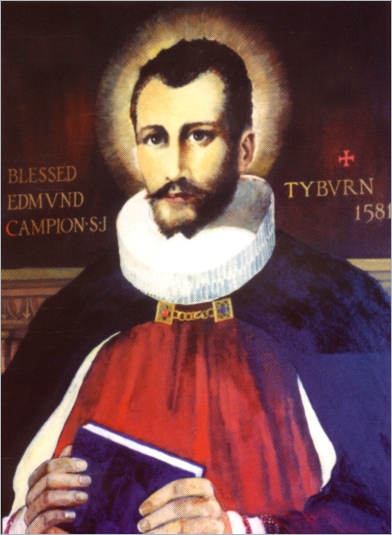
Had this been anything like a fair trial Campion would surely have won his freedom with such arguments, but this was simply a show trial; and a poor one at that for the government as it showed only the justice of the man whose cause they condemned and revealed their own arbitrary tyranny. Campion was condemned to death for treason and would suffer a horrific execution. After being given the news he sung a Te Deum in thanks to God for the gift of martyrdom and spent the rest of his short time on earth in prayer. On December 1, 1581 he was taken to Tyburn for his execution. His last statement was simple and moving. |
|
|
I am a Catholic man and a priest; in that faith I have lived and in that faith I intend to die. If you esteem my religion treason, then I am guilty; as for other treason I have never committed any, God is my judge. |
|
|
|
Saint Edmund Campion was then hung, drawn and quartered. In 1886 he was beatified and finally canonized by Pope Paul VI. However, he had long been hailed as the most noble of all the English martyrs. He was an exemplary individual in his learning, his speaking, his clarity of thought and his devotion. After gaining a very high and respected position he sacrificed it all to become Catholic. He admitted his own weakness and became all the stronger for it, eventually suffering the glory of martyrdom and his case is one of the best examples of true Catholic martyrdom. He harmed no one, showed only concern for the souls of his enemies and was thoughtful and articulate in his defense. His words in defense of the Catholic Church and the hypocrisy of the Protestant position in charging him with treason must stand out as some of the greatest ever spoken in public for the cause of Christ and His Church. |
|
|
|
|
|