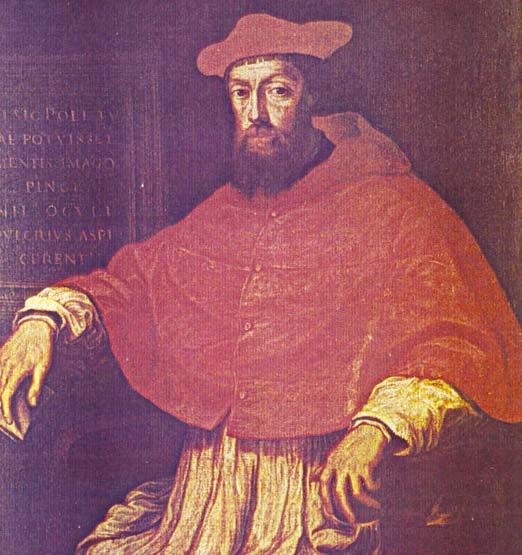
Cardinal Pole was a crucial figure in the history of Tudor England, yet his story seems to be one mostly told in terms of what might have been. He might have been King of England, he might have been Pope and things might have developed much differently in Europe and England if had won either position. He was one of three sons of Sir Richard Pole and Margaret, Countess of Salisbury who was the daughter of George, Duke of Clarence, the brother of King Edward IV. This meant that Cardinal Pole had the blood of the English Royal House of York in his veins, which during the Tudor reign could be a curse as well as a blessing. Yorkist descendants were often sought as royal spouses to help shore up the rather shaky legitimacy of the House of Tudor but it also meant that they were seen as potential rivals and so had an air of suspicion about them which cost many their life. In fact, this ultimately happened to Pole's mother when, following a Catholic and Yorkist uprising in northern England King Henry VIII had the Countess of Salisbury put to death.
Pole was born in Staffordshire in March of 1500 and he studied at Oxford before being coming to the attention of King Henry VII. An accomplished scholar, he went to study in Italy where he met many people of great importance, some of whom would later be branded as heretics and one, Gianpietro Carafa, who would become Pope Paul IV. From early on he was also connected with England's future queen, Mary I, daughter of Henry VIII and Catherine of Aragon. Pole's mother, the Countess of Salisbury, was Mary's governess for some time and the two were very close. Rumors even spread that Pole might make a good husband for Mary, but of course nothing ever came of the talk. In fact, in his chosen career as a churchman, Pole gained such a high reputation that King Henry VIII desperately sought his support in his attempt to divorce Queen Catherine, offering Pole such top jobs as the archbishopric of York or the bishopric of Winchester. Naturally, being a devout man of the Church, Pole refused these not-so-subtle bribes and went into exile when Henry VIII broke with Rome to divorce his wife.
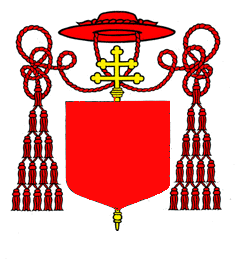
In 1536, Pope Paul III awarded Pole the red hat of a Cardinal, though Pole himself protested that he was unworthy of such a position. He was one of three papal legates at the Council of Trent and when Paul III died Cardinal Pole missed being elected Supreme Pontiff by only one vote. It is tempting to speculate as to what Pole would have done differently had he been chosen for the Petrine Throne as Cardinal Pole had a reputation for being conciliatory with the dissidents in the Church and pushing for reform. This was a somewhat dangerous position to be in as one man's reformer is another man's heretic and Pole was at times labelled as both.
His return home came in 1554 when King Edward VI died the previous year and the devoutly Catholic Mary became Queen of England. The Queen, with the advice of the Holy Roman Emperor Charles V, put off Pole's arrival in an effort to move somewhat slowly towards Catholicism after England had just had Protestantism enforced on them so dramatically in the previous years. Nonetheless, Pole did come back, was awarded the position of Archbishop of Canterbury (the last Catholic to hold the post) by Queen Mary and officially absolved England for her schism and as legate on behalf of the Pope, welcomed the country back into full communion with Rome and the rest of the Church. He supported the full restoration of Catholic England, but when the heresy laws were restored and the fires began to be lit, he cautioned Mary toward moderation. He was listened to by the Queen almost before all others, but even he could not weaken her zeal to see England made purely Catholic again.
This was Cardinal Pole's time of triumph, but political problems would once again be a plague to him. When King Philip II of Spain went to war with Pope Paul IV, and persuaded Mary to go along with this, the Pope retaliated against Cardinal Pole (though he had always been faithful) by dismissing him as legate in 1557. There were even threats that if Cardinal Pole returned to Rome he would be arrested as a heretic. Naturally, nothing ever came of this, and Queen Mary was careful to keep Pole in England, especially as since King Philip had left for the continent, she needed his support more than ever. The two seemed to be linked in a special way and when Queen Mary I died, Cardinal Pole followed her only twelve hours later on November 17, 1558. It was just as well, as his days would certainly have been numbered after the Protestant Queen Elizabeth I came to the throne.
Could Pole have been an English husband for Queen Mary? What would have happened if this friend of Erasmus and St Thomas More had been elected Pope? These are some of the questions that cannot have concrete answers. Nonetheless, Cardinal Pole's place in history is assured by his leadership in bringing England back into the Church as well as for his landmark work "In Defense of Ecclesiastical Unity" in which he denounced Henry's divorce, his attack on the Church and firmly upheld the authority and supremacy of the Pope. |