 |
 |
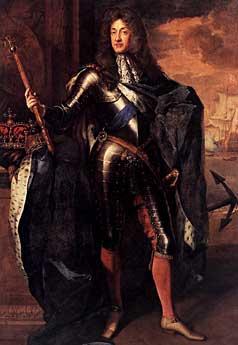
| Anti-Catholicism in England reached its most absurd height in 1682 with the so-called "Popish Plot" orchestrated by Titus Oates, but backed by the Protestant elites who wanted to pressure Charles II to remove James from the succession. The Duke of York went abroad to Belgium and Scotland, but Charles refused to disinherit him, holding firm that the succession remain in the hands of God alone. Later, as the Tories regained influence, James came back to England and was a leader in the Privy Council. Tempers seemed to have cooled, but his enemies remained when Charles died in 1685, converting to Catholicism on his deathbed, and the crown passed to a Catholic for the first time since Queen Mary I, when the Duke of York became King James VII of Scotland and II of England. For his coronation, James II was crowned privately according to the rites of the Catholic Church before he was crowned publically at Westminster Abbey by the Anglican church, though he did not, of course, take communion. In many ways, James II was the last traditional British monarch, even washing the feet of the poor on Maundy Thursday when distributing the traditional charity. He also continued the custom of "touching for the king's evil" began by St Edward the Confessor, throughout the rest of his life. However, King James II had trouble from the outset, starting with the invasion of Scotland by the Marquis of Argyll and the invasion of England by Charles II's bastard son, the Duke of Monmouth in 1685. They had the backing of the Protestant radicals, but were surprised to find that the people remained loyal to their Catholic king and both rebellions were crushed without undue difficulty. Actions such as this, only strengthened James' position to keep a standing army. He also had to deal with continued, ridiculous attempts by the Parliament to force him into taking action against religious dissenters. James, driven by the zeal of a convert and a sense of urgency by the continued attacks against him, was determined to do the exact opposite and remove all of the laws which punished non-Anglicans. He also allowed Catholics to serve in the military once again. Parliament, still paranoid as ever, reacted harshly to the thought of a standing army commanded by Catholics and in 1687, James II was forced to dissolve the body and rule in his own right. In this way, he was able to legalize religious toleration for all people on his own authority. He also acted to prevent religious hatred from causing further divisions by cracking down on Anglicans who slandered the Catholic Church. However, such long standing prejudice could not be easily overcome and Protestants became even more radical, screaming that James II was setting up a Catholic absolute monarchy and would soon force the whole country to bend their knee to the Pope in Rome. By 1688 matters came to a head. Laws protecting the Catholic Church were being openly defied and when Queen Mary gave King James his first son, James Edward Stuart, the Protestants regarded this as the last straw; they would not allow a Catholic dynasty to exist in Britain. In June, a small group of conspirators secretly contacted the King's son-in-law, the Protestant William of Orange, and invited him and his Dutch army to invade England and overthrow the legitimate monarchy and suppress freedom of worship for Catholics, which of course they dressed up with phrases of "liberty" as all true enemies of the people always do. On November 5, William and his large Dutch army landed in England, and King James II could see how dangerous the situation had truly become if even his own family was betraying him because of his faith. The King tried to come to terms with Parliament and work out some solution that would at least save his legitimate position, but it was too late. Key leaders in the government and military deserted James and joined with William, though the common people remained largely ambivalent toward the Dutch invaders. Seeing that there was no hope, James II was forced to go into exile in France, though he by no means considered himself beaten. Pope Innocent XI was shocked by the loss of James' throne, though he had consistently urged James to go slowly in his reforms so as not to provoke the wrath of the Protestants in just the sort of way that happened. In France however, James II gained the support of King Louis XIV and planned for the day when he could restore the Stuarts to the British throne. In 1609 he made an effort at restoration, landing in Ireland where he had considerable Catholic support, and declared the independence of the island. However, at this critical moment, the promised French support did not arrive, and the Irish were outmatched in every way by William's Anglo-Dutch army. Louis' aggression also meant that being an ally of France was of little help to James with the rest of the Catholic world, the Holy Roman Empire and Pope Alexander VIII standing opposed to the invasions and power-grabbing of Louis XIV. Ultimately, the game was lost at the battle of the Boyne, thanks in no small part to William's best unit, the Blue Division, which was made up entirely of Dutch Catholics. The Irish fought on under the skilled General Patrick Sarsfield, but ultimately to no avail. William's throne was secured and Catholic persecution became worse than ever. James II spent the rest of his life in exile, but still preparing his son in the hope of one day re-ascending the throne. Since his death, King James II has been very unjustly criticized. Considering that there were attempts to assassinate him before he even came to the throne, concerted efforts to exclude him from the succession, and rebellions against him as soon as he took the crown, it is quite clear that regardless of his own abilities, the anti-Catholic Protestants were never prepared to give him a chance to prove what kind of monarch he could be. It is true that he tried to do too much too soon (as the Pope warned, just as they had the previous Catholic monarch Queen Mary I), but it is also true that there was obviously such hatred against James, due to his Catholicism, that no matter how careful he may have been, the Protestants were simply never going to allow Catholics to be treated equally, nor for a Catholic Royal Family to remain on the British throne. Nonetheless, by keeping his faith, and standing by it, regardless of the consequences, King James II deserves to be known as one of the most upright and courageous British monarchs in history. |
 |
|