
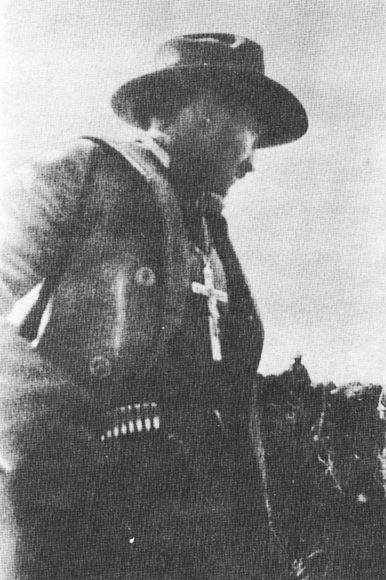

Gorostieta was certainly not the image of a Christian, cross and crown, Crusader. He was only nominally religious, was not a practicing Catholic, and at times was even mocking and contemptuous of those who were devout in their faith. However, he stated that he believed the anti-clerical policies of the government, the suppression of Christianity and the increasing licentiousness of Mexican society was destroying the very fabric of the country. It also didn't hurt that the "National League for Religious Defense", which employed him, offered a salary many times that of what a federal officer of comparable rank was paid at the time.
Militarily, he was a skillful commander and particularly pushed for the Cristeros to be tied with the great mass of common people. He made the religious struggle the people's struggle and brought consolidation and organization to what had previously been little more than a collection of independent raiding parties.
Always a very private man, stories and rumors about Gorostieta spread quickly and varied in the extreme. Recounting his indifference to religion, it was said that he ridiculed those who frequented the sacraments and that once, during a mass, he stretched out on a back pew and smoked while his men worshipped. He was known for his fairness, his moral principles but also for very liberal ideas about secularism, believing in seperation from Church by the State, but not suppression of the Church by the State. Yet, according to a close staff officer, he later became devoutly religious. There were also rumors placing him on the extreme right as well as left, one saying that he was a closet Freemason and another that he believed that he was General Miguel Miramon, of Emperor Maximilian's army, re-incarnated. Whatever the truth, there was no doubting his talent and that, while problems between Gorostieta and the civil leadership of the Cristeros abounded, the Cristeros needed him on their side.
He certainly had a great many obstacles to overcome. Support groups, such as the famous Feminine Brigades, were so independent that he often had to procure supplies on his own to meet the needs of his army and to make things more difficult, the U.S. government???? was aiding the federal government against the Cristeros. However, Gorostieta had built a true army and was justly proud of his men, the Guardia Nacional. According to him they were, "men of order, of a morality such as has not existed nor will...in Mexico; [troops] which I doubt can be bettered in any other country." He was also a man of considerable foresight. When peace negotiations were underway, he stated that he would fight on even if the bishops gave in and warned that, regardless of government assurances, no one who surrendered would long survive.
However, the Generalissimo would not live to see it. In a surprise raid on the hacienda he was staying at, on June 2, 1929 Gorostieta was killed be federal troops. He held off the troops so his officers could escape and died trying to shoot his way out. The Archbishop of Yuacatan, in exile in Havana said of him, "The hero conducted himself with a selflessness and a valor that will forever do honor to his memory. He was one of the few career military men who had the courage to place himself at the side of the liberators; he organized and unified them. A great loss has been sustained".