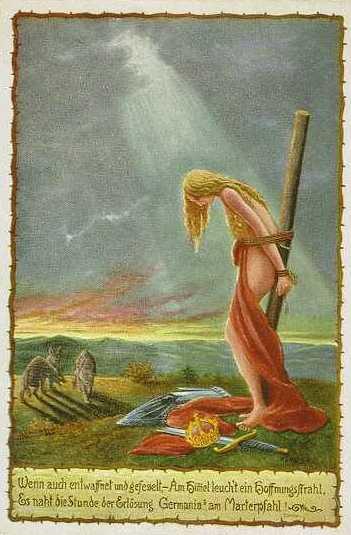
Hardly any country in the world can be seen as unimportant, but Germany stands along with a select few that have had a crucial role to play for as long as Europe as we know it has existed. Long known as a fierce, warrior people, Germania, as the Romans called it, first gained such a reputation following the stunning defeat of three Roman legions under Varus in the Teutoburg Forest at the hands of 'Herman the German' which caused even the great Caesar Augustus to go mad with grief and halt any further encroachment on German territory. Indeed, Germania was never conquered by the Romans and ultimately came to play a major role in the fall of Rome before being converted to Christianity in later centuries.
Once the Germans were converted, they became in many ways the fortified tower of Christendom. The Holy Roman Empire of the German People, the First Reich, became the champion and guardian of the Church under such legendary Emperors as Otto the Great, St Henry II and later Maximilian, Charles V and Ferdinand II. Of course, in this time, Austria was still very much a part of "Germania" and all German-speaking people were united, not just by language, but by religion as well. This first German Empire was an empire of decentralized power, with many self-governing duchies, principalities, kingdoms and even a republic or two. However, it was perhaps the military prowess of Germany that ultimately led to her downfall. As one English writer put it, the Germans began to put their faith "in reeking tube and iron shard". The Protestant Revolution led to the so-called "Enlightenment" which in turn led to the French Revolution which ended the already fractured Holy Roman Empire and the era of German unity (loss of religious unity being the prelude to this).
The French Revolution, with all of its emphasis on nationalism and mass-politics had taken its toll on 'the Germanies' and led, at least indirectly, to the pan-German movement. Most of the Prussian kings, for all of their faults, were sufficiently conservative to see the dangers of this and were reluctant to embrace the attempts at liberal unification made in 1848. Even in 1871, with the scheming Bismarck at the helm, the Prussian King Wilhelm I was very reluctant to accept the title of "Kaiser", because he knew this was the title of the Hapsburgs and no other, there was only supposed to be one Emperor and it had nothing to do with the traditions of Protestantism. Finally, this was done but the title was specifically "German Emperor" rather than "Emperor of Germany" though this was often mistakenly printed in many places. It was a deliberate attempt to ape the old, traditional Catholic Kaisers of the Holy Roman Empire, especially by the term "2nd Reich" (the pagan 3rd Reich being downright sacriligious). The short-lived Kaiser Friedrich III even pondered numbering himself according to the Catholic emperors of the first Reich but ultimately was numbered 'the third' in the line of the Prussian kings.
Alot of negative propaganda has been written about Wilhelm II, and certainly his own brand of honesty caused him to say many things that weren't exactly prudent, but he was not a bad man. Although he ridiculed Catholics at times, he opposed the anti-Catholic policies of Bismarck, eventually sacking him, visited the Pope several times, being a big fan of Catholic pageantry, and also allied himself with the Hapsburgs, who were certainly in need of a powerful friend to counter the enemies surrounding them (Italy, Russia, Serbia). What is important though, for all of Wilhelm's faults and political mistakes, he was a monarch who saw himself as first answerable to God and very conscious of the true meaning of kingship. He also tried to foster a feeling of cultural connection with the Holy Roman Empire which symbolized the great age of German chivalry. The loss of his throne was a disaster, not only for Germany but for the world.
The regime of Adolf Hitler has sort of been "done to death" in terms of historical attention, yet still many fail to understand such basic things as the fact that Hitler was a National Socialist rather than a Fascist as he is often called. The absolute wickedness of the Nazi regime cannot be understated. About the only good things Hitler ever did (and then only because it served his interests at the time) was to destroy Communism in Germany and to aid the forces of Francisco Franco in the Spanish Civil War. On the whole though, everything he touched he corrupted. Even the oppressive regime of Mussolini in Italy wasn't nearly so bad until they became dependent on Hitler. Although often described as a conservative extremist, Hitler was far from it. He learned his political theatrics from the Communist, hated the class distinctions in German society and suppressed all of the real conservatives who were Christian monarchists. Sadly, since the fall of Hitler, and despite some good work done by Konrad Adenauer, Germany today, like most other countries, has embraced secularism and turned again to the policies of socialism and of European unity, though not like the unity of her own history, based on Christ and the Emperor, but on secular, materialistic humanism, specifically anti-Christian and anti-European tradition and culture. Only time will tell if this trend can be reversed and the old "Germania" restored to her glory. |