

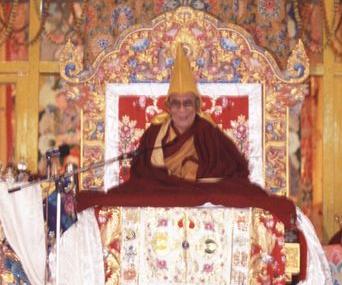

It has also been suggested to me that the Dalai Lama does not 'sound' like a monarch with all of his talk of peace, dialogue, unity and environmentalism. Well, so does the Prince of Wales. Further, I would respond by asking just how they would expect the Dalai Lama to speak? Were he to call for counterrevolution he would likely be called a hypocrit and automatically lose what limelight he has for his cause as well as being faced with the very real fact that there is no way Tibet could win in fight with Communist China. He really has no other option than to take the peaceful route and even when it comes to the most symbolic gestures the international community often backs down from showing him too much favor for fear of offending the Red Chinese. Yet, it is also true that the Dalai Lama has shown a willingness to compromise while the Chinese have not. Since adopting his "middle way" he has given up calling for Tibetan independence and, as the Chinese have demanded, said that "genuine autonomy" (which has long been promised but never delivered) is all he wants for Tibet. In spite of this, in typical revolutionary fashion, the Chinese get what they want and then demand more or more precisely in this case simply choose to deny that the Dalai Lama really means what he says. Given how international support has slipped almost completely away from the Republic of China on Taiwan, which has at least managed to maintain itself against the Communist mainland, there seems to be very little hope for Tibet and so far, 50 years of peaceful calls for good-will and dialogue have changed nothing.
So far, the Tibetans in exile, led by the Dalai Lama, have had to work hard just to keep their voices being heard. China pushes hard with serious threats against any nation which would even speak to him and even India, in which the Dalai Lama resides with his government-in-exile, has diplomatic relations with Red China and recognizes Tibet as part of China; as does the USA and all the rest of the world. What then does the future hold for the aging Dalai Lama who has already had to retire from any active role in his government and has openly said that he is preparing for his next life? The Chinese government could declare that the reincarnations are at an end but that seems too ham-fisted for the Red Chinese. More than likely they will follow the same course taken with the Panchen Lama, the number two man in the Tibetan theocratic hierarchy. The boy who was Panchen Lama when the Chinese first took over Tibet openly collaborated with them at first, becoming essentially a communist civil servant, yet when he dared to speak up about the oppression and persecution in Tibet he was denounced, thrown in prison and then kept under house arrest for the rest of his life. Upon his death the Red Chinese oversaw the choice of his reincarnation which was conveniently the son of two loyal communist party members. They chose the boy by lottery, picking his name out of a Golden Urn filled with the names of "suitable" candidates.
This seems the most likely course of events to me and the big question then becomes; what will the high lamas in exile in India do at the passing of the current Dalai Lama? I will admit to being slightly uncomfortable with this subject as I am not a Buddhist nor do I believe in reincarnation but know and am related to people who are and do and have the utmost respect for their beliefs. The lamas could discover the reincarnation of the Dalai Lama among the exile community and bring him up in the traditional fashion or at least as much as possible for the leader of an opposition government-in-exile. Tibetans would then have to choose whether to accept the Dalai Lama in Tibet, the Dalai Lama in India or both, which may seem odd but there is at least some precedent in the history of the religion for dual-reincarnations. Perhaps most significantly the precedent could be set for a seemingly permanent Dalai Lama-in-exile. Whichever scenario comes to pass it does not look good for the future of the Tibetan people. The Catholic popes did eventually come to an agreement with a hostile, occupying government, yet there is a vast gulf of difference between Communist China and the Kingdom of Italy, even when the fascists were in power as they were never ideologically opposed to religion on principle as the communists are. I would hope that the resistance carries on, that perhaps an even more hard-line would be taken (which could simply be refusing to give in anymore to the Red Chinese at least until they do the same) and I would hope that more monarchists remember the issue of Tibet and not exclude the Dalai Lama from that sadly long list of deposed monarchs in exile worthy of support.
Ride hard.........pray harder
Joseph Crisp
April 5, 2009



-G. K. Chesterton