 |
|
|
|
|
|
|
|
|
|
|
Monarchy: Christian and Constitutional? |
|
|
| Throughout the world today, wherever monarchy is seen as permissible, it is understood that it must be a "constitutional monarchy", which today effectively means, "limited to the point of political irrelevance". This is an important point since there is no reason that a constitutional monarchy necessarily be a purely symbolic one. Once there were many monarchies which had written constitutions, but constitutions which clearly defined and gave a strong, in cases even "sacred, absolute and inviolable" position and authority to the monarch. |
|
| In most monarchies today, however, the monarch is either totally powerless or at least effectively so, allowed to remain only so long as they refrain from exercising their constitutional powers. It is also true that these countries, once founded on the authority of the Christian religion have also ceased to be truly Christian in any meaningful sense. Even in the few cases where the monarch is associated with an "official" church, the close relationship between these two most ancient institutions has been legally or effectively dissolved and the countries themselves have become Christian only in historical perception. |
|
| Given that all of the existing monarchies have developed in this same way, it is worthy of consideration to ask, can a limited monarchy really be, or long remain, truly Christian? The circumstances, as they stand today at least, are effectively the same for Catholic and Protestant countries alike (though currently the only Catholic kingdoms left in the world are Spain and Belgium), and the connection between throne and altar has been emphasized as essential by learned men from each faith who strongly denounced limited monarchy. |
|
| The Protestant royalist, Sir Robert Filmer, was convinced of the total enmity between monarchy and democracy; that neither could be reconciled with the other and that, if forced together, ultimately one must perish. He addressed those governments which were a mix "of popular and regal power" as an "impossibility or contradiction" saying, "For if a king but once admit the people to be his companions, he leaves to be a king, and the state becomes a democracy". As to the notion that power for the people was necessary to act as a counterweight to a tyrannical monarch, he dismissed that as, "a remedy far worse than the disease". |
|
| For Filmer, it is given as inevitable that all power is or will become arbitrary. As he says, "The question is not, whether there shall be an arbitrary power, but the only point is who shall have that arbitrary power, whether one man or many?" In this, he comes into a condemnation of the "Romanists" as he calls them, who insist on the supremacy of the Church even above the monarchy. In fact, he compares arbitrary monarchy with Christ, killed between the two thieves of "the Pope and the people". |
|
| Certainly, this would also be the point of disagreement for Catholics as well, even the most famous teacher and defender of the "Divine Right of Kings", Bishop Jacques Bossuet. While stressing that, "the person of kings is sacred, and that to attempt anything against them is a sacrilege", Bossuet was also careful to say that this position came, not from God directly, but "through his prophets", a clear statement that in the partnership of Church and monarchy, it is the Church which has the higher position. |
|
|
| Bossuet, however, was clear that this was a strength and not a weakness for monarchy. The sacredness of monarchy meant that Christians must obey even a heathen monarch that is legitimate and that for Christian monarchies it meant that, "Kings should respect their own power, and use it only for the public good". In this way there is a subtle but significant difference between the Catholic monarchist views of Bossuet and the Protestant monarchist views of Filmer. Bossuet was emphatic in pointing out that there was an important distinction between "absolute government and arbitrary government". However, he was just as positive as Filmer that there can be no compromising the absolute authority of kings. According to Bossuet, "Without this absolute authority, he can neither do good nor suppress evil: his power must be such that no one can hope to escape him; and in fine, the sole defense of individuals against the public power must be their innocence". |
|
|
| Yet, Bossuet is again quick to point out that an absolute monarchy should not be an arbitrary monarchy. He calls for absolute monarchy in that the king should be free to act as he sees fit, "there being no power capable of forcing the sovereign, who in this sense is independent of all human authority". However, this same government must not be arbitrary, but must have a clear legal code, rights of appeal and strict rights of private property. This was not seen as something hindering the power of the king, but reinforcing it by stressing that everyone has absolute authority over everything that belongs to them, and for the king, this would include the government of the nation. |
|
| Bossuet was adamant in the king being sacrosanct. He said, "One must protect kings as sacred things; and whoever neglects to guard them is worthy of death?Whoever guards the life of the prince places his own in the guardianship of God himself". His emphasis was more on the monarchy rather than the monarch, that is, the principle, or doctrine, of sacramental kingship rather than the person of the king himself. Bossuet was more strict in insisting that, as a King exercised power given by God it was the greatest sacrilege to misuse it. However, both men agreed that monarchy was paternal, with Filmer stressing the patriarchal nature since the time of Adam, and both agreed that as such, just as a father and his house, the rule of kings was absolute, beyond question and something no one had any "right" to take from them, save perhaps the Almighty. |
|
|
| Ultimately, this issue, that of limited versus absolute royal power, comes down to the matter of sovereignty. It is an issue many monarchists would rather avoid, particularly those who live in reigning monarchies and thus have something to lose; which in fact is the exact point. Given the long accepted definition of sovereignty, it is possible to submit that there is not a truly traditional and Christian monarchy left anywhere in the world, with the possible exception of the State of Vatican City. Although often identified as a theocracy, this is a matter of "form" of government rather than "style" of government. Iran, for example, is often identified as a theocracy though it is officially, by name, a republic. Such things as sovereignty and government have always been defined by who holds the final or absolute power within that nation. Whether democracy, oligarchy, aristocracy or monarchy, all are defined by who holds this absolute power. |
|
|
| According to St. Thomas Aquinas (De Regimine Principum) a king is a necessary figure whose duty it is to direct the endeavors of mankind toward the ultimate goal and purpose of life. It is the king who must bring order out of the chaos, unite the people to work in concert for their security and welfare calling to mind the words of the most wise King Solomon that, "Where there is no ruler, the people will be dispersed". |
|
|
| He does not flatter the role of kingship by stating that this will always be accomplished; the common good is not always achieved. St Thomas makes it clear that a king, as with any ruler, can direct the people down a correct or an incorrect path whereas in the absence of such an authority, there would be no hope for any movement, but only stagnation. It is this very choice of direction which determines whether the ruler will be a true king, considering the good of his people, or a tyrant who uses his authority only to serve himself. As you can see, this takes for granted that the ruler must be able to rule. St Thomas cites Biblical evidence (Ezekiel 37:24) that God commanded there to be one supreme king to rule His people as there is one shepherd to tend a flock. |
|
|
| Like subsequent defenders of Christian monarchy, he draws the, quite natural and obvious, comparison between the king of a nation and the father of a household. Just as a patriarch is the father and judge over his family, just as God is creator and Heavenly King of all the universe entire, so is the king also father of his people. |
|
| Aquinas also, like all other traditional Christian political scientists, stresses that the authority of the king must be absolute and beyond the power of any sort of collective body. The nature of man, he insists, tends toward selfishness and then disagreement, resulting in a loss of this great unity of purpose. When power is left to a multitude, each individual will naturally, and not necessarily malevolently, tend to be convinced of their own wisdom and act in their own interest. Because each individual is unique, this inclines the group toward disagreement and disunity when not directed by the hand of a king. Aquinas, always a reasonable man, likewise points to the example of nature where power is always concentrated rather than dispersed whether taking the example of a colony of ants or of God Himself. |
|
|
| When comparing the various forms of government, St Thomas recognizes the inherent dangers in all of them but nonetheless states firmly that, "kingship is the best form of government". Tyranny, which he calls the worst, is separated solely by the manner of the ruler, rather than the style, which is what we of modern times have become so obsessed with. |
|
|
| In a brilliant piece of reasoning, which seems to escape so many modern thinkers, Aquinas explains how substance trumps style when it comes to government; how the best and worst methods stand in contrast regardless of whether the system itself is absolute or democratic. He explains that, "monarchy is better than aristocracy, and aristocracy is better than polity" if the government is righteous, there being fewer and fewer limitations placed on the authority or authorities to "do good and repress evil" as Bossuet would say. If, however, the government is unrighteous and self-centred, "tyranny is more harmful than oligarchy and oligarchy is more harmful than democracy". |
|
| This, I would interject, is where the importance of the social teaching of the Church comes into play since, from the days of King Saul to King Hezekiah, it has been the role of the lords spiritual to guide, advise and even admonish the lords temporal. The fact that King Saul was God's anointed did not stop the Prophet Samuel from admonishing him for straying from the path of God. Even Bishop Bossuet, often touted as a champion of Gallicanism, never hesitated from criticizing Louis XIV for his romantic dalliances. As those who, in the words of St Paul, watch for our souls, they have this duty to admonish the sinner no matter what his social standing. The Church has the duty to care for the salvation of mankind, from the highest king to the poorest ploughman. Likewise, all around the world, it has been established as fact that all civilizations reach their greatest heights when able monarchs rule in conjunction with any religious devotion that stresses the common good and condemns excess. This was true in Christendom during the High Middle Ages, in pagan Rome under Caesar Augustus and his strong "patriotism and family values" campaign as well as the Qing Empire of China under the strongly Confucian Emperor Kangxi. |
|
|
| St Thomas points to the example of the Jews, who reached their grandest heights of power under the reign of Davidic kings, but only when they acted in accordance with the will of God as expressed through his pontiffs, such as the Prophet Samuel and his later successors. This also underlines the fact that, despite his realistic view of the inherent dangers of human government, Aquinas was by no means indifferent as to which government was most likely to lead the people in the proper way. He certainly could sympathize with many modern voters when he wrote that, "If a choice has to be made between two courses of action both of which involve danger, one should choose the course that leads to the lesser evil." |
|
|
| St Thomas Aquinas, lest their be any doubt, was an open and avowed monarchist, based on his own reason and observation as well as his fervent Christian faith. He supported the government of monarchy because, in his words, "Tyranny is more likely to develop from the rule of the many than of one person". Given this astute observation, we can surmise that the advent of such quintessential tyrants of modern times like Joseph Stalin, Adolph Hitler and Mao Tse-tung could hardly have come as a surprise. In fact, even in St Thomas' time there was already more than enough similar cases for the saint to point to history for his justification. In a passage eerily foretelling of the French Revolution, Aquinas explains how rebellion and mob rule most often result in the domination of the masses by an unscrupulous individual who provides a cure worse than the original disease. Certainly it would seem that the "mild tyranny", as Aquinas might have called it, of the ancien regime, was preferable to the chaos, aggression, desecration and massacres of the Terror. |
|
|
| St Thomas urges prudence in the selection or preparation of a king and clearly stresses the sacred duties and responsibilities that come with the crown but also condemns any action against a rightful monarch in the very strongest terms, calling to mind St Peter?s command to obey the harsh as well as the good and gentle. Citing the examples of early Rome and later of the apostles, he urges that legal redress be our first course of action. It should also be noted that in his work Commentary on the Sentences of Peter Lombard, St Thomas draws a clear distinction between a legitimate ruler who behaves badly and a usurper who does the same. |
|
|
| The key factor though, in achieving the best and avoiding the worst of human government, is the submission, which must also be absolute, of every single soul to the authority of God. It is God, and the Kingdom of Heaven, which is the goal and purpose of our human existence; and so it is the sacred duty of the true king to direct his people along that path under the universal and unchanging guidance of Holy Mother Church. The king must also submit, "So that spiritual and earthly things may be kept distinct," St Thomas says, "the ministry of this kingdom is entrusted not to earthly kings but to priests, and especially to the Highest Priest, the successor of Peter, the Vicar of Christ, the Roman Pontiff, to whom all kings over Christian peoples should be subject as to Christ himself". |
|
|
| In applying all of this to our present circumstances we should not think that we are unique or so advanced as to be beyond the comprehension of men like St Thomas Aquinas, Bishop Jacques Bossuet or especially Filmer who addressed constitutional government directly. The basic concepts are nothing new or innovative, in fact, when looking at government and all of the habits and attitudes of man, it is impossible not to think of the Biblical passage that "there is nothing new under the sun". Even in the time of Christ, democracy and the republic were already old ideas; born during the reign of Caesar Augustus, the Romans had already tried a republic, enjoyed a period of success, degenerated into depravity and anarchy and had once again become a monarchy. As for the Jews, while they must have certainly learned about the history of democracy later on from the Greeks and Romans, it was something they had no history of success with themselves. Theocracy had always been at the core of Jewish governments, whether from the early family patriarchs to the temporary tribal judges and finally to their grandest heights under the royal House of David. |
|
|
| Democracy, upon which ideal any republic is based, is the rule of the people. Most republics never truly conform to this idea, but it is there nevertheless. It is the base for those who actually do hold power, by popular selection, in the name of the people. Sovereignty is invested in ?the people? and their wishes and desires, even if only 51% of them, must rule supreme. Although tempting, this notion is hard to reconcile with all of the Biblical commands to submit to those placed over us, to obey the Lord and the king, tolerating no rebellion against either of them, in fact shunning the rebellious and trusting in God rather than depending on our own personal judgment. However, whether monarchy or republic, this is the basis of most every government in the modern First World, nominally or at least formerly, the Christian nations of the world. |
|
|
| Some monarchies, most notably the United Kingdom, may at least claim that sovereignty resides in the Crown, but the actual truth is quite different and has been so for some time. In the strictest sense, the last true British king was, or can at least be argued to have been, the Stuart Charles II as the last monarch who was able to dissolve Parliament and rule independently on his own authority. King James II made a brave show of it, but ultimately had to submit himself to the representatives of the people, though little good it did him. It was this issue of sovereignty which lay at the heart of the critical refusal of King Charles II to remove the Duke of York from the succession as Parliament wished. Many have pointed this out as an uncharacteristic act of stupidity on the part of the "Merry Monarch" but it actually is not, in fact it reveals a deep understanding of the essence of kingship on the part of the King. Charles II may have been a playboy, but he was certainly no fool when it came to statecraft. He was a man only too aware of the value of pragmatism in a ruler and what dire consequences could result from even the most noble and pious form of intransigence. |
|
|
| King Charles II knew however, when a stand had to be taken and this was such a time. He knew of course that the Duke of York, a devout Catholic, would have the cards stacked against him in a predominately Protestant and increasingly anti-Catholic country. He knew also that his younger brother was a man whose attitudes would certainly clash with those politicians Charles had become only too familiar with. Yet, touching on a subject that dealt with the very nature of monarchy itself, he knew he had to take a stand. If the Parliament could dictate who would succeed and who would not, in the mind of Charles II at least, Britain was not really a monarchy at all, the King was not the real sovereign but rather it was the politicians who held final and ultimate sovereignty. His dissolution of Parliament sent a clear message: that he was the King, he was the sovereign, and while he would be willing to work with the members of Parliament, he was not about to submit himself and his family to their arbitrary power. Were he to do so, in his view, he would no longer be a king at all. |
|
|
| The inherent contradiction between a democracy and a monarchy in their traditional forms, should not be hard to see. In whose name is power exercised? In whose name is justice meted out? On whose behalf do civil services operate? In a republic, the people may not have as much freedom as they think, but they still have ultimate power. Politicians can still rule them, but only by manipulating the public into thinking it was their own idea. In a modern monarchy, the monarch is allowed neither power nor freedom. There position is not permanent as no one argues the fact that, in this day and age, a simple vote of the national legislature is all that is required for the monarchy to be abolished. This very fact inherently means that the monarchy is not based on the traditional supports of the institution, primarily religion, but rather on popularity, on the whim of a fickle, easily fooled and oft manipulated mob. So, in short, even in these modern "constitutional" monarchies, sovereignty is ultimately not in the crown at all but also, once again, in public popularity. |
|
|
| It is no coincidence that moral decline and the deterioration of religion have gone hand-in-hand with the advent of the popularity-dependent "symbolic" monarchy. When people lose respect for God, how can they be expected to maintain respect for someone claiming power only "by the Grace of God"? Power descends from God, as the Bible says, 'the powers that be are ordained by God and no powers exist except from God'. Even the most vocal atheist knows this to be true. What we have seen, with the first breakdown in Christian unity, to the first rebellions against absolute royal power, and finally culminating in modern times is the progressive rejection of the God of Heaven and the deification of the god of humanity. It is only natural that final and absolute power reside in the people because the people have declared themselves to be gods. |
|
| Consider all of the aspects of religion throughout the world, what religion does for us, what answers it gives. Modern man has already claimed to know the secrets of human behavior, through psychology and psychiatry to know how we are formed, how we are locked into a pattern of character and behavior. Modern man has mastered the secrets of life. We can clone human beings, grow human life in test tubes, we can reproduce without a male and a female in the greatest and most horrific tradition of Dr. Frankenstein himself. We have deemed ourselves worthy to determine who lives and who dies; we have taken the power to decide if a child should have their life terminated or if a sick person should no longer be a burden on our society. We have even, in all of our democratic and republican glory decided that we, not some invisible God, can determine what should be considered right and wrong. Along the way, it is only natural that modern man also decided no one was fit to rule him but himself. |
|
| The republican movement around the world, and the constitutional monarchist movement with it, are all one more illustration of the continuous, eternal, repeating fall of man, or the fall of Lucifer if you like. It is the Eastern Churches refusing to submit to the supremacy of Rome, it is Martin Luther claiming the right of every man to interpret Scripture, it is Henry VIII becoming his own "pope", it is Robspierre declaring the cult of "Reason", it is Thomas Jefferson claiming the pursuit of pleasure to be a divine right, it is Puritan England declaring that the voice of the people to be the voice of God, it is Mao Zedong announcing that "the world has stood up", it is Australians voting on whether or not to "allow" Elizabeth II to remain their Queen, it is Lucifer saying, "I will exalt my throne above the stars of God...I will be like the Most High". |
|
|
| Inherently, a constitutional monarchy need not be a bad thing, for that depends upon the basis of the constitution. In earlier cases, the constitution was based on the absolute inviolability of the monarch. However, a constitution based on popular support, while still claiming to invest sovereignty in a monarch is like asking someone to serve two masters. The god of man knows just as well as the God of Heaven that ultimately there are no shades of gray. Everyone must choose one side, there can only be one God, one true belief and similarly one legitimate source of authority, all of the rest is heresy, rebellion and arrogance. As all of the early Christians knew, God cannot be compartmentalized and a true king cannot be kept on a leash. Do we remain faithful to God, or follow the crowd in bowing to Baal; do we entrust ourselves totally to those God placed over us to "watch for our souls" or do we "make ourselves priests", do we submit absolutely to the King, "in regard of the oath of God" or do we demand his position for ourselves? Ultimately it is all the same question, the same temptation since the dawn of time. We can make a leap of faith and submit absolutely to our Creator or we can listen to the other voice which says, "do this, and you will be as gods". |
|
|
| Joseph A. Crisp, II |
|
|
 |
|
|
|
|
|
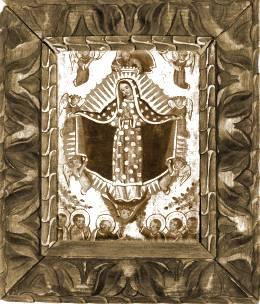
Empress of the Americas, Pray for Us |
|